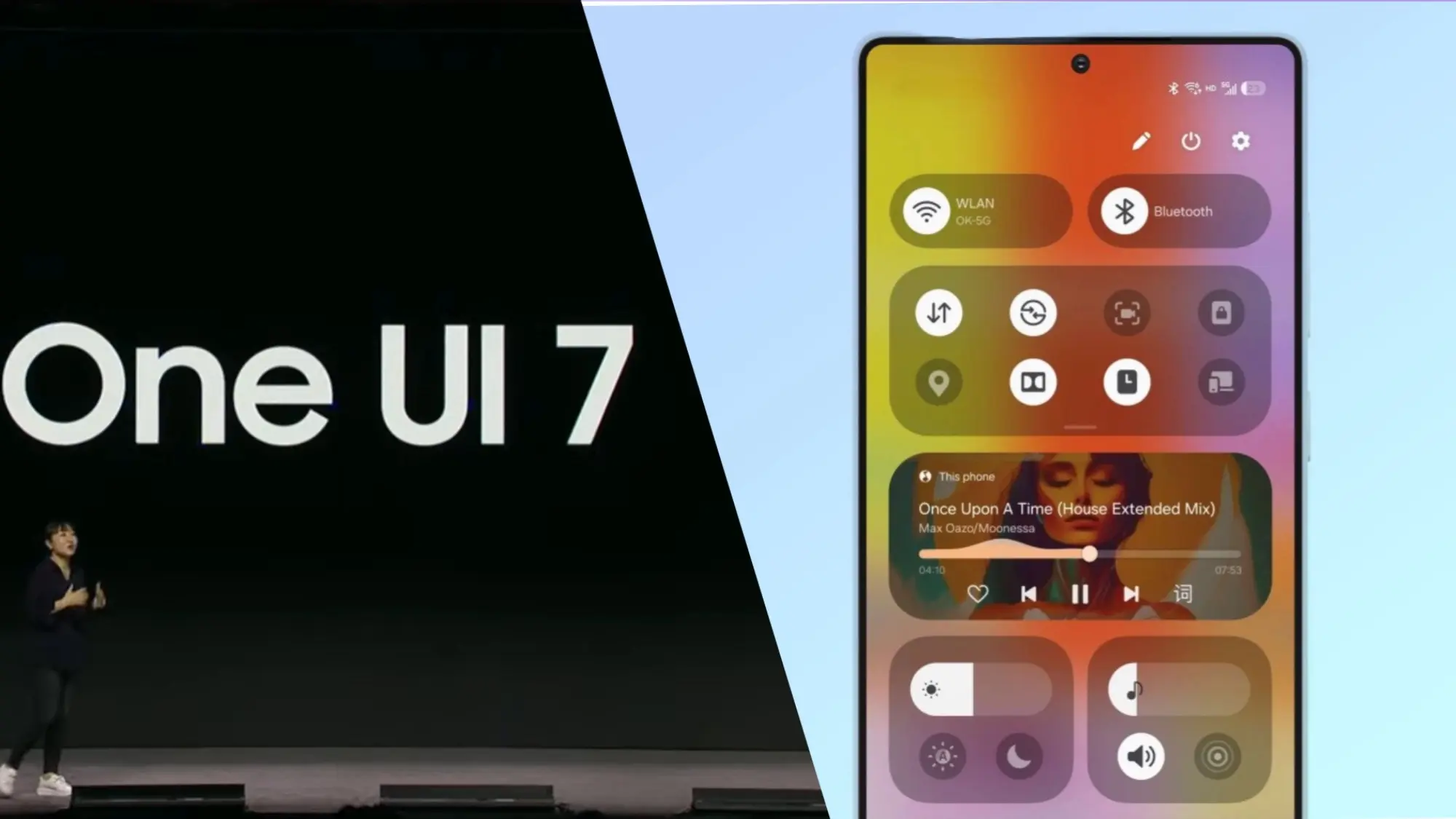
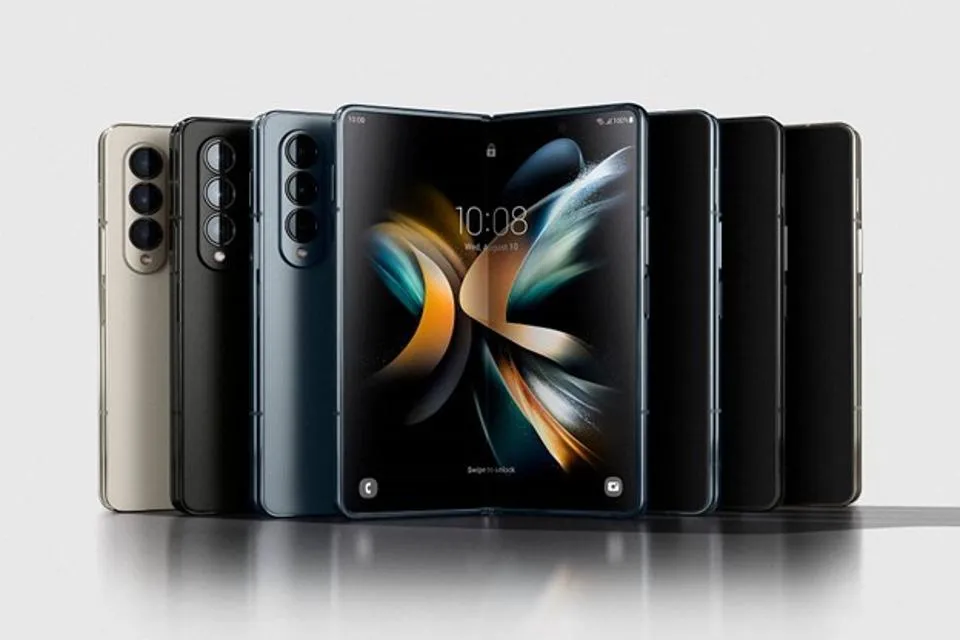
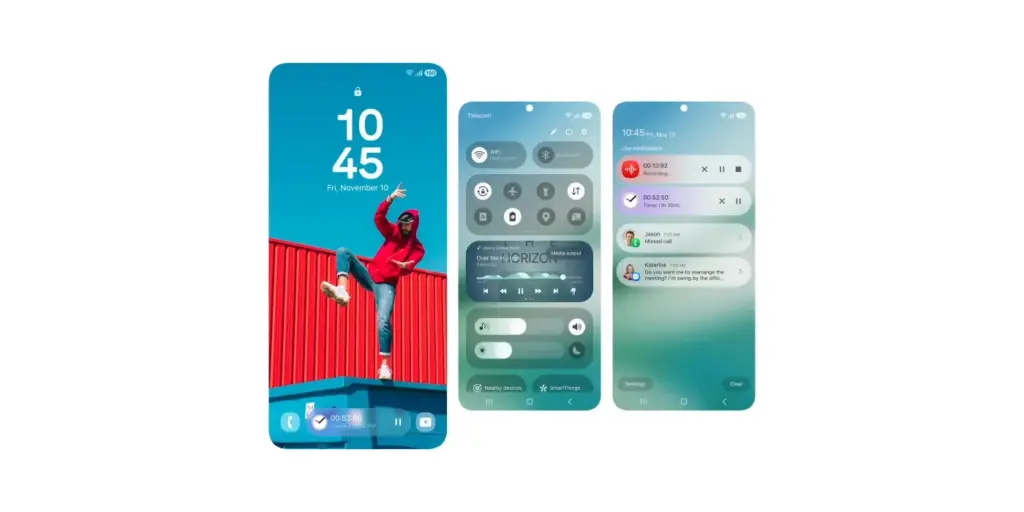
The release date of Samsung’s upcoming major software upgrade, One UI 7.0, for Galaxy customers has finally been revealed. Early April 2025 is when the Android 15-based update is expected to launch, most likely with the Galaxy S24 series before moving on to previous flagships and a few mid-range devices.
You are not the only one who has been anticipating this update; Samsung has been testing One UI 7.0 through its beta program for months in order to improve the user experience prior to its official release. What specifically does this upgrade offer, though? Let us dissect it.
Rollout Plan for One UI 7.0
Multiple beta updates have been released since Samsung launched its One UI 7.0 beta program with the Galaxy S24 series in December 2024. Samsung is now anticipated to deliver a few more beta upgrades prior to the final deployment, with the stable version approaching.
The Galaxy S24 series should be the first to get the update, followed by: Galaxy S23 series Galaxy Z Flip 6 Galaxy Z Fold 6 Galaxy A55
Galaxy S23 series
Galaxy Z Flip 6
Galaxy Z Fold 6
Galaxy A55
In order to provide tablets a preview of the new software prior to its official release, Samsung is also extending the One UI 7.0 Beta Program to additional devices, such as the Galaxy Tab S10 series.
What’s New in One UI 7.0?
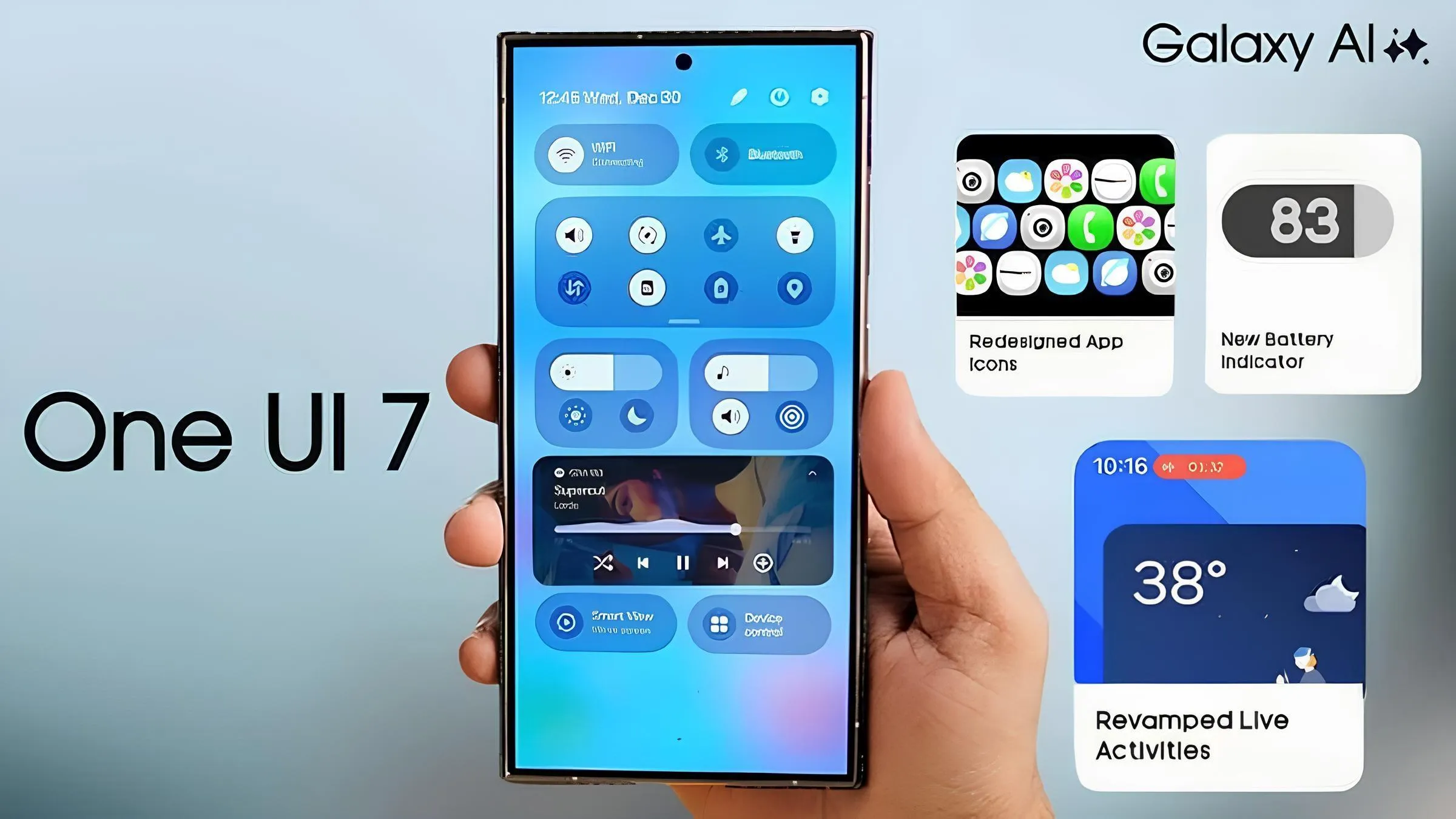
One UI 7.0 is not just another small update; it also brings a new look and a number of usability and performance enhancements. What is noteworthy is this:
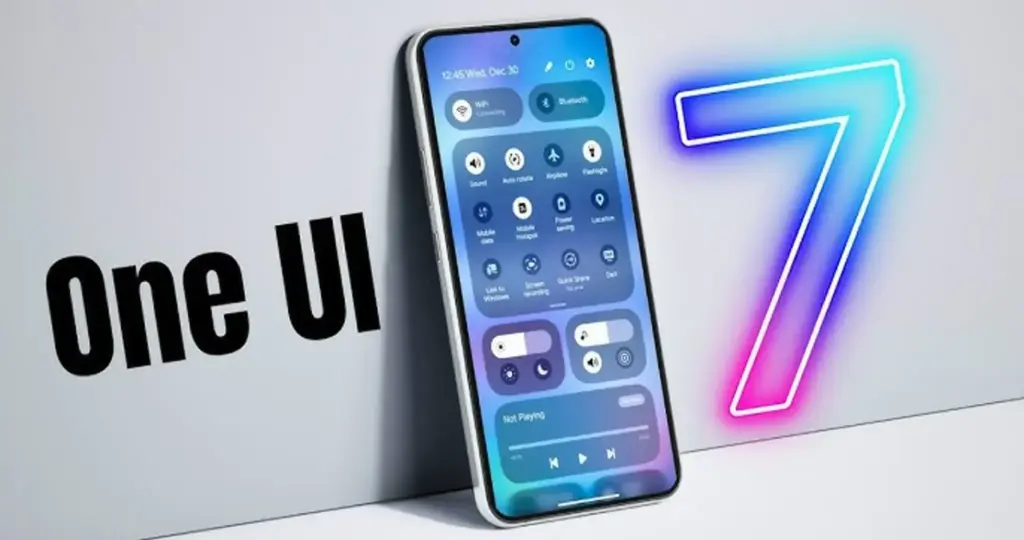
Redesigned Quick Panel – A cleaner, more intuitive way to access essential settings.
Smoother Animations & Transitions – Lighter, faster, and designed to improve the overall experience.
Updated Iconography – A new look for system icons to match the refreshed design language.
Now Bar – A persistent status bar that shows ongoing activities at a glance.
Revamped Camera App – Controls are now easier to reach for one-handed use.
New Battery Icon & Charging Animations – A subtle but noticeable visual upgrade.
AI Features & Performance Optimizations
The software’s AI-powered capabilities may be one of the reasons Samsung has taken its time with One UI 7.0. Samsung is probably striving to make sure its infrastructure can support these AI features across its wide range of devices, as some of them may need cloud processing.
You will not have to wait long for One UI 7.0 if you are using a high-end mid-range mobile or a recent Samsung flagship. This version aims to provide a more sophisticated user experience than a mere refresh thanks to a revamped UI, smoother animations, and AI-driven optimizations.
Samsung still has a few beta updates to go, but by April, Galaxy users should finally get the stable version.
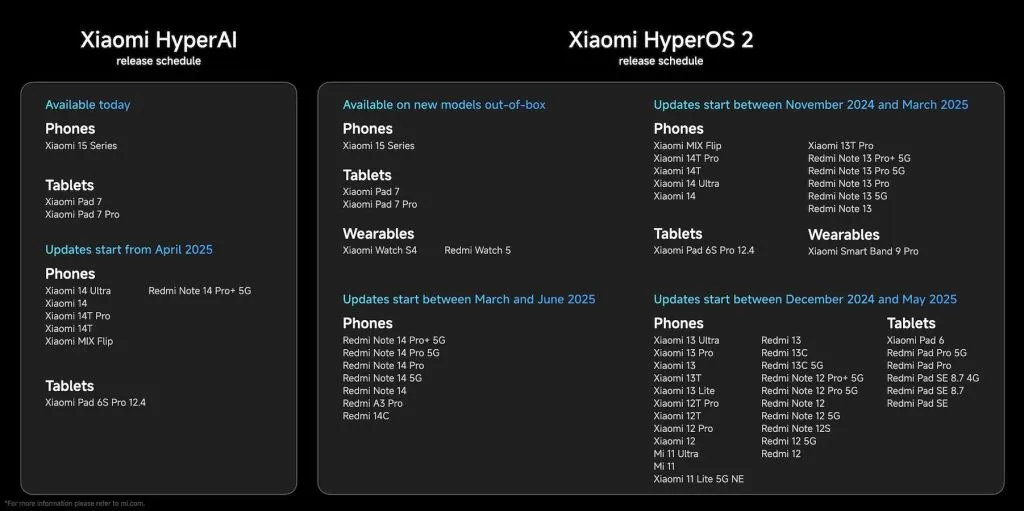
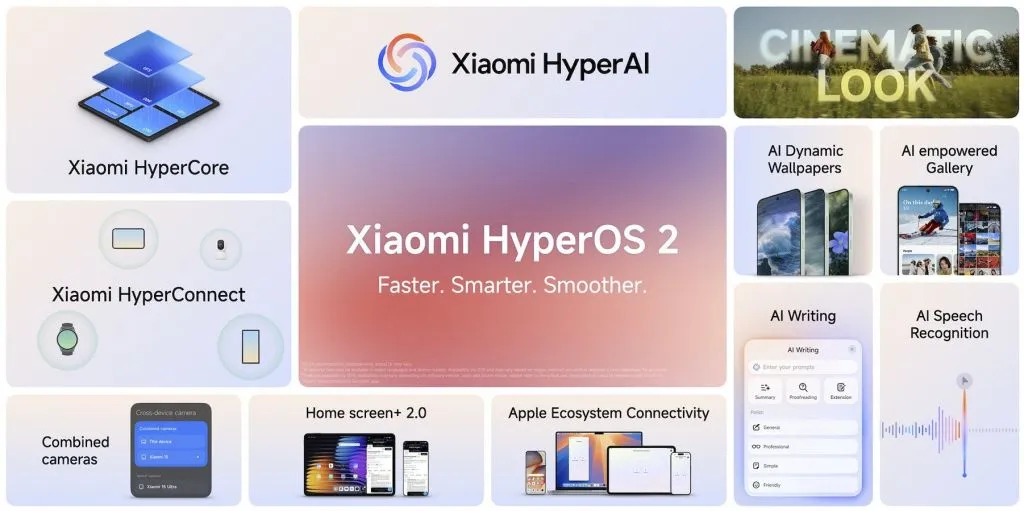
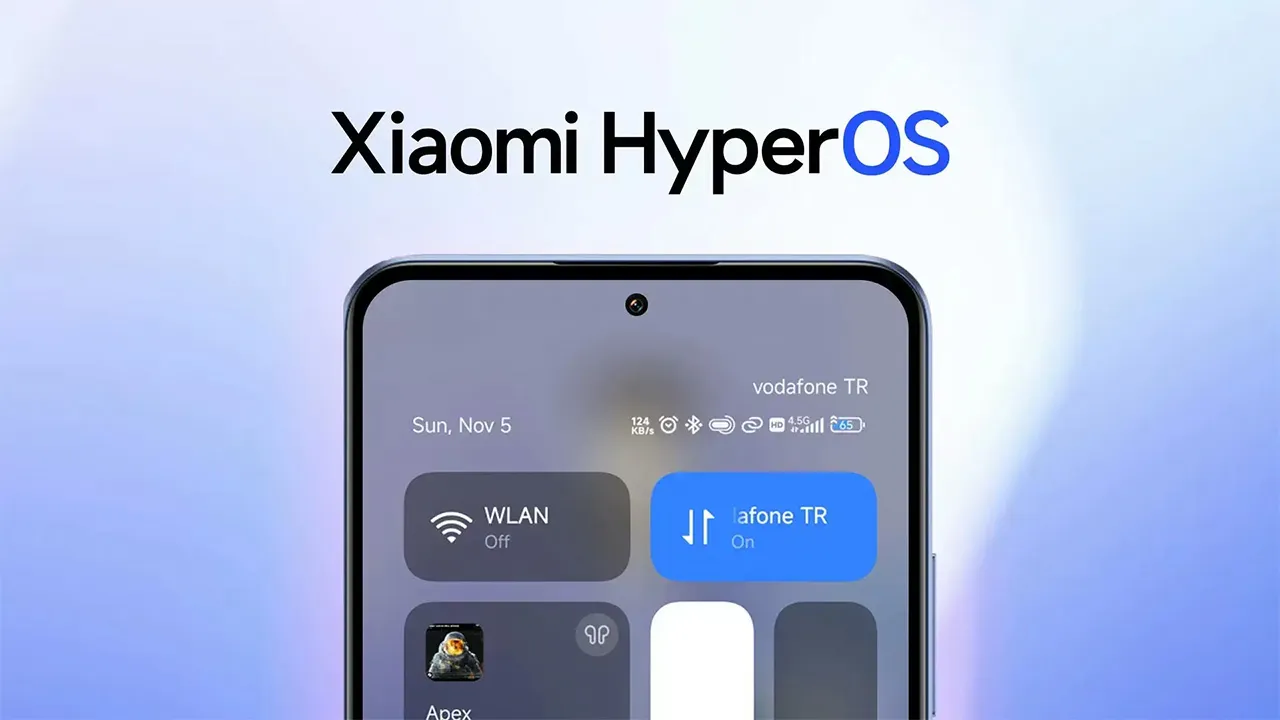
At the worldwide launch event for the Xiaomi 15 series, Xiaomi revealed the timeline for the release of Xiaomi HyperAI and HyperOS 2.0, which are based on Android 15. These changes offer a more seamless, integrated user experience along with AI-powered improvements. The official upgrade schedule and a list of the new software’s key features are provided below.
Xiaomi HyperOS 2.0 global update schedule for 2025
Time
Models
Available Today
Phones: Xiaomi 15 Series Tablets: Xiaomi Pad 7, Xiaomi Pad 7 Pro
A potent new system engine called Xiaomi HyperCore was created to improve efficiency and performance. With quicker app launches and longer battery life, it ensures a more seamless user experience by optimizing resource management.
All Xiaomi devices can connect seamlessly thanks to Xiaomi HyperConnect. It makes it easier for users to switch between smartphones, tablets, wearables, and other smart devices in the Xiaomi ecosystem by improving multi-device synchronization.
With Cinematic Look’s sophisticated image and video processing features, users may take pictures and films with a professional-caliber touch. This function produces visually spectacular content by improving lighting, sharpness, and color grading.
AI Dynamic Wallpapers & AI Gallery customizes the user experience by utilizing artificial intelligence. The AI Gallery cleverly classifies and arranges images for convenient access and administration, while AI-powered wallpapers constantly adjust to user preferences.
AI Speech Recognition and AI Writing offer more intelligent input techniques that improve communication. While AI Speech Recognition allows precise voice commands and real-time transcription, AI Writing assists with text summarizing, proofreading, and tone correction.
Cross-device Camera & Home Screen 2.0 enhances multitasking and ecosystem integration. With improved app categorization and interactive widgets, the new home screen layout improves usability, and users may use cameras from various devices interchangeably.
Better cross-platform compatibility is ensured by Apple Ecosystem Connectivity, which makes it possible for Xiaomi smartphones to function more effectively with Apple goods. Data exchange, notifications, and device synchronization across several operating systems are made easier by this functionality.
With a planned deployment strategy that guarantees a smooth transition between devices, Xiaomi HyperAI and HyperOS 2.0 want to provide customers with a quicker, smarter, and more seamless experience.
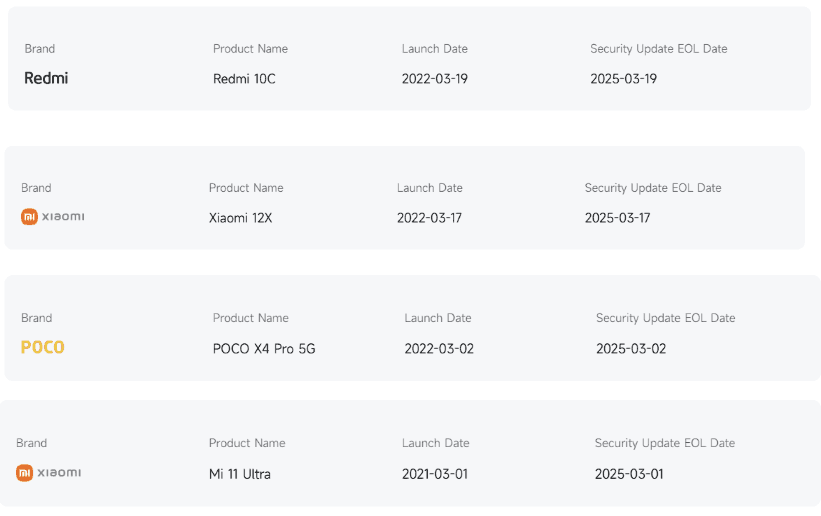
According to their Product Software Support Information page, Xiaomi has officially announced the end of security updates for some of its most popular products, marking a significant milestone for its fans throughout the world.
Although there is a strange silver lining for Xiaomi 11 Ultra customers, this move affects thousands of users who have been using these smartphones for their everyday digital demands. The decision represents the latest development in Xiaomi’s ongoing controversy surrounding its software support policy, which is ongoing despite the company’s success in maintaining older devices while giving priority to newer product lines.
Xiaomi devices reaching EOS
The Redmi 10C and Redmi 10 that have attained end-of-life (EOL) status running MIUI 14 based on Android 13 are among the devices on the list that would no longer receive security updates. For most users, that means they are no longer protected against recently found vulnerabilities, which may raise questions about long-term device security.
In a similar vein, HyperOS 1 based on Android 13 has reached the end of life (EOL) of the Redmi Note 11 Pro 5G, Redmi Note 11E Pro, Redmi Note 11 Pro+ 5G, and POCO X4 Pro 5G. Updates in the form of security patches will no longer be available for mid-range phones, which were highly popular when they were first released due to their great specifications at low costs.
The impact on Xiaomi 12X
The Xiaomi 12X, which was marketed as a lightweight flagship model, is now among the phones that will not be receiving any more security updates. The 12X ends its update cycle with HyperOS 1, which is based on Android 13, just as the previously mentioned Redmi Note 11 series. Despite being ready for an upgrade, the Xiaomi 12 Lite will not get the HyperOS 2 update.
Xiaomi 11 Ultra Receives HyperOS 2
However, Xiaomi has revealed that the Xiaomi 11 Ultra would receive HyperOS 2 even though it has stopped receiving regular security upgrades, which is a welcome surprise for the majority of Mi enthusiasts. With the impending Android 15, this 2021 flagship luxury device—which was praised for its superb camera setup and high-end specs—will receive an update based on Android 14, but not HyperOS 2.
The terms for Xiaomi’s update strategy are called into doubt by this special treatment of the 11 Ultra. The fact that the 11 Ultra comes with HyperOS 2 indicates that Xiaomi may be offering prolonged software support for its flagship premium phones, maybe to keep its premium user base happy, even though the majority of the devices on the list are mid-range or low-cost phones.
It is advised that users of the impacted devices take extra security precautions, include exercising more caution when downloading apps from unidentified sources and maintaining strict protection for sensitive data.
Google shocked the Android smartphone community with the announcement that its new flagships, the Pixel 8 series, will receive an astounding seven years of Android updates. Samsung swiftly adopted this strategy for its premium Galaxy smartphones. Few brands have entered the “seven-year club,” though a few have extended their update commitments since then.
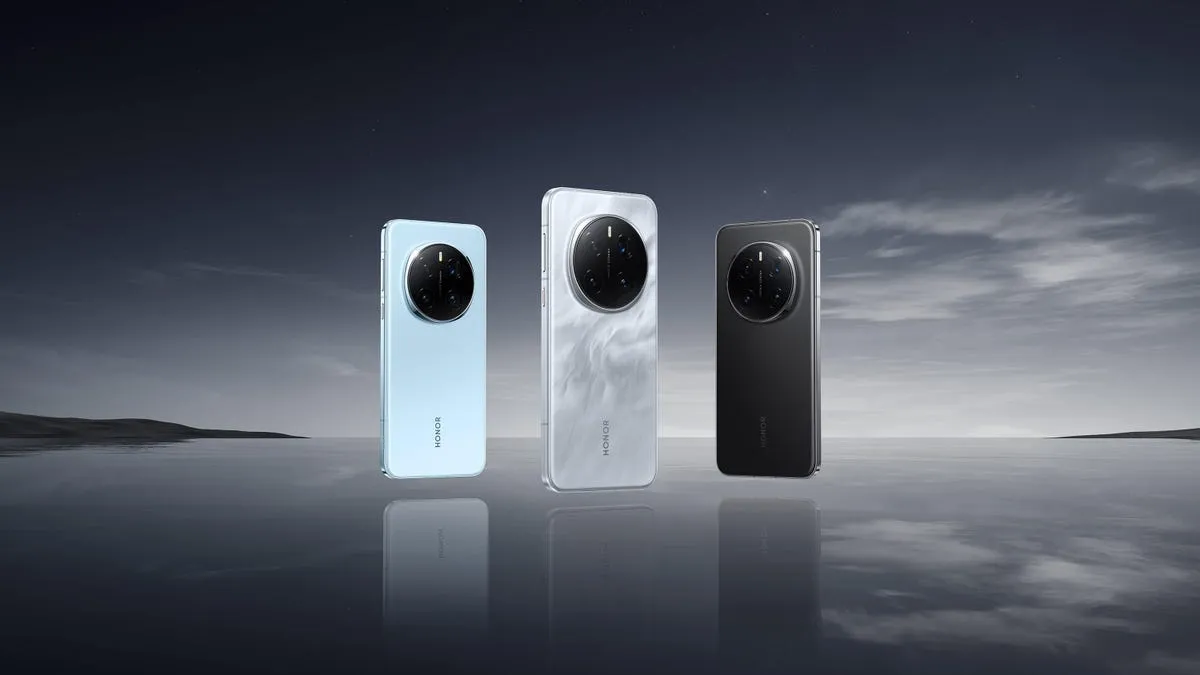
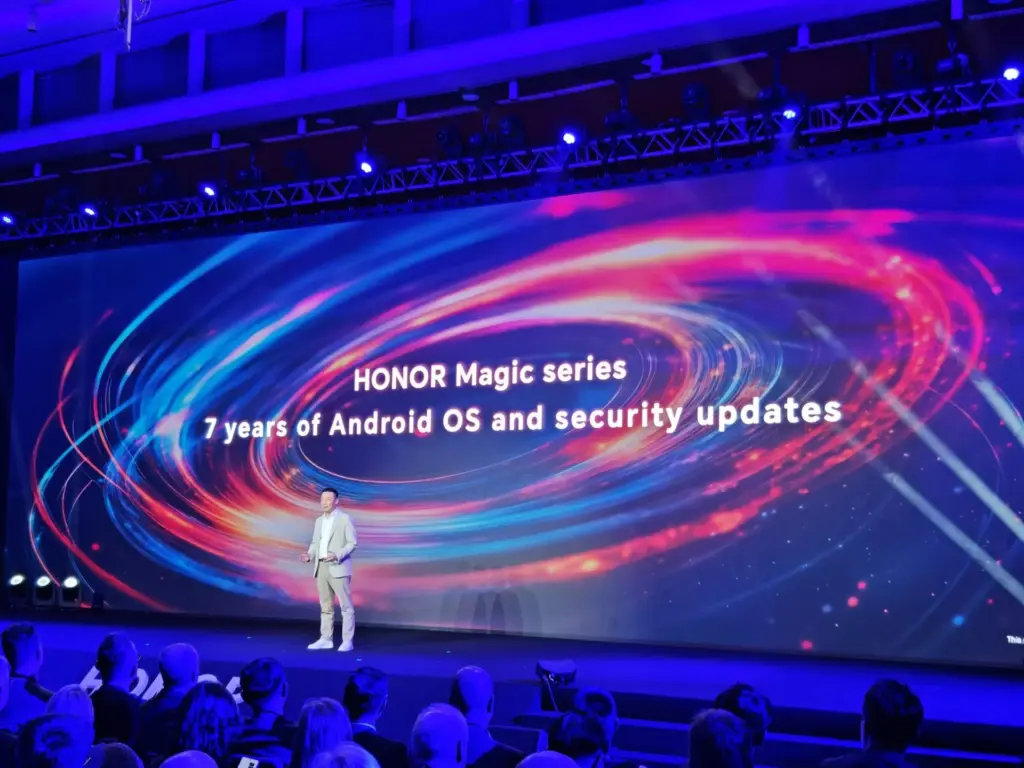
Honor is the newest member of that exclusive group. During its ill-named HONOR ALPHA Plan keynote address at Mobile World Congress 2025 today, the company said that it will provide seven years of Android updates and security fixes for its top Magic series handsets.
Honor updates are welcome
Magic lineup are typically HONOR’s best Android gadgets, including as tablets, folding phones, and slate-style phones. The first gadget to receive this policy will be the Honor Magic 7 Pro. This is a welcome change from company’s previous assurance that the Magic 7 Pro would receive OS updates for four years and security updates for five.
It is unclear, though, if this rule will apply to any other older devices in the past. It is also unknown which handsets in the future will have this, however the Magic V4, a foldable tablet, is probably going to be one. We will hopefully find out more details about this in the upcoming weeks and months. The Magic 7 Pro and other flagship devices will soon receive a far more comprehensive update commitment, which should delight HONOR enthusiasts for the time being.
Xiaomi has widely distributed the HyperOS 2.1 worldwide update, which brings the newest features and enhancements to a wide variety of phones, including tablets, high-end flagships, and budget-friendly models. The update release is a significant step toward Xiaomi’s goal of offering consistent software updates across its range of devices worldwide.
Devices receiving HyperOS 2.1 update
The global update is now available on the following devices:
Xiaomi’s worldwide software strategy has advanced significantly with this deployment, which offers the newest HyperOS capabilities across a range of device categories and pricing points. The inclusion of both high-end and mid-range devices in the rollout demonstrates Xiaomi’s dedication to maintaining software parity throughout its whole product line.
Building on the basis established by the original HyperOS, this update 2.1 offers a number of enhancements on these products. Better UI elements, system animations, and enhanced system performance are in store for the users.
Samsung has not yet finished the Galaxy S24 beta phase, but it promised a stable One UI 7 update, based on Android 15, for qualified Galaxy S models by Q1. One UI 7 Beta 4 has now been made available; it is a more compact upgrade than earlier iterations, but it includes a crucial camera function from the Galaxy S25.
Beta testers started posting on Reddit and other social media platforms that One UI 7 Beta 4 had begun to arrive on their devices a little more than a day ago. The United States, India, South Korea, and a few European nations are now implementing the update. The firmware is marginally smaller than earlier betas, with an average size of 1.4 GB, depending on the carrier and area.
Log Video is available on Galaxy S24 on One UI 7 Beta 4
Although the main focus of Beta 4 is bug repairs and speed enhancements, the Galaxy S24 trio now supports log (logarithmic) video recording, a capability that was formerly available with the Galaxy S25 and Galaxy S25 Ultra.
Photographers and videographers can benefit from log video recording in a number of ways. It has a flat color profile, which gives post-production color grading and editing more freedom, and a higher dynamic range, which preserves more details in highlights and shadows.
However, when compared to regular video recording, this format uses more storage space. Users must activate log video from the advanced video options in order to use it. Both pro mode and regular video mode are available for activation.
One UI 7 Beta 4 Changes
AI-powered camera filters are yet another noteworthy inclusion in Beta 4. These comprise pre-built filters like Shiver, Crystal, Breeze, Pulse, and Chill, to name a few. Additionally, users can use pre-existing photos to create custom filters.
In addition to these enhancements, the firmware fixes a number of problems and improves performance. Notably, it improves performance in other areas while resolving some difficulties with the quick panel and home screen.
Will this be final beta release?
Whether One UI 7 Beta 4 is the last beta release or how many more Samsung intends to issue before the Galaxy S24 series’ stable release is still unknown. Samsung has reaffirmed its goal to provide the stable One UI 7 version by the first quarter of 2025. The distribution schedule is yet unknown for other devices, including as the Galaxy S23 series, Galaxy Z Fold 6, and Galaxy Z Flip 6. Whether these devices would go straight to the stable release or undergo a beta period has not been verified by the South Koreans.
A few Redmi and POCO devices that Xiaomi has listed will no longer receive HyperOS updates. It is a typical change in the lives of Xiaomi smartphones. When some models reach the end of their existence, the corporation formally updates its EOL (end of life) list.
The Chinese OEM is well-known for delivering upgrades for HyperOS to a variety of smartphones. It uses a distinct approach for each model, such as POCO and Redmi.
In addition to four years of security fixes, Redmi and POCO phones are eligible for two or three major OS upgrades. The business then puts them on the EOL list.
The tech giant has currently stopped supporting HyperOS updates for a few Redmi and POCO smartphones. Major software updates, monthly security patch rollouts, and basic enhancement patches will no longer be available for these models. Look at the phones listed below:
Redmi Devices
Redmi Note 11 SE
Redmi Note 11S 5G
Redmi Note 11S
Redmi Note 11
Redmi Note 11 5G
Redmi 10C
Redmi 10 2022
POCO Devices
POCO M4 Pro
POCO X4 Pro 5G
As Xiaomi devices reach the end of their life cycle, software support is frequently discontinued. For customers that are already utilizing the EOL models, this procedure poses a problem. In this scenario, you can keep using the gadget without anticipating security upgrades or new features.
With long-term software support, users can even move to a different model. Searching for unofficial upgrades like LineageOS is the last resort.
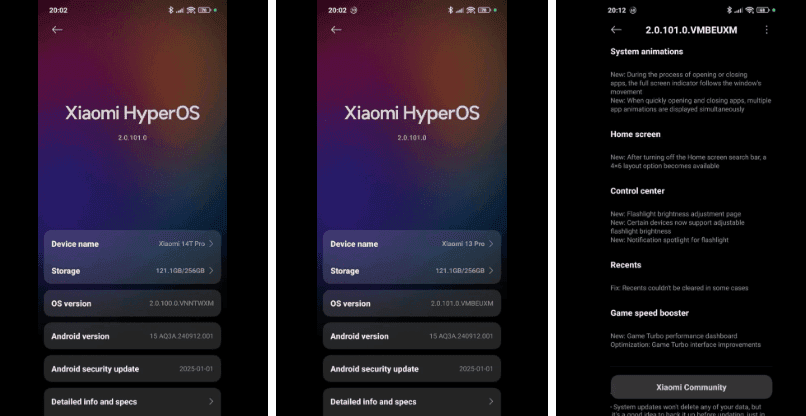
Since the first HyperOS version was released, the HyperOS has already garnered media attention. We are already seeing HyperOS 2.1’s incredible features and enhancements. The Hyper OS 2.1 upgrade also includes some new animations and some intriguing AI enhancements.
It is anticipated that HyperOS 2.1 will be released in February. The Chinese New Year is relevant to this.
HyperOS 2.1 releaset timeline
Let’s check out the release date and the rollout timeline for this update:
Version
Release Date
HyperOS 1.0
Late 2023
HyperOS 2.0
Early 2024
HyperOS 2.1
March 2025 (Phase 1)
HyperOS 2.1
Mid-2025 (Phase 2)
HyperOS 2.1
Late 2025 (Phase 3)
HyperOS 3.0
Early 2026
HyperOS 2.1 eligible devices
The list of the first devices to get the HyperOS 2.1 update has been made public by Xiaomi. The majority of these are high-end models, but the update will probably be released for more devices in the future.
You will be among the first to test out HyperOS 2.1 if you own one of these phones. The update will be released later for more Xiaomi devices, such as the Xiaomi 14, Xiaomi 15, and Xiaomi 13 Ultra. After the Chinese New Year, Xiaomi is probably going to release a complete list of devices that qualify.
There are a ton of enhancements and new features in HyperOS 2.1. The highlights are as follows:
Better Photo Editing with AI
There are now more intelligent features in the gallery app to enhance and correct your photos. AI can be used to expand images, improve image quality, and eliminate undesired items.
New Torch Control
Inspired by iOS 18, Xiaomi has included a torch (flashlight) capability. It functions flawlessly and has a sleek appearance, particularly on premium phones.
Smoother Performance
Whether you are playing games or navigating between apps, the update makes your phone operate more smoothly and quickly.
Regular Updates
Xiaomi’s “1+3+8” plan guarantees that your phone receives upgrades on a regular basis. This entails enhancements, bug repairs, and new features all year round.
New Dynamic Wallpapers
The HyperOS 2.1 Update’s New Dynamic Wallpapers are now available for download from the Theme Store. With the aid of this upgrade, they add more customizations to the system. You must manually enable India ROM as a video background from the Gallery or File Manager if you are using it.
FAQ
1. What is HyperOS 2.1?
It’s Xiaomi’s latest software update with new features, AI tools, and performance improvements.
2. Which phones will get HyperOS 2.1 first?
The Xiaomi 14 Ultra, Xiaomi 13, and Xiaomi 13 Pro will get it first. More devices will follow later.
3. What are the new features?
You’ll get better photo editing, a new torch control, smoother performance, and regular updates.
4. When will HyperOS 2.1 launch?
It’s expected to roll out globally after the Chinese New Year, but the exact date isn’t confirmed yet.
For Xiaomi, HyperOS 2.1 is a significant advancement rather than merely a minor upgrade. Better performance, more intelligent AI tools, and features modeled after cutting-edge technology like iOS are all included. Xiaomi intends to provide the update for additional devices soon, albeit it begins with flagship phones.
Based on Android 15, Samsung’s One UI 7 represents a significant shift from their usual release timetable. The beta program ended after just one month, having been launched in December of last year. Samsung has now released further details about the One UI 7 rollout for Galaxy smartphones and tablets ahead of the release of the Galaxy S25. Find out which models will receive the update initially.
One UI 7 will come to S series
Samsung is trailing behind in the implementation of Android 15, which is bad for a company that generally sets the pace. Xiaomi and OnePlus have already released their updates, while Samsung appears to be taking its time. After launching last month, the One UI 7 beta ended last week, but what about the stable version?
According to Samsung’s most recent press release, on January 22, 2025, the new Galaxy S models will receive the stable One UI 7 update. Translated, earlier flagships, such as the Galaxy S24, S23, S22, and S21, will have to wait their time, while the Galaxy S25 series is expected to come pre-installed with One UI 7. And those who own Galaxy S20s? I apologize, but Android 14 was the end of your life.
Devices like as the Galaxy Z Fold 6, Galaxy Z Flip 6, and Galaxy Tab S10 Ultra are noticeably absent from the roadmap. With Samsung’s history, we will likely learn more after the Galaxy S25’s release, which is expected to come pre-installed with One UI 7. However, for the time being, there is a significant silence, which disappoints those who anticipate more frequent updates from Samsung.
Other samsung Galaxy series?
Although Samsung has not yet released an official list of Galaxy devices that will receive Android 15, we can speculate. Although the deployment for these smartphones is probably going to lag behind the flagship updates, One UI 7 should ultimately make its way to mid-range and budget models based on their software strategy.
For now, we have put together a list of Galaxy tablets and smartphones that should get the upgrade, with an emphasis on models whose software support lasts until 2025 and beyond. Naturally, this list is merely conjectural and will be revised as soon as Samsung officially announces the lineup.
Galaxy A series
With Android 15, Samsung’s versatile Galaxy A series is about to receive a major update that will bring the newest features to these well-liked mid-range phones. This significant update is anticipated for many recent A series models as Samsung continues to fortify its software support policy. From better photography capabilities to more effective battery management, the new Android version promises to improve the well-balanced blend of features that fans of the A series adore. Android 15 will deliver a new wave of enhancements to keep your Galaxy A handset feeling powerful and up to date when combined with Samsung’s One UI 7 interface.
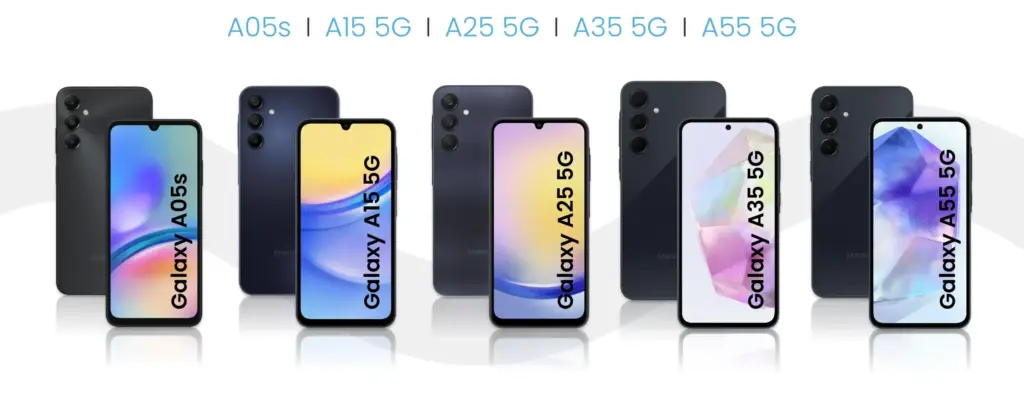
Galaxy A05s
Galaxy A06
Galaxy A14 4G
Galaxy A14 5G
Galaxy A15 4G
Galaxy A15 5G
Galaxy A16
Galaxy A24
Galaxy A25
Galaxy A33
Galaxy A34
Galaxy A35
Galaxy A53
Galaxy A54
Galaxy A55
Galaxy A73
Galaxy S series
Samsung’s flagship Galaxy S series is set to take the lead in getting the much awaited Android 15 and One UI 7 upgrade, carrying on the company’s custom of giving priority to its high-end smartphone portfolio. Owners of newer Galaxy S models can anticipate using Samsung’s improved One UI interface in conjunction with the newest Android improvements. It is anticipated that this update would further enhance the premium experience of the Galaxy S series by introducing cutting-edge security measures, improved performance optimizations, and enhanced AI capabilities.
Galaxy S21
Galaxy S21+
Galaxy S21 FE
Galaxy S21 Ultra
Galaxy S22
Galaxy S22+
Galaxy S22 Ultra
Galaxy S23
Galaxy S23+
Galaxy S23 FE
Galaxy S23 Ultra
Galaxy S24 FE
Galaxy S24
Galaxy S24+
Galaxy S24 Ultra
Galaxy Z series
Galaxy Z Flip 3
Galaxy Z Flip 4
Galaxy Z Flip 5
Galaxy Z Flip 6
Galaxy Z Fold 3
Galaxy Z Fold 4
Galaxy Z Fold 5
Galaxy Z Fold 6
Galaxy M series
With Android 15, Samsung’s well-liked mid-range Galaxy M series is expected to get a significant update that will provide new features and enhancements to these reasonably priced gadgets. Samsung has remained committed to offering prolonged software support for the M series family, even though the precise rollout schedule may differ depending on the model. With improved energy management, enhanced speed, and new customization choices, this update promises to improve the user experience and revitalize your Galaxy M device.
Galaxy M14 / F14
Galaxy M15 / F15
Galaxy M34 5G
Galaxy M35
Galaxy M54 / F54
Galaxy M55 / F55 / C55
Galaxy XCover series
Galaxy XCover 6 Pro
Galaxy XCover 7
Galaxy Tab series
With the next Android 15 upgrade, Samsung’s Galaxy Tab portfolio is poised to embrace the next evolution of Android and promises to revolutionize the tablet experience for users across all Tab models. It is anticipated that this upgrade will include tablet-optimized features that will improve productivity tools and multitasking abilities as tablets continue to gain significance for both work and play. Many current Galaxy Tab models, ranging from the high-end S series tablets to the more reasonably priced A series tablets, will get this important update as part of Samsung’s dedication to expanding software support for its tablet lineup. The goal is to provide an even more sophisticated and powerful tablet experience by combining the improvements of Android 15 with Samsung’s tablet-focused One UI 7 enhancements.
Galaxy Tab A9 / A9+
Galaxy Tab Active 4 Pro
Galaxy Tab Active 5
Galaxy Tab S6 Lite 2024
Galaxy Tab S8
Galaxy Tab S8+
Galaxy Tab S8 Ultra
Galaxy Tab S9
Galaxy Tab S9+
Galaxy Tab S9 Ultra
Galaxy Tab S9 FE / S9 FE+
Galaxy Tab S10+
Galaxy Tab S10 Ultra
Besides the models listed above, all models released throughout 2024 should also be eligible for the Android 15 upgrade. This includes the entry-level models announced in the first week of the year, such as the Galaxy A05s, A15, and A25, and the recently unveiled Galaxy A06 and Galaxy A16.
As in the past few years, we expect to see Samsung confirm its list of Galaxy phones and tablets eligible for the Android 15 update as soon as it starts updating the first model. The list is traditionally shared on the Samsung Members app with the expected timeframe for the update on the phone’s market. When that happens, we will update this list to follow the rollout, so be sure to bookmark this page and follow us on social media.
As in previous years, as soon as Samsung begins upgrading the first model, we anticipate seeing the confirmation of its list of Galaxy phones and tablets that are eligible for the Android 15 upgrade. Traditionally, the list is made available on the Samsung Members app along with the anticipated release date for the phone. Make sure you bookmark this page and follow us on social media as we will update this list to reflect the launch.
A new stable update for the Enduro 3, Fenix E, and Fenix 8 is being released by Garmin to close out the year. In the past few months, the company has delivered hundreds of bug patches to the three, but it has also discovered a number of other enhancements that have emerged.
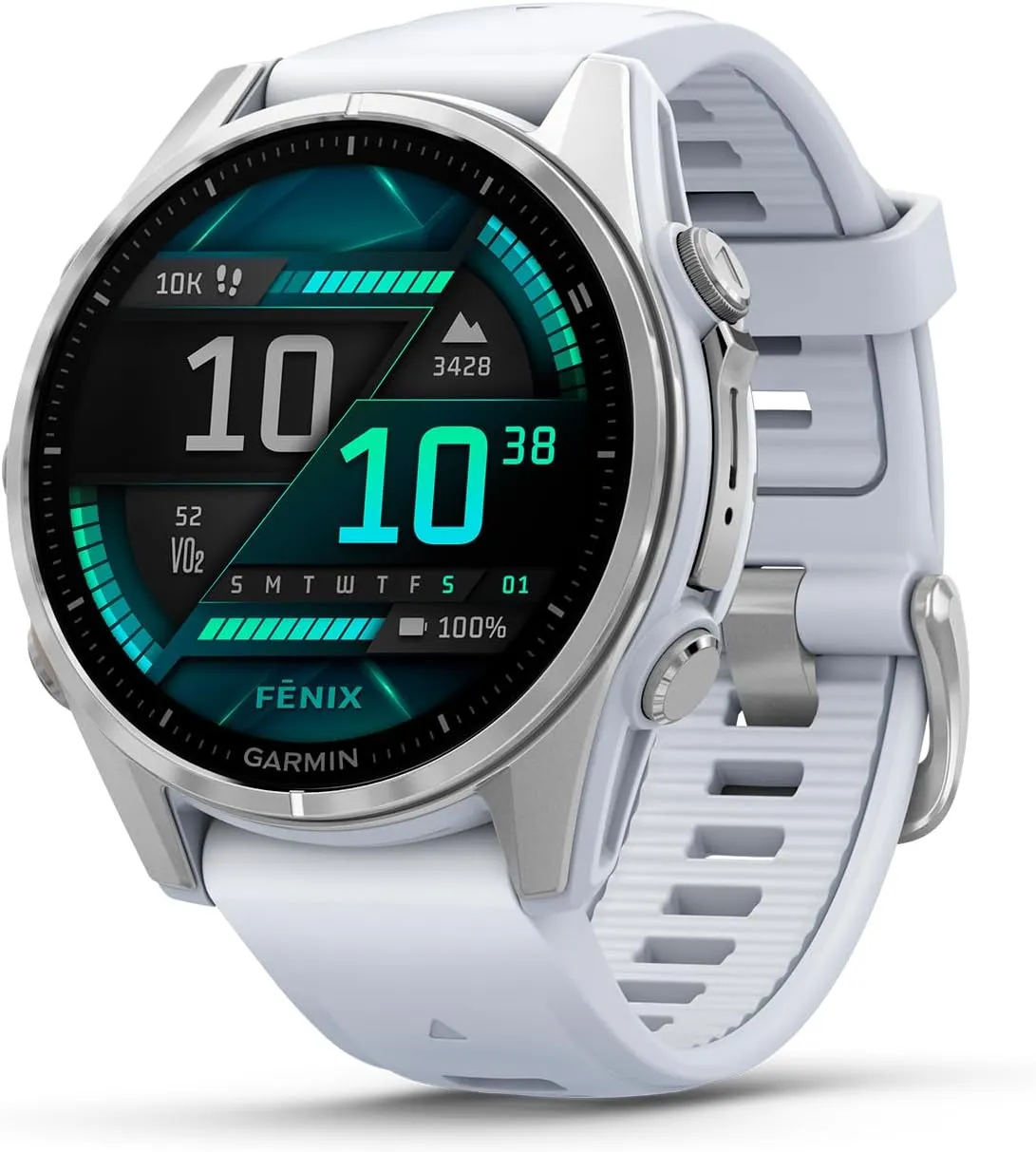
The Fenix 8 (now available on Amazon for $999.99) has received a new update from Garmin, which is also being rolled out for the Enduro 3 and Fenix E. Notably, the latest version is now available via Garmin’s official software distribution channel instead of its beta program.
Garmin fēnix® 8
AMOLED, Premium Multisport GPS Smartwatch, Long-Lasting Battery Life, Dive-Rated, Built-in LED Flashlight, Silver with Whitestone Band
System Software 12.35 should therefore have fewer issues than the most recent beta versions. In light of this, Garmin just released an update for the Fenix 7 and Fenix 7 Pro smartwatches that fixes a previous stable build that was troublesome.
In the same way, System Software 12.35 for the Enduro 3, Fenix E, and Fenix 8 primarily fixes issues in previous software. For example, after transferring settings from a Fenix 7 family smartwatch, alarms should not be set to silent any more.
Additionally, Garmin claims to have resolved problems that hindered the proper display of CIQ watch faces following a device reset. Additionally, System Software 12.35 should not have any missing call alert tones.
Additionally, Garmin’s Workout Execution Score is limited to running and cycling workouts as a result of the recent upgrade. Additionally, by positioning sensors in pairing mode at the top of a search list, Garmin has improved the user experience of its sensor search. For reference, the following is the whole changelog for System Software 12.35 as detailed by Garmin in its forum post:
Fixed missing tones for phone call alerts.
Fixed alarms being set to silent after migrating settings from Fenix 7.
Fixed CIQ app ability to close with Palm Cover.
Fixed CIQ watch face display issue after device reset.
Fixed event Countdown icon selection via touch.
Fixed Fishing timer status toggle.
Fixed Tides app time-out issue.
Fixed potential crash when opening Map Manager from Garmin Connect Mobile.
Fixed potential ConnectIQ application crash.
Restricted Workout Execution Score to only Running and Cycling workouts.
Updated sensor search to place sensors in Pairing Mode at the top of the search list.
Garmin fēnix® 8
AMOLED, Premium Multisport GPS Smartwatch, Long-Lasting Battery Life, Dive-Rated, Built-in LED Flashlight, Silver with Whitestone Band