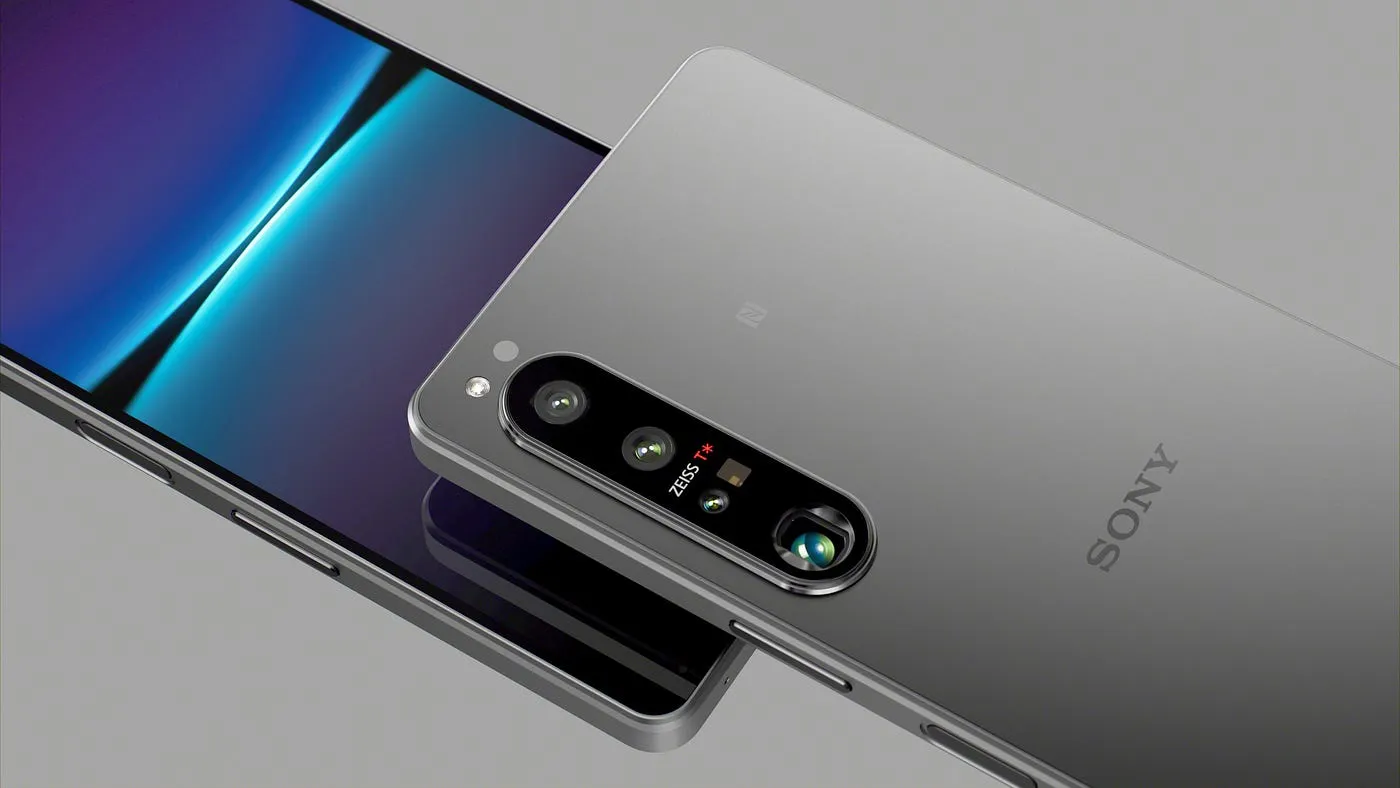
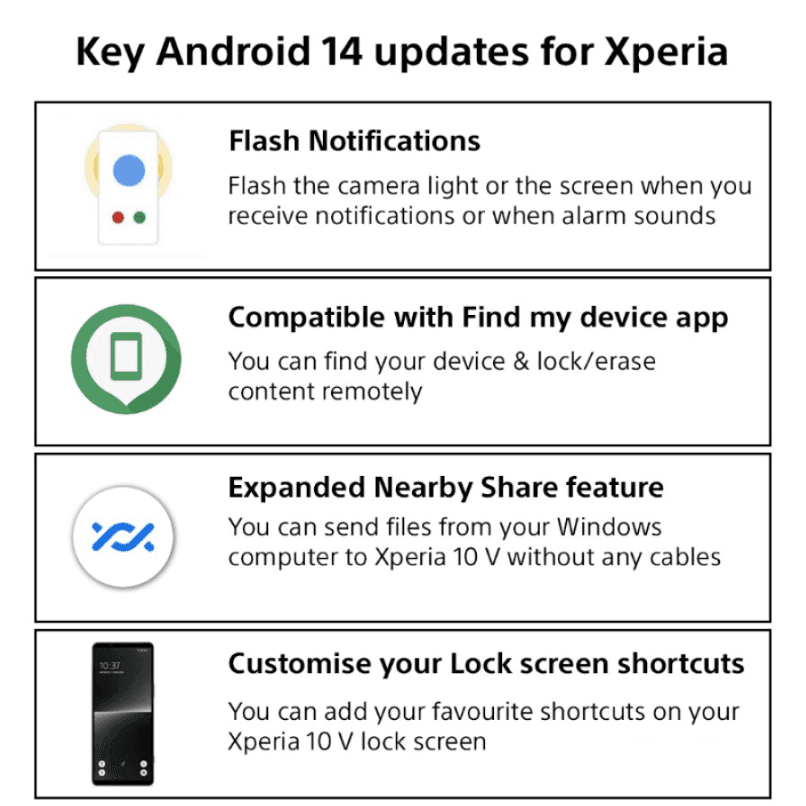
The Xperia 1 IV, Xperia 5 IV, and Xperia 10 IV are among the smartphones in Sony‘s 2022 portfolio that are now receiving the Android 14 update. These devices receive all of Android 14’s customization and security features in addition to some additional, exclusive customizations.
The updates will likely follow a scheduled release meaning some regions will get the update quicker than others.
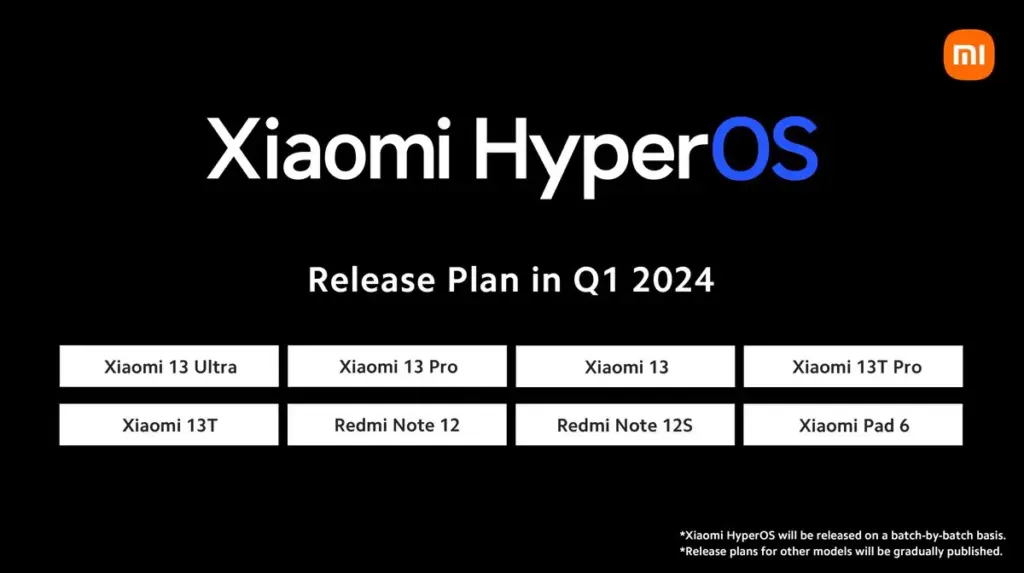
With the official launch of HyperOS, Xiaomi created quite a stir. Many are curious about when the HyperOS update will become available globally. The smartphone maker has been working on the HyperOS Global update for 11 models, which indicates that the update will arrive soon and millions of people will be able to experience HyperOS immediately.
HyperOS Global Coming Soon
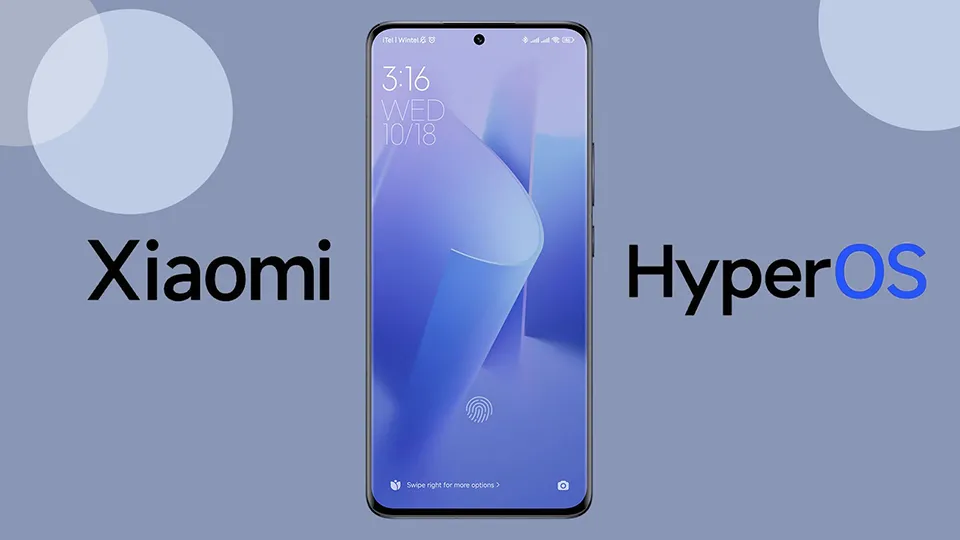
What sets Xiaomi apart from the competition is its optimization of HyperOS. With this new interface, which enhances system animations and reworks the interface among other things, HyperOS Global will have all of these features. Xiaomi is currently testing HyperOS Global and is prepared to roll out new updates.
HyperOS Global will be available for 11 smartphones on the Xiaomi server.
Which smartphones will be the first to receive this new update?
POCO X5 Pro 5G: OS1.0.2.0.UMSMIXM, OS1.0.1.0.UMSEUXM (redwood)
Xiaomi Pad 6: OS1.0.3.0.UMZEUXM, OS1.0.4.0.UMZMIXM, OS1.0.2.0.UMZINXM (pipa)
Here are the 11 smartphones that will get HyperOS Global! This information is taken from the Official Xiaomi server, so it is reliable. HyperOS Global update has been confirmed by Xiaomiui. These builds are expected to start rolling out to users very soon. Millions of people are asking when HyperOS Global will be released and are impatiently waiting for the new update to come to their devices.
Based on Android 14, HyperOS is a user interface that will bring a major Android update to smartphones. The HyperOS Global update will be released to users in the HyperOS Pilot Tester Program first, and we have leaked the HyperOS Global Changelog to give you an idea of what to expect when HyperOS Global is released globally.
Official HyperOS Global Changelog
Global aesthetics draw inspiration from life itself and change the way your device looks and feels
New animation language makes interactions with your device wholesome and intuitive
Natural colors bring vibrancy and vitality to every corner of your device
Our all-new system font supports multiple writing systems
Redesigned Weather app not only gives you important information, but also shows you how it feels outside
Notifications are focused on important information, presenting it to you in the most efficient way
Every photo can look like an art poster on your Lock screen, enhanced by multiple effects and dynamic rendering
New Home screen icons refresh familiar items with new shapes and colors
Our in-house multi-rendering technology makes visuals delicate and comfortable across the whole system
Multitasking is now even more straightforward and convenient with an upgraded multi-window interface
Many smartphone models are scheduled to receive an update to the state-of-the-art HyperOS Global. Stay tuned for the most recent information on HyperOS Global developments. The details as of right now are as follows. To view a detailed list of devices that qualify for the HyperOS update—which Xiaomi, Redmi, and POCO models are included—visit our special article titled “HyperOS Update Eligible Devices List: Which Xiaomi, Redmi, and POCO Models Will Receive HyperOS?” We look forward to hearing your thoughts on the upcoming HyperOS Global update; please feel free to leave a comment.
The world’s flagship phone owners can prepare for rollouts beginning early next year, with the newest models receiving priority. Xiaomi has unveiled its exciting HyperOS update, a stable release built on Android 14 for its top-of-the-line devices. However, there is a twist: not all Xiaomi devices will unlock the full spectrum of HyperOS features.
Xiaomi has decided to tailor the update based on different Android versions. Some lucky phones will jump straight to the Android 14-powered HyperOS, while others will receive a version tailored for Android 13.
The selected devices set to experience the Android 14-based HyperOS include Xiaomi Mi Mix Fold 2, 12X, Mi 11X, 11i / Hypercharge, Pad 5, Mi 10S, Redmi K40, Note 11 Pro 5G, Note 11 Pro+ 5G, Note 11 NFC, Redmi Note 11S, Redmi 10 / Prime, Redmi 10C / 10 Power, Poco X3 GT, Poco X4 Pro, Poco M4 Pro 5G, Poco M4 Pro 4G, Poco F4, Poco F3, and Poco F3 GT. This strategic approach ensures that users of specific devices will receive an optimized HyperOS experience tailored to the capabilities of their device and the Android version it operates on.
Xiaomi HyperOS global rollout in early 2024
Xiaomi recently began to roll out HyperOS 1.0, a stable update based on Android 14. This is a major software innovation step forward, bringing a plethora of new features and optimizations. While the initial release of HyperOS was restricted to five particular Xiaomi models in China, the global rollout is scheduled for mid-2024, with a primary focus on the newest flagship devices.
But not every Xiaomi device will go to HyperOS goodies. Xiaomi decided to divide the update according to Android versions, so some devices will get the Android 14-based HyperOS, while others will only get the Android 13 version. This separation is because some HyperOS features require the more sophisticated features that Android 14 brings.
These are the Xiaomi devices that will miss out on HyperOS
Here is a brief overview of the Xiaomi devices deemed worthy of the Android 14-based HyperOS:
Xiaomi Mi Mix Fold 2
Xiaomi 12X
Mi 11X
Xiaomi 11i/Hypercharge
Xiaomi 11i 5G
Xiaomi Pad 5
Xiaomi Pad 5 Pro 5G
Mi 10S
Redmi K40
Redmi K40S
Redmi Note 11 Pro 5G
Redmi Note 11 Pro+ 5G
Redmi Note 11
Redmi Note 11 NFC
Redmi Note 11S
Redmi 10/Prime
Redmi 10C/10 Power
Poco X3 GT
Poco X4 Pro
Poco M4 Pro 5G
Poco M4 Pro 4G
Poco F4
Poco F3
Poco F3 GT
Android13 was a challenge
Good news for owners of older Xiaomi devices: the company plans to release an update called HyperOS, which is based on Android 13, for these devices sometime in the second quarter of 2024. However, if your device receives this version, it will not have all the features that come with the full HyperOS package.
Nevertheless, while some devices will enjoy the full Android 14-based HyperOS experience, others will have to settle for a slightly scaled-down version. Despite the excitement surrounding the future of smartphone technology, not everyone will get to experience it in its entirety.
Hopefully, Xiaomi continues to push boundaries, ensuring that future updates are inclusive, bringing innovation to all corners of their extensive user base. Fans of Xiaomi are eagerly awaiting the HyperOS update, but the split based on Android versions adds some complexity to the situation.
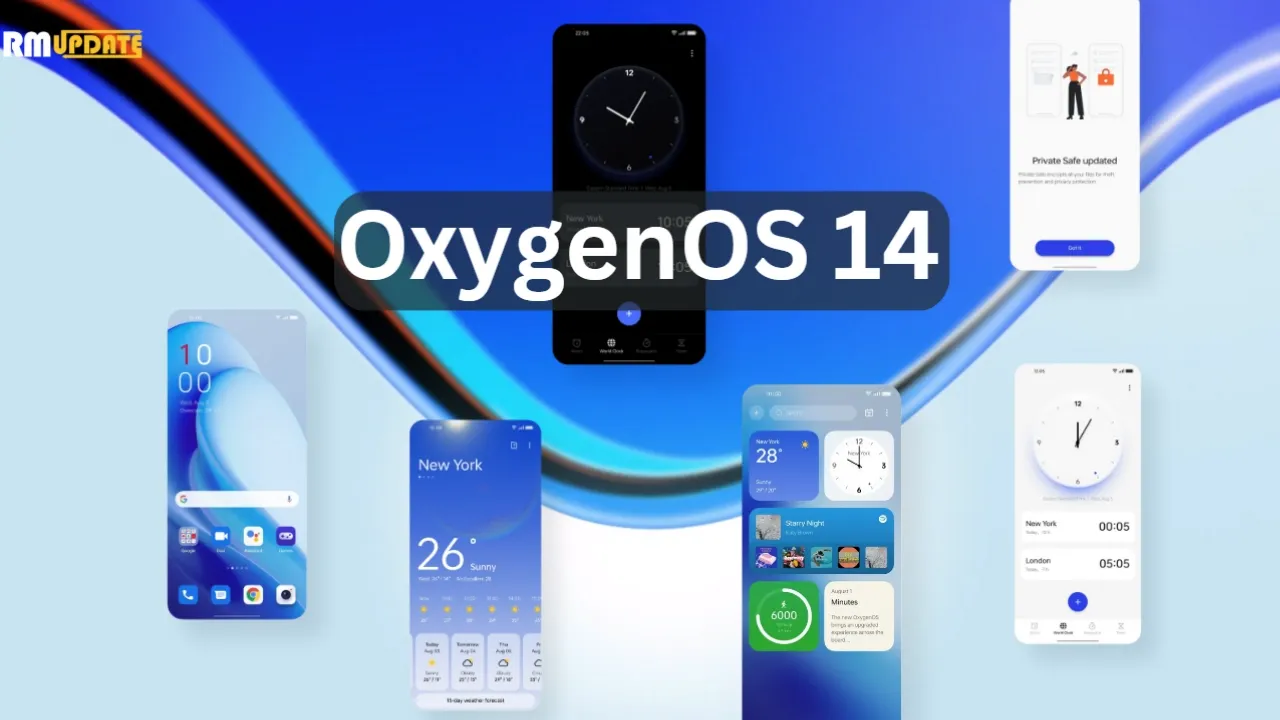
Today, OnePlus officially unveiled OxygenOS 14, the latest iteration of its Android 14 skin. Although OxygenOS 14 isn’t officially available yet, at least not in a stable state, OnePlus wants you to be prepared for it when it does. For the time being, it’s accessible as a second beta for the OnePlus 11 that includes all of the new features.
What new features are those? Truthfully, I’m not sure. Although OnePlus was gracious enough to invite us to a briefing on OxygenOS 14, it was challenging for me to learn much because the verbal word salad used to describe what this skin aims to do is more than my brain can process. This stuff is filled with laughable buzzwords and talking points. I’m fairly certain that it was created by a set of algorithms powered by artificial intelligence (AI) and a microchip inserted into the brain.
I’ll do my best to sum-up what OxygenOS will offer your OnePlus phone.
The Trinity Engine! I have no idea what this is, but OnePlus describes it as a combination of CPU, ROM, and RAM Vitalization, as well as the attachment of the capitalized word HYPER to rendering, touch, and boost. All you need to know is that they are powered by an algorithm…and they should make your phone feel faster and smoother for years to come.
OnePlus Cloud now integrates with Google Photos for backups. Cool.
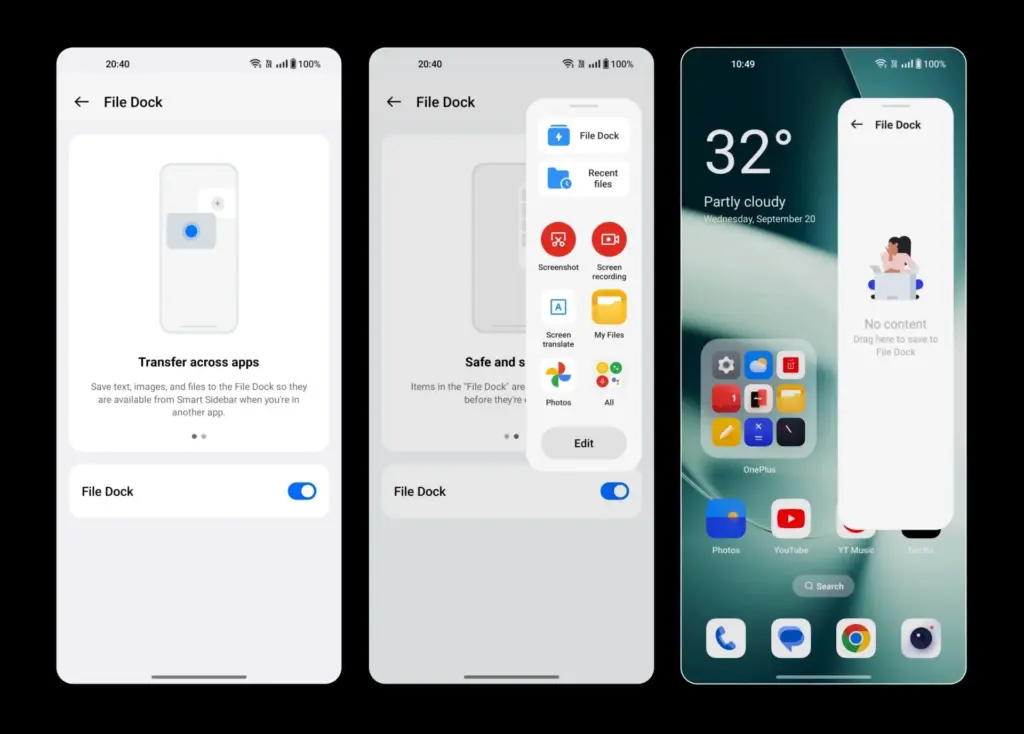
File Dock “enables collection, analysis, and sharing of global information through the Dock or other applications simply by making gestures.” What? I think that means you have a system-level copy-paste-clipboard feature that works across your phone and tablet and PC. Maybe?
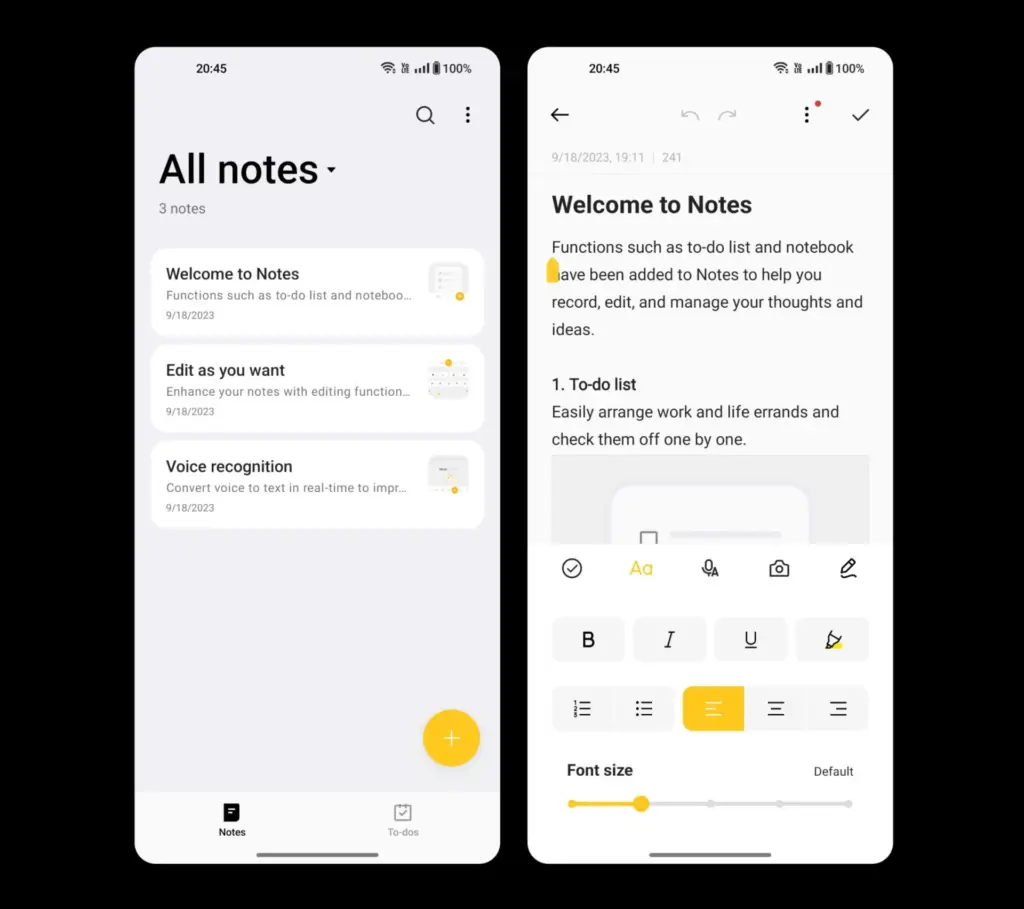
Notes app is more robust with a “touch of personality” that includes color, a creative font, and different sized text or images. You’ll also find note editing using underlines, strikethrough, and split lines, as well as categorization.
Smart Cutout allows you to long-press any person or pet in a full-size image (or on a paused video) to crop them out and then play with them as a wallpaper or poster. In OxygenOS 14, you can now identify up to 3 objects in a single photo.
Multi-Screen Connect 2.0 connects your OnePlus phones running OS 14 with a “faster and more stable” connection.
Clone Phone 2.0 lets you setup a new phone to quickly syncrhonize your network, account, and other basic settings.
Security Center from Android 14 is here, because this is Android 14.
Auto Pixelate 2.0 can now “intelligently detect formats like receipts, screenshots from social apps, car license plates, ID documents, boarding passes and more” to pixelate that sensitive info.
Fluid Cloud is apparently not a cloud service and is instead a new design on information presented through notifications and the status bar. It’s like water and liquid, or something, because it expands on OnePlus’ Aquamorphic Design. I just hope they fixed the way notifications work on the lock screen and in the pulldown.
Sounds from nature have taken over with new ringtones and notification sounds.
Go Green AOD is a new take on the always-on display that tracks your steps as you walk throughout the day to then let you know that you are reducing CO2 in the air because you didn’t drive a car.
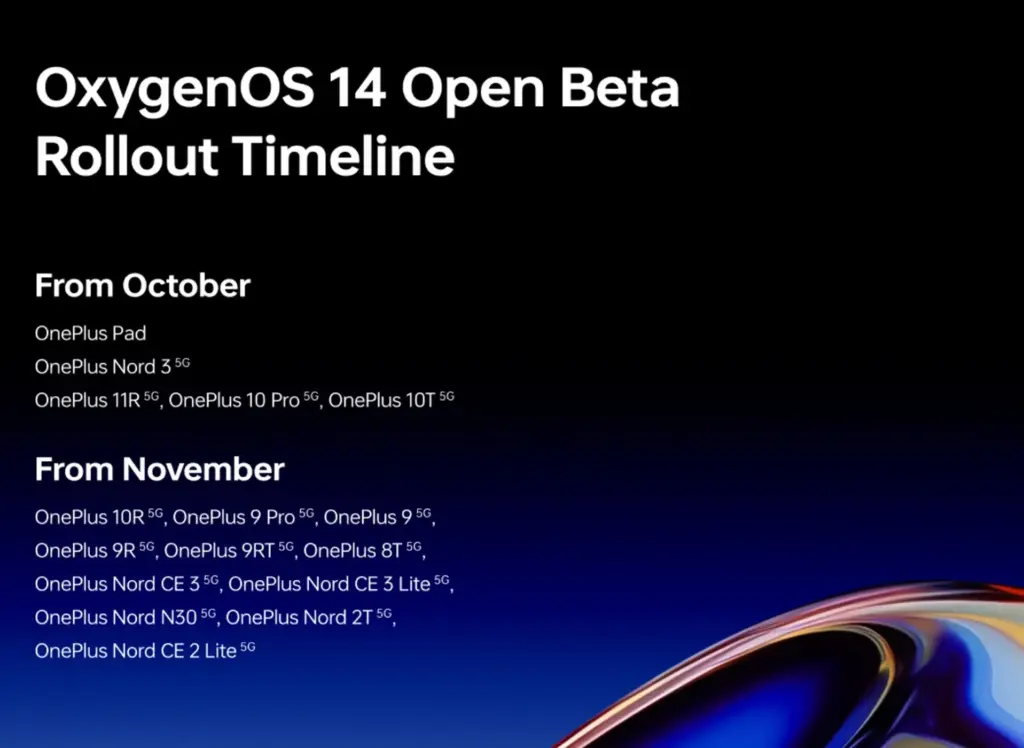
Once more, OxygenOS 14 Beta 2 is now available to OnePlus 11 users. There is no information yet on when it will become stable. You may expect beta builds for devices including the OnePlus Pad, Nord 3, OnePlus 11R, 10 Pro, and 10T in October. In November, beta builds will be released for yet another set of hardware. Below is a list of everything on it.
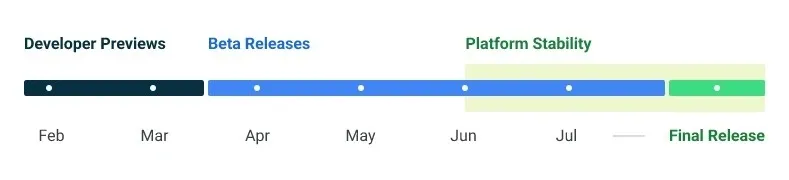
Google made the Android 14 Developer Preview (DP) available for testing on devices from the Pixel 7, Pixel 6, and Pixel 5 series, even the rudimentary Pixel 4a. A new DP edition is expected to be published in March, followed by a few beta releases until the summer, when more stable and feature-rich versions will be issued, and finally the final Android 14 release in the fall.
New Android 14 features
Speaking of new Android 14 features, as usual in the Developer Preview stage, there aren’t many user-facing ones, but rather deep under-the-hood changes that bring interface speed and power-draw optimizations, as well as security and privacy upgrades. Still, there is one biggie one it comes to new Android 14 feature that you will immediately notice.
System fonts
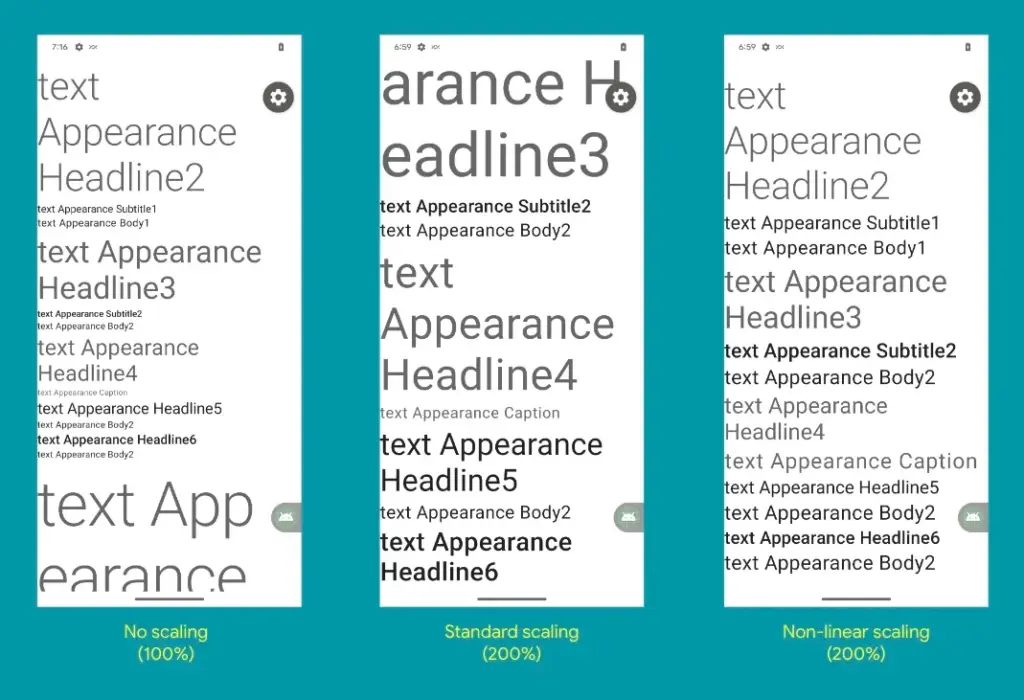
Bigger fonts with non-linear scaling is exactly what Google refers it as this new Android 14 option as. Instead of the current 130% threshold, Android phone owners will be able to increase the size of the system fonts by two times.
It makes sense considering that screens are growing bigger and bigger—we now have foldables with screens north of 7 inches diagonal and difficult-to-read small print. Without a doubt, Google uses “non-linear” scaling to raise text in fonts that are already sufficiently large compared to the smaller text that receives a size increase, rather than simply increasing the font size of Android 14 in a way that is deserving of the list of the best phones for seniors.
Performance and battery life
Android 14 will optimize the speed of the mobile OS system overall and offer less of a power pull from unnecessary activities thanks to a clever combination of background process optimization and presenting actionable requests to apps only when they are out of a cached state.
Additionally, without the user’s express consent, apps that don’t need a strict timing schedule, such clocks or calendars, won’t be able to continuously probe for resources by setting precise alarms.
Adapting to foreign language
With Android 14, a number of foreign language optimizations address the accessibility issues of the device by modifying the text to reflect the peculiarities of non-English speakers, such as tailored translations that take into account the different grammatical genders used in various languages.
The ability to dynamically update the list of foreign languages in an app’s settings to reflect the location and even alter the keyboard based on the interface language that the app is displaying in is another fantastic locale adaption improvement in Android 14.
Security and privacy
Down on the system level, Android 14 will include several new malware-fighting features that plug known exploits by blocking app installations or only allow them if they meet certain criteria.
Dynamically loaded applications that can be changed by injecting code in the process will be marked to be read-only in Android 14 in order to close another door for the installation of malware and various exploits.
Android 14 release date
Android 14 Beta: April 2023
Final Android 14 release build: October-November 2023
How to install Android 14 Developer Preview on Pixel phones
Flash an Android 14 system image on a Pixel 7 Pro, Pixel 7, Pixel 6a, Pixel 6 Pro, Pixel 6, Pixel 5a 5G, Pixel 5, or Pixel 4a (5G) phone.