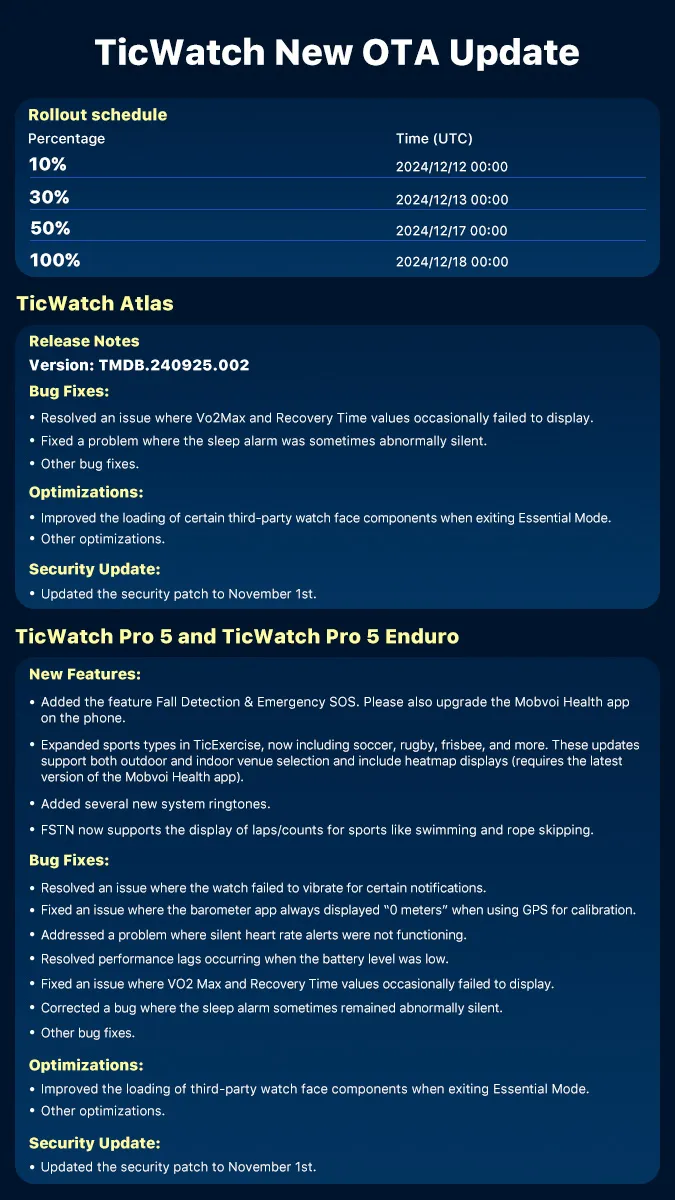
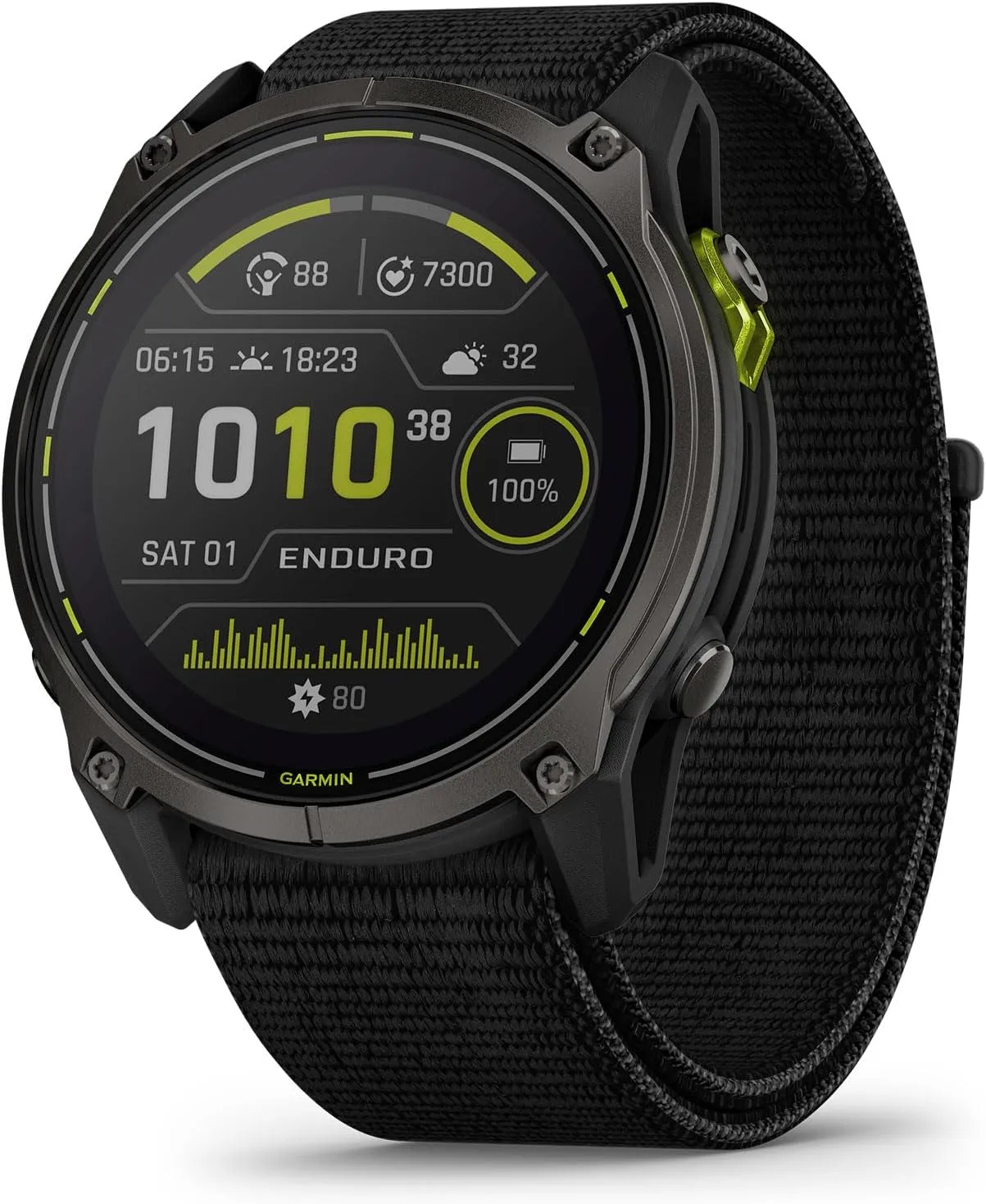
Mobvoi has announced that the TicWatch Pro 5 and TicWatch Pro 5 Enduro smartwatches will soon receive an update. Version TMDB.240925.002 adds new capabilities to the wearables, including a safety tool and other sports.
In addition, these wearables have received a number of improvements and bug fixes.
The Mobvoi TicWatch Pro 5 and Pro 5 Enduro smartwatches are set to be updated. This release and a comparable upgrade for the latest TicWatch Atlas smartwatch have been announced on Facebook.
The version TMDB.240925.002 upgrade is expected to add new features to wearables. These include Fall Detection and Emergency SOS, which allow users to raise an alarm if they are in distress; however, you must also update the Mobvoi Health smartphone app to use this capability.
TicExercise now includes additional sports such as soccer, rugby, and frisbee. Additionally, there are new system ringtones, updates to several third-party watch face components, and a security patch for November 1st.
In addition, Mobvoi has fixed issues such as the watch failing to vibrate in response to a notification, missing VO2 Max and Recovery Time statistics, and performance lagging at low batteries.
Version TMDB.240925.002 will be available to TicWatch Pro 5 and Pro 5 Enduro smartwatch users beginning December 12th. It will initially be available to only 10% of units, growing to 50% on the 17th and 100% on the 18th. The TicWatch Pro 5 Enduro smartwatch is currently available on Amazon for $313.81.
Ticwatch Pro 5 Enduro
Experience uninterrupted productivity and training with TicWatch Pro 5 Enduro’s remarkable battery life.
Over the past month, we have seen some fantastic deals on the Samsung Galaxy Watch 7. But if you have been waiting for this long, now is the time to buy, as the Galaxy Watch 7 has plummeted to its lowest price ever. This is extremely impressive given that there were no notable reductions during the first several months of the watch’s release.
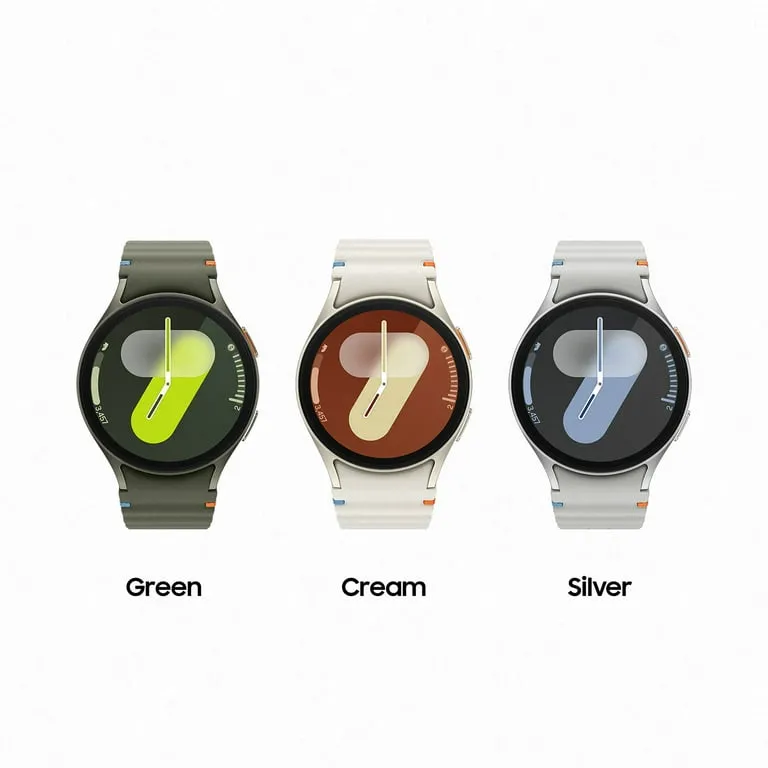
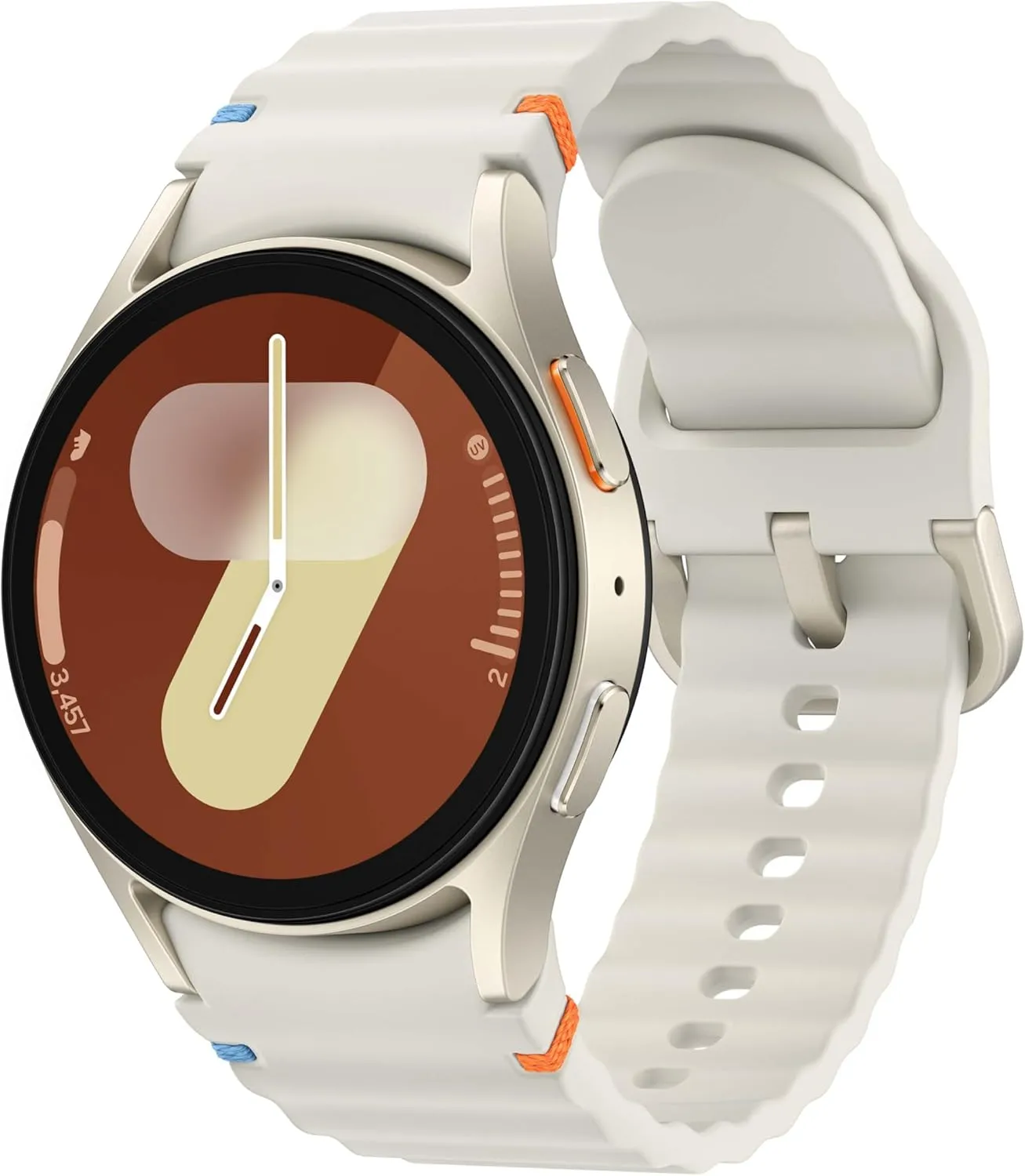
However, in the last month alone, the price of this watch has dropped significantly. For a limited time, you can save 25% on this popular wearable, which is $75 off the original retail price. The 40mm model now on sale comes in cream and is the greatest Android smartwatch available. So get it while you can, since the price is too excellent to pass up.
Samsung Galaxy Watch 7 40mm
A floating glass design and colorful stitching points add a touch of elegance to your wrist, while ripples on the band show you’re ready for workouts.
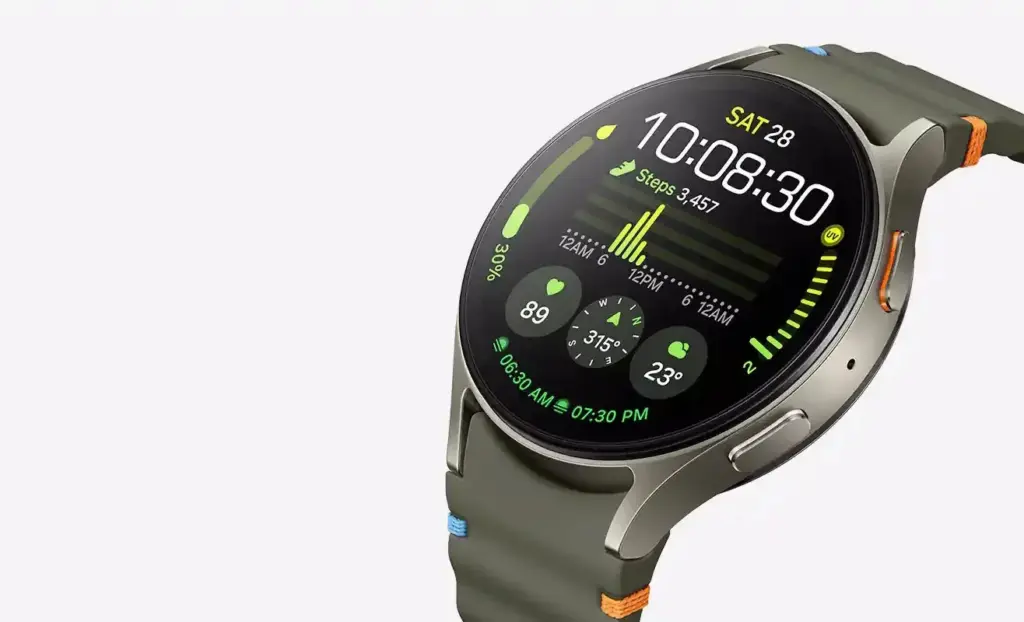
The Galaxy Watch 7 impresses on all fronts, thanks to its elegant and lightweight design and strong software. You get a stunning AMOLED display that looks fantastic in any setting, and there are numerous sensors onboard to help you stay on top of your health.
The watch not only tracks fitness activities, but it also provides information about your stress levels and sleep quality. This is essential if you want to truly optimize your lifestyle and become a better version of yourself.
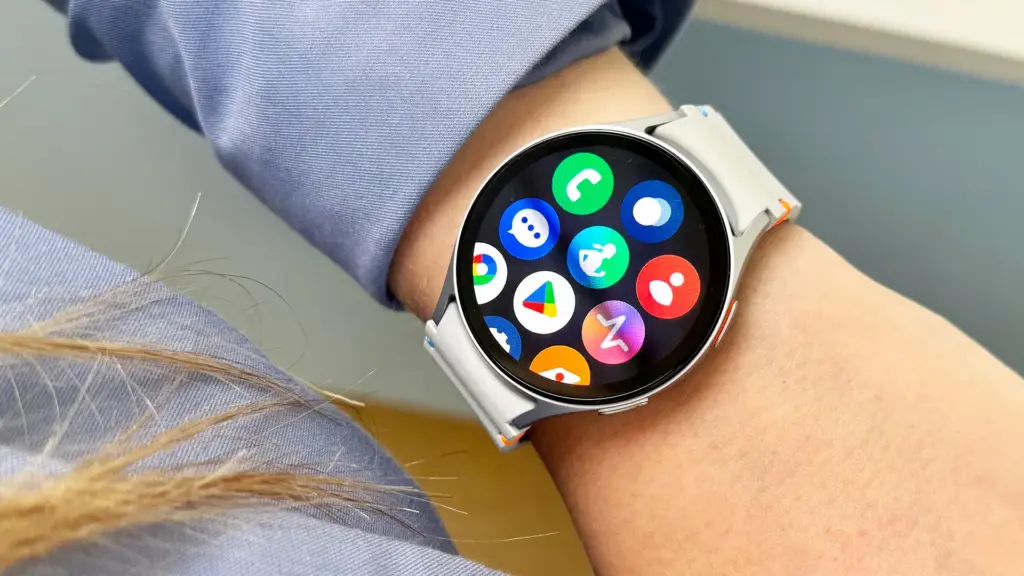
Of course, you get superb connectivity here, with the ability to take phone calls and respond to messages as well. Wear OS also allows you to download a large number of popular apps to the watch, making it one of the most extensive software ecosystems for a smartwatch.
This is the greatest smartwatch you can buy right now. It truly does everything you need it to and is now priced to sell. Make sure you get to Amazon and take advantage of this discount while it lasts. The Galaxy Watch 7 is an excellent value at $225, and you do not want to miss out.
Samsung Galaxy Watch 7 40mm
A floating glass design and colorful stitching points add a touch of elegance to your wrist, while ripples on the band show you’re ready for workouts.
These days, swift screens are not limited to the the greatest Android phones. The majority of premium and mid-range Android phones, as well as many low-cost phones, have displays with refresh rates higher than 60 Hz.
However, because their displays do not support variable refresh rate (VRR) technology, the majority of these phones only refresh at a few set speeds, such as 60Hz, 90Hz, or 120Hz. As it turns out, Android has not had real VRR support up until now, although certain phones do feature VRR-capable screens.
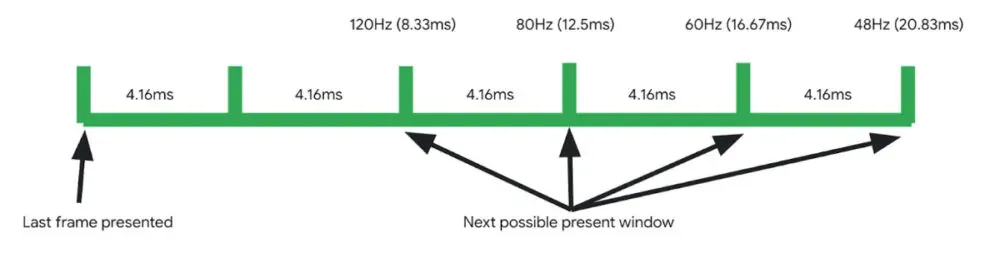
Google claims that Android 15 is the first version of the Android operating system to feature adaptive refresh rate (ARR), also known as variable refresh rate. The operating system allowed for multiple refresh rates with refresh rate switching prior to Android 15. In essence, the OS would instruct the screen to alternate between the many display modes that it supported, like 1080p@60Hz and 1080p@90Hz.
Therefore, it would track the type of view that is displayed in an attempt to do this intelligently, but it was never really adaptive. Nevertheless, Android 15 introduced adaptive refresh rate, which allows the refresh rate to alter within a single display mode in addition to adapting to the content frame rate.
According to Google, there are two main advantages to Android 15’s adaptive refresh rate functionality. By allowing devices to “function at rates lower than their maximum refresh rates, switching to higher rates only when critical for the user experience, which eliminates wasteful power consumption,” it first lowers power usage. Second, by removing the need to switch between display modes—which Google claims is a “known cause for jank”—ARR enhances performance.
Many of you are probably asking if this adaptive refresh rate feature is indeed new. What gives, considering that smartphone manufacturers have been promoting variable refresh rate as a key feature made possible by the advent of LTPO screens for years? Although I am not very knowledgeable about display technology, from what I gather, even these gadgets have never offered full VRR on Android, unlike PC players. For instance, unlike many PCs, Android smartphones with LTPO OLED screens are unable to synchronize their display refresh rates with games.
Many of you are probably asking if this adaptive refresh rate feature is indeed new. What gives, considering that smartphone manufacturers have been promoting variable refresh rate as a key feature made possible by the advent of LTPO screens for years?
While We aren’t very knowledgeable about display technology, from what I gather, even these gadgets have never offered full VRR on Android, unlike PC players. For instance, unlike many PCs, Android smartphones with LTPO OLED screens are unable to synchronize their display refresh rates with games.
Rather, the introduction of LTPO backplanes to OLED screens just improved the power efficiency of operating those screens at lower refresh rates. This expanded the range of available refresh rates by enabling Android devices with LTPO OLED displays to operate at 1Hz or even 10Hz when necessary.
These refresh rates were still connected to distinct display modes, though, and Android controlled them by calling lower-level display software through the Hardware Composer (HWC) hardware abstraction layer (HAL). As a result, the Android OS would alter the refresh rate by switching the display mode even on devices having a real VRR/ARR panel.
Some Android devices already have the ability to switch refresh rates inside the same display mode, but their OEMs had to add kernel-level support for this, according to display expert Dylan Raga.
The drawback of this strategy is that every OEM would have to create their own logic for determining when to reduce the refresh rate. This is difficult not only because Android requires a generic kernel image, but also because the kernel does not know as well as the OS does what content is displayed.
Because it offers a uniform method of reducing the refresh rate using data and cues that are more easily accessible to the OS, Android 15’s implementation of appropriate support for VRR/ARR at the HAL level is crucial. However, OEMs must implement version 3 of the HWC HAL APIs in addition to supporting the necessary kernel and system updates on Android 15 or later devices in order to allow VRR/ARR.
It is hoped that more apps would utilize lower refresh rates once Android devices have this adaptive refresh rate capability enabled. Dylan Raga cited the fact that most Android phones now run at 60 Hz when a movie is playing rather than 30 or 24 Hz, which this feature may correct.
Yet, according to Google’s documentation, this functionality only permits the panel to operate at refresh rates that are “divisors of the panel’s tearing effect (TE),” therefore it is unlikely to bring PC-like game refresh rate syncing to Android. It is long overdue that Google disclose more information about this function and whether it is available on any of its current Pixel smartphones.
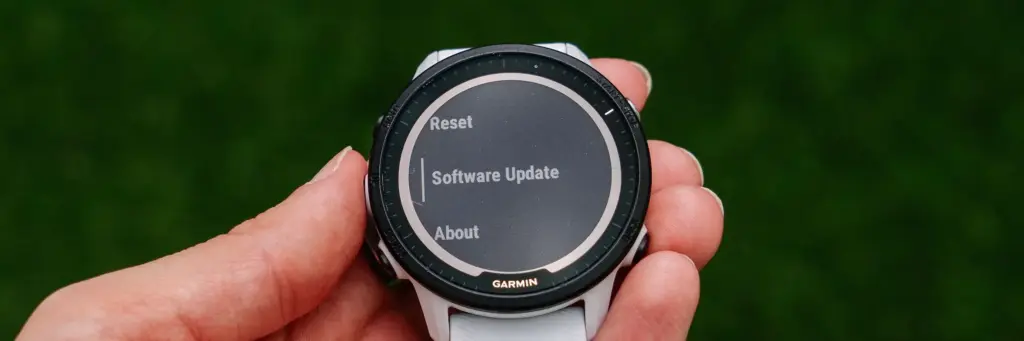
Many of the top Garmin watches on the market seem to be having issues with a recent software update that Garmin published. But there is a lot of uncertainty about what Garmin has changed and what might or might not be broken in the most recent version, especially for owners of the well-liked Forerunner line.
On December 2, Garmin released software version 21.19. The new Meditation activity, upgrades to the Pool Swim routines, and corrections for various issues and oddities are among the improvements mentioned.
Users of Forerunner have reported a number of problems with the update, particularly with accessing the touchscreen and syncing their devices with Wi-Fi. What is happening, and what information is necessary for you to know?
Garmin Forerunner software update
First, the simpler problem is that some customers are having trouble syncing their Wi-Fi after the update. One user complained on December 4 that “the wi-fi sync does not work after installing Forerunner 955 – Software Version 21.19.”
In its release notes, Garmin states that “it is advised users sync their devices via Garmin Express or Wifi to speed the transfer of files required for the meditation activity.” This is in line with the many complaints that point to a similar problem. Wi-Fi sync problems might be caused by the majority of the new version, which is packed with new features, but there does not appear to be an obvious cause or solution.
The changes and bugs pertaining to the touchscreen are much more perplexing. A issue that causes the Forerunner touchscreen to remain active during activities even when the ‘Touch Disabled’ setting is activated is being reported by a few of users. One user agreed, “I saw the same as the wet sleeve of my jacket was swiping through the data fields while I went out for a run in the rain at noon today.” Garmin has responded on at least one post stating, “We are aware of this issue and are presently investigating,” which suggests that this is a bug. I am sorry if this has annoyed you.
However, the problem is complicated since customers are experiencing another touchscreen “bug,” which Garmin claims is a deliberate modification. The Forerunner’s Stopwatch in 21.19 is operated using the device’s buttons rather than its touchscreen. “Since software version 21.19, I am unable to operate the stopwatch with a touch screen. I can only start, stop, and reset it using the buttons. One customer complained, “The touch screen does operate in the timer.”
In response, Garmin has subsequently stated that “This was a deliberate alteration. Now, you have to start, stop, and reset the time using the buttons on the Stopwatch and Timer screen. I apologize for any disappointment this modification may have caused.
In conclusion, there are undoubtedly some issues with the most recent Garmin update when it comes to Wi-Fi and utilizing the touchscreen when engaging in activities. However, Garmin claims that this is a deliberate adjustment if you have noticed that your stopwatch no longer functions via touchscreen and can only be operated by buttons. It remains to be seen if it was a good one. It is been a rough few days for the company’s software section because of this most recent disturbance and the recent problem with Garmin watch faces crashing.
Google discusses issues consumers have faced with previous generations when creating the Tensor G6 for the Pixel 11 series, and battery life is predictably a factor. Google discusses how less than 86% of Pixel 6/7 users survived the day in Tensor G6 design/planning docs that Android Authority was able to view (original text: “Pixel 6/7 generation < 86% MITTD”).
“Battery life is always at the top of conjoint research,” the statement reads. Along with the notion that “Good battery life attracts user & drives loyalty with increased satisfaction,” none of that is really shocking.
Of note is a line about how “Users expect 36 hrs of battery life.” In context, that’s presumably what Google found after surveying users.
It is unclear if Google intends to fulfill that expectation with Tensor G6 and Pixel in the future or if it is merely something they are considering. Google boasts “24+ hour battery life” on the specs list for the Pixel 9 series, yet the Pixel 6 Pro-8 Pro has “Beyond 24-hour battery life.
The Extreme Battery Saver life has increased each time, reaching up to 100 hours this year after reaching up to 48 hours on the 6 Pro and 72 hours on the 7/8 Pro.
If a user forgets to charge their phone overnight, the 36-hour battery life may allow them to continue with their day. Accidents do occur, but most people are now conditioned to plug in at the end of the day. The remainder of the paper discusses the necessity of lowering the chip’s price since “Tensor based Pixel applications have not accomplished our financial targets.” In particular, “~$65 to make this business viable” is the goal.
To achieve that, the aim is to make Tensor G6 physically smaller than the G5 (121 mm² to 105 mm²), and removing various components. For example, the GPU will drop ray tracing support after introducing it a generation earlier. Other examples include removing cores and reducing caches across the chip. Of course, none of this is finalized yet.
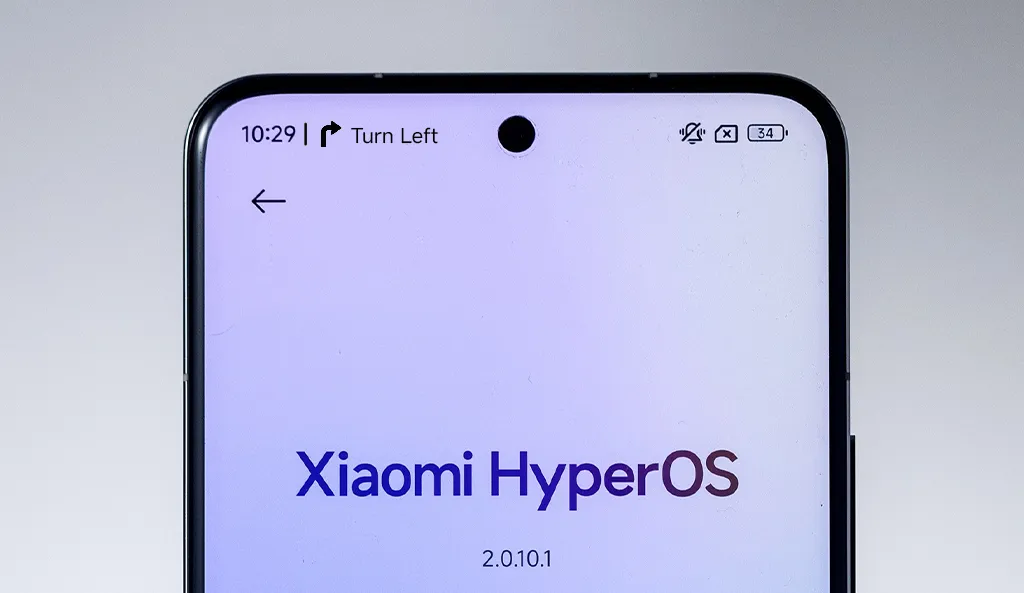
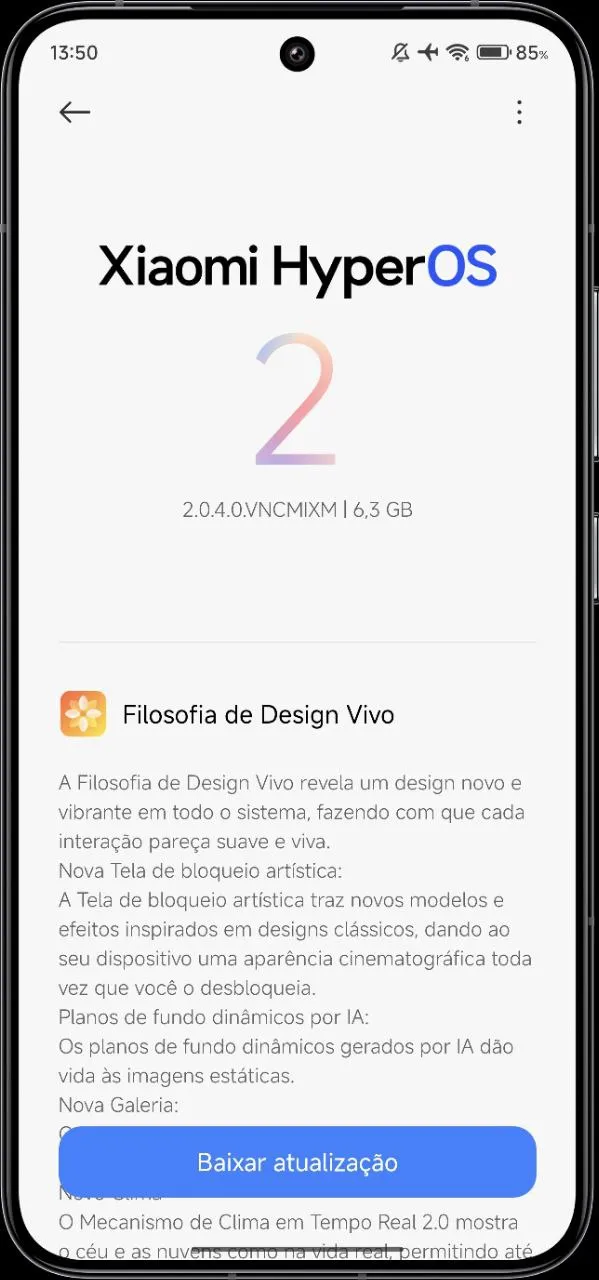
With the official release of the HyperOS 2 Global Beta upgrade, Xiaomi has treated customers outside of China to the newest system features.
Xiaomi promised a global debut in November, and the global version of HyperOS 2 has come precisely one month after its first release in China. The update, which had the version code OS2.0.4.0.VNCMIXM, was unannounced for Xiaomi 14 Global users on Wednesday evening.
Xiaomi is demonstrating its dedication to providing the newest software to users worldwide with this initial step in the global rollout of HyperOS 2.
New in HyperOS 2
HyperOS 2 represents a major development and-thus-major update of its predecessor, complete with:
Better User Interface: Redesigned multitasking, new layout of desktop, new animations for smoother and easier use.
AI Driven Tools: Advanced AI capabilities with real-time translations, cinematic lock screens, and an improved AI camera for better photography.
Better Performance: Better memory management and optimization of battery for continuity with no hassle on any device.
Customization Choices: New layouts of desktop, widgets, and folder designs serving the needs of various personalization.
This is a huge accomplishment for Xiaomi since it is the first time the company has successfully released an OS update globally in tandem with its local release. Xiaomi demonstrates its commitment to closing the gap between regional and global user bases by launching HyperOS 2 globally within a month of its Chinese release. In the meanwhile, this beta release enables Xiaomi, the vendor, to gather more user feedback for future worldwide updates that will result in a more stable and refined system.
Currently, the first model to get the HyperOS 2 Beta upgrade is the Xiaomi 14 Global. In the upcoming weeks, more qualifying models are anticipated, including the Redmi K60 and Xiaomi 13 series. It will be rolled out gradually using Xiaomi’s standard “grayscale to full volume” approach.
How to Update
In case you are using an Xiaomi 14 Global user, if you didn’t get the update from your Updater you can download it via following guide.
Download MemeOS Enhancer app on your phone from the Google Play Store.
Open app and check updates.
Download latest update from there.
However, Xiaomi intends to make the new HyperOS 2 available on a larger variety of devices in the next months, so it is not just about the worldwide beta release. Xiaomi will continuously improve the system based on input from beta users to ensure that it meets the high standards of its worldwide audience.
HyperOS 2 Beta’s worldwide release undoubtedly demonstrates Xiaomi’s increased focus on the global market. With its cutting-edge features and enhanced performance, HyperOS 2 will undoubtedly raise the standard for Xiaomi enthusiasts worldwide in terms of user experiences.
You have undoubtedly seen Garmin’s wide range of cycling computers and athlete-focused fitness trackers in your search for a reliable fitness tracker. Even though they come with a ton of features already, the brand maintains momentum by regularly delivering feature updates automatically over the air. You can begin getting acquainted with the latest additions as one for December was recently announced.
Garmin’s December feature update bulletin for wearable fitness trackers and cycling computers was just made public (via NotebookCheck). This edition has three notable additions. First of all, you may now monitor your meditation practice, which may aid in stress and anxiety management.
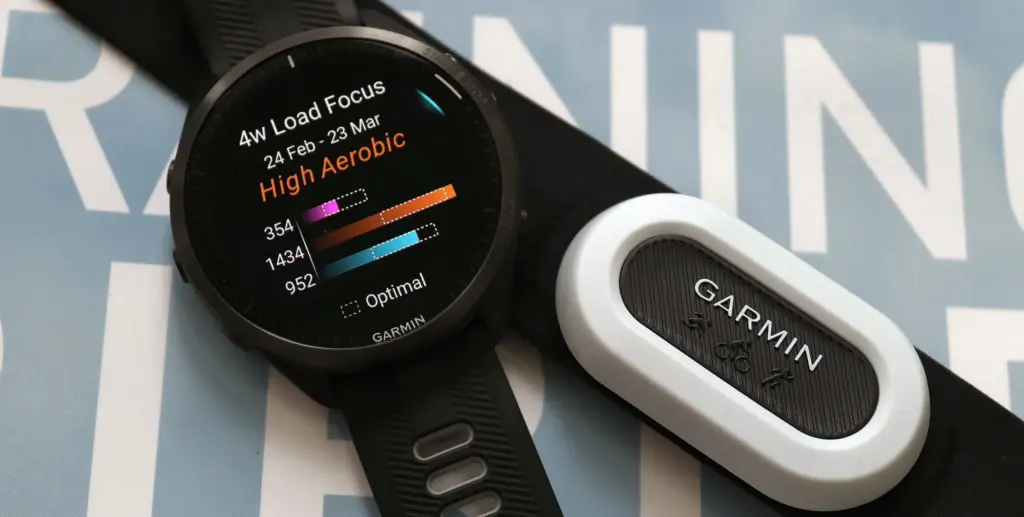
Your lactate threshold heart rate and other information can be used by the wearables to help you target the appropriate training intensities. As your muscles deteriorate, your level of weariness increases significantly beyond this point. Although this is computed automatically, Garmin advises against utilizing the data at first because the accuracy of threshold detection increases with additional workouts.
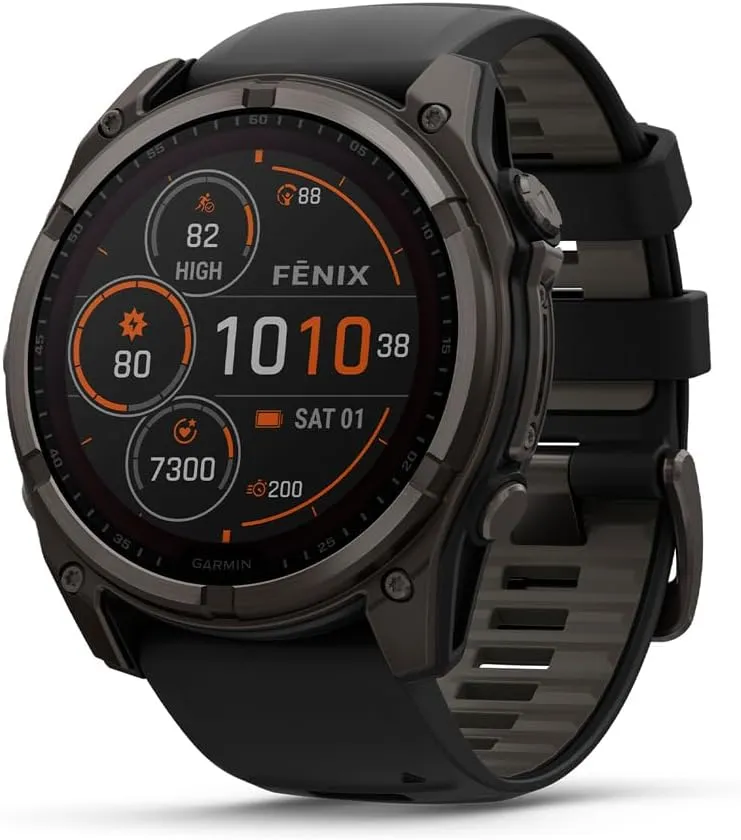
Garmin fēnix® 8
Be limitless. The fenix 8 multisport GPS smartwatches are built for serious athletes and outdoor adventurers who want to push beyond their limits. The fenix 8 Series now comes with a bright AMOLED display.
Garmin Coach strength training plans are the final significant addition this month. The companion app can assist you in creating a personalized workout routine to gain muscle or improve your fitness level, as the name implies.
The update is rolling out as we speak
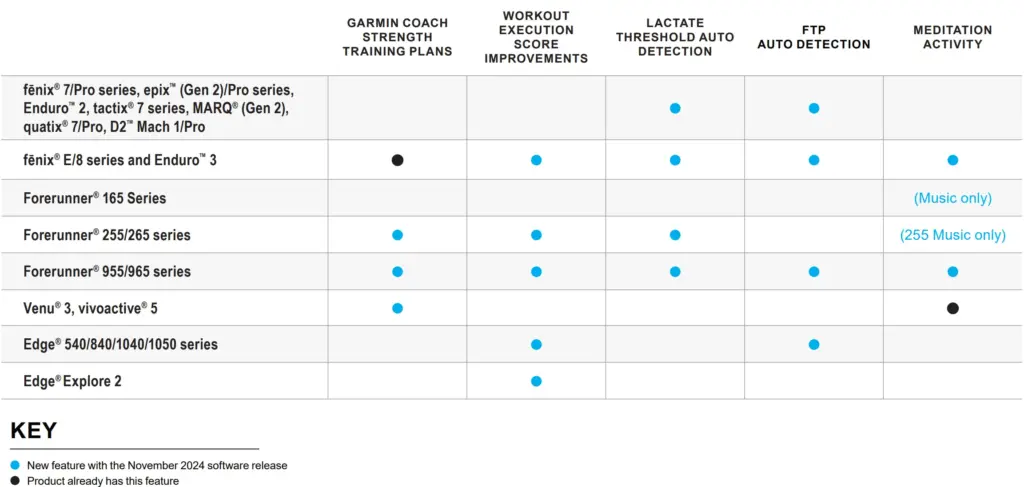
According to Garmin’s announcement, the most latest and compatible devices will be updated in the upcoming weeks. Some of these features, nevertheless, have been included in new products since their introduction and are now being added to older versions.
For example, the Vivoactive 5 and Venu 3 offered meditation tracking, and the Fenix E, Fenix 8, and Enduro 3 have long included Garmin Coach strength training. Lactate threshold detection, however, is novel for every product. Additionally, owners of the Forerunner 955 and 965 will have access to all of the previously listed functionalities.
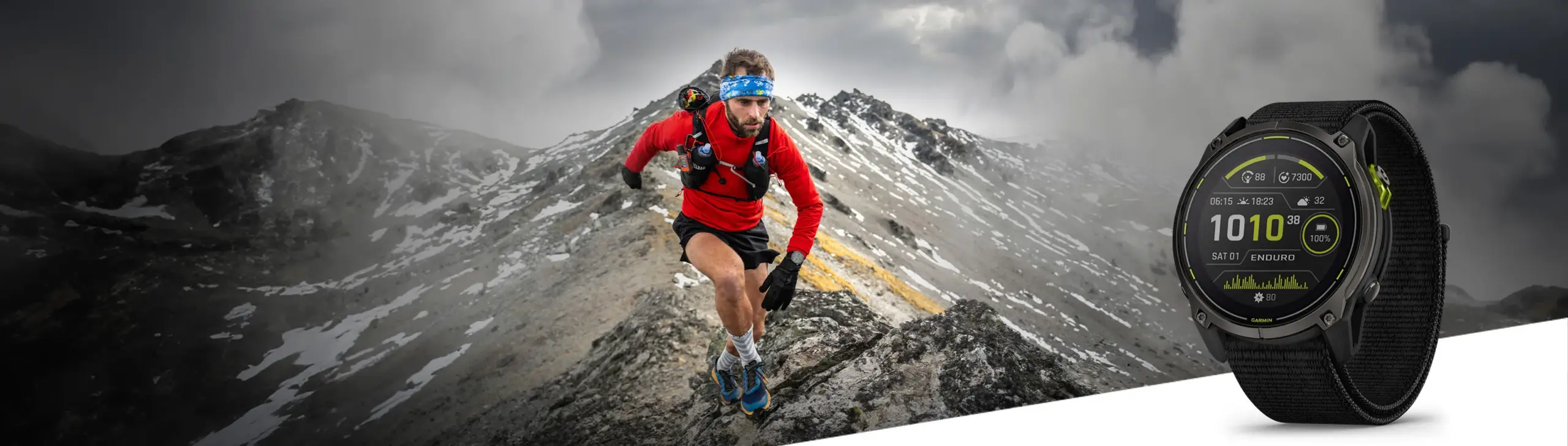
Garmin Enduro™ 3
Designed for ultra-endurance athletes, with a lightweight design weighing just 63 g to help improve performance.
It has already been announced that the Redmi K80 series will debut on November 27. The business has revealed how well the Redmi K80 Pro can function in AnTuTu in order to create expectation.
On November 27, Xiaomi will formally launch the Redmi K80 series in China. According to reports, the regular model will launch as the F7 Pro and the K80 Pro as the F7 Ultra. The lineup is also anticipated to make its global premiere under the Poco brand sometime in December or early 2025.
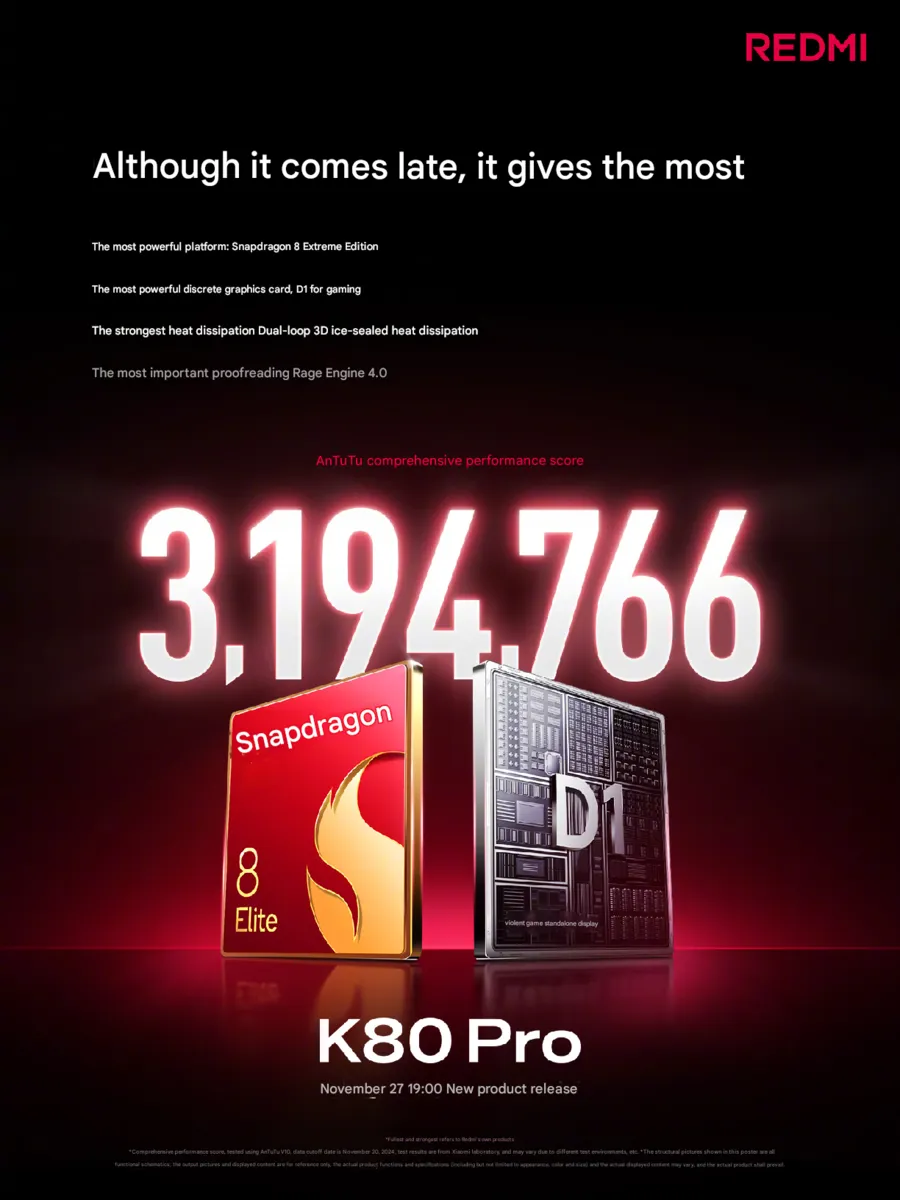
Xiaomi has revealed that the Redmi K80 Pro may score close to 3.2 million in AnTuTu before its Chinese launch. The business claims that it can reach 3,194,766 points in particular. The Snapdragon 8 Elite flagship phone has the greatest score to date, and it is far higher than the Asus ROG Phone 9’s record-breaking benchmark run.
Perhaps the Redmi K80 Pro’s enhanced 3D cooling technology made this record-breaking score feasible. This cooling method probably comprises a sizable vapor chamber, though the company has not disclosed any other setup information yet. It is currently unknown, though, if it will be sufficient to provide strong, long-term performance under high loads.
In addition to the AnTuTu score, the company said that the Snapdragon 8 Elite and D1 chip will be paired with the Redmi K80 Pro. Its purpose is to regulate the screen and improve game resolution and frame rates. In order to improve battery life, the chipset also seeks to provide excellent gaming performance without using a lot of power.
Overall, based on the company’s teasers, it appears that the K80 Pro will be a fantastic choice for anyone searching for a smartphone with a performance focus. Next month, it may even take the top spot in AnTuTu’s flagship smartphone list.
With the next-generation Snapdragon flagship CPU around the corner, the OnePlus 13 is anticipated to come soon. According to a OnePlus employee, the modified version of the SoC can outperform the Apple A18 Pro in terms of efficiency, even though the chipset’s name is still unknown.
At the Snapdragon Summit, Qualcomm will formally unveil its next-generation flagship smartphone SoC. The OnePlus 13 is anticipated to be one of the first smartphones to use the technology, though it is still unknown if it will be called Snapdragon 8 Gen 4, Snapdragon 8 Extreme Edition, or something else.
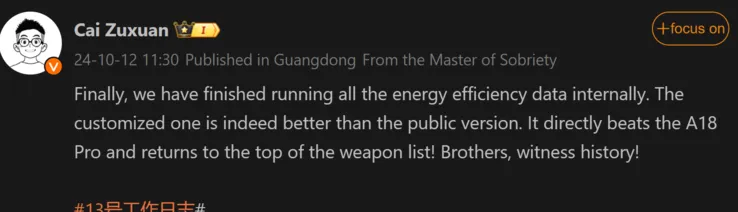
Although OnePlus has not given away many details regarding its next flagship phone, Cai Zuxuan, an employee, hinted on Weibo that it will use a modified Snapdragon chip. The employee’s assertion that the customized SoC will provide better energy efficiency is more intriguing.
More precisely, the employee asserts that the custom Snapdragon SoC can outperform the Apple A18 Pro in terms of power efficiency, citing internal statistics from OnePlus. According to Cai Zuxuan, this would force Qualcomm to take the top slot once again.
Additionally, a “public version,” which is allegedly inferior than the custom SoC, is mentioned in Cai Zuxuan’s Weibo post. There have been previous mentions of two distinct iterations of what is allegedly the Snapdragon 8 Extreme Edition. In August, a SoC datasheet that appeared legitimate was released, mentioning the SM8750 and SM8750P versions.
The SM8750P was thought to be a more expensive model among them; the letter “P” was presumably an acronym for “Performance.” Qualcomm has been using its previous flagship SoCs in a similar manner. Consider the Snapdragon 8 Gen 3 for the Galaxy. The normal SoC is significantly overclocked in this version. Later, Nubia smartphones came with the same overclocked processor, which now leads the AnTuTu benchmark.
Cai Zuxuan, however, indicates that this time, efficiency will be given a lot of weight in addition to performance. The good news is that October 21, which is not too far away, is when Qualcomm’s Snapdragon Summit will begin. In order to find out how Qualcomm’s 3 nm smartphone chip stacks up against the competition, you do not have to wait.
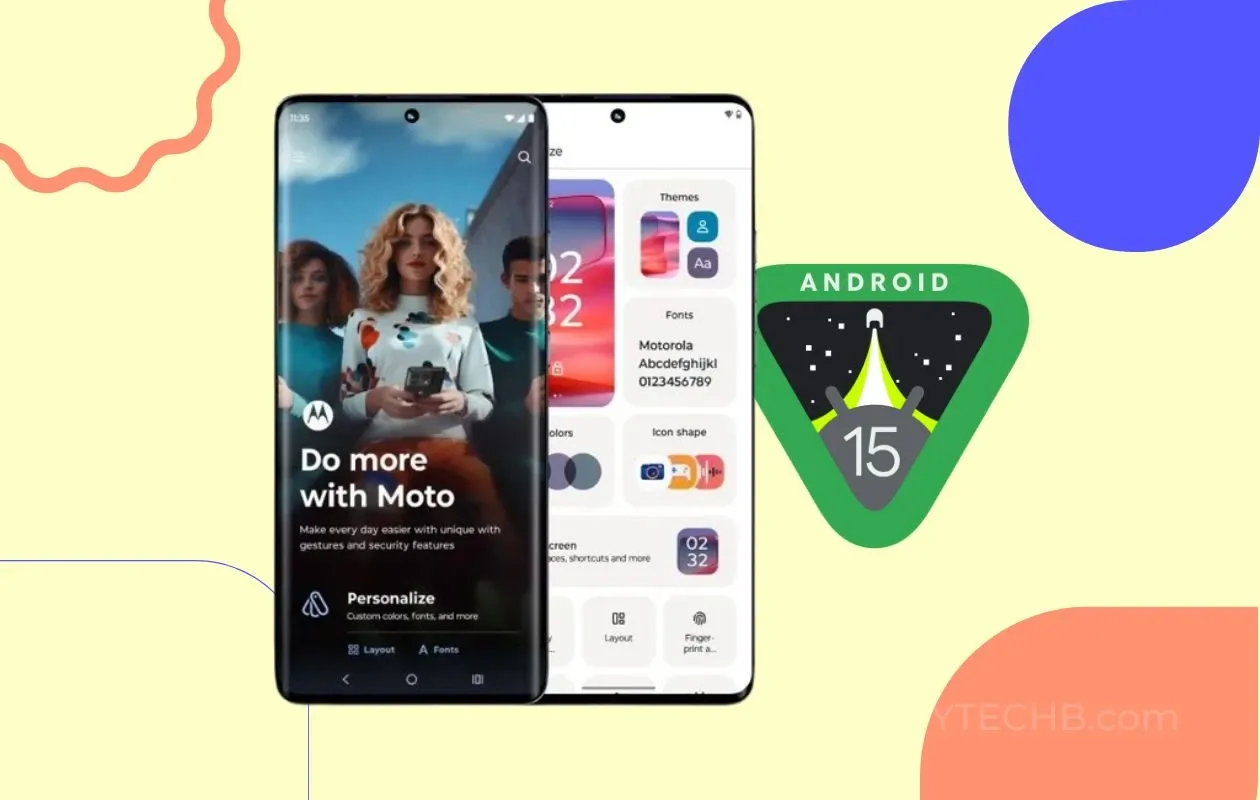
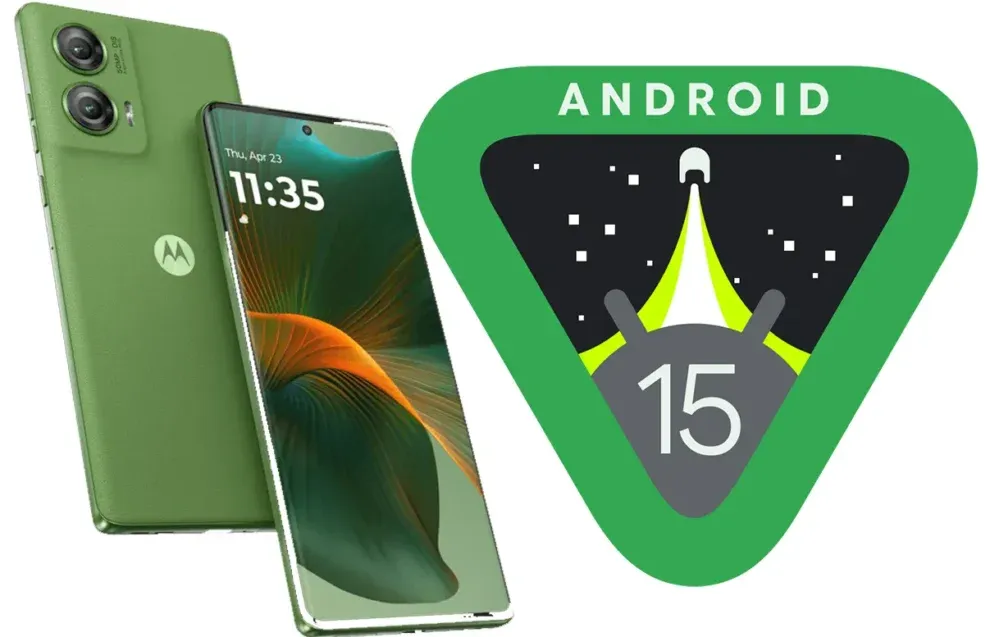
There has been a lot of interest in determining which firms would be the first to update their phones to the latest version of Android, as well as which phones will be included, since the official release of Android 15 on October 15. Motorola most recently stated that the Android 15 update will be applied to a few more devices.
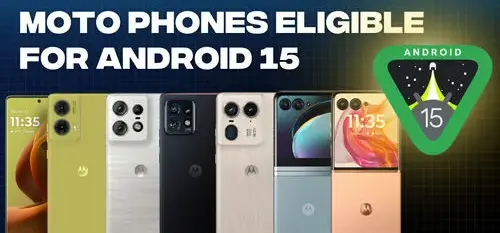
Motorola has started updating support pages for its devices and verifying Android 15 upgrades in this manner, despite the fact that the company has not made any official pronouncements about its plans for Android 15. Motorola has now announced that the following handsets will receive Android 15 as part of this most recent batch of updates:
It is heartening to see Motorola continuing to expand its network of Android 15 updates, even though only one of those phones—the Edge 2023—is accessible in the United States. Updates for Android 15 were confirmed for a far wider range of other Motorola phones, such as the Razr (2024), Razr Plus (2024), Edge (2024), and others, this past October. Motorola began its upgrade process by releasing the Android 15 beta to the Edge 50 Fusion shortly after the first list was found.
There is a lingering asterisk, even if more Motorola phones are receiving Android 15. When Android 15 will be formally available on any of Motorola’s smartphones is yet unknown. Furthermore, Motorola has a reputation for being among the slowest firms to offer timely Android upgrades. Therefore, even though Android 15 for other Moto phones is fantastic, it can take some time for your device to receive the update.