Being a Pixel owner outside the United States has always come with a catch: a long list of AI features that simply aren’t available in your region. Google has gradually extended some of these to international markets, but the majority remain US-only. That gap may be getting a little smaller, as the company appears to be preparing another Pixel feature for a broader global rollout.
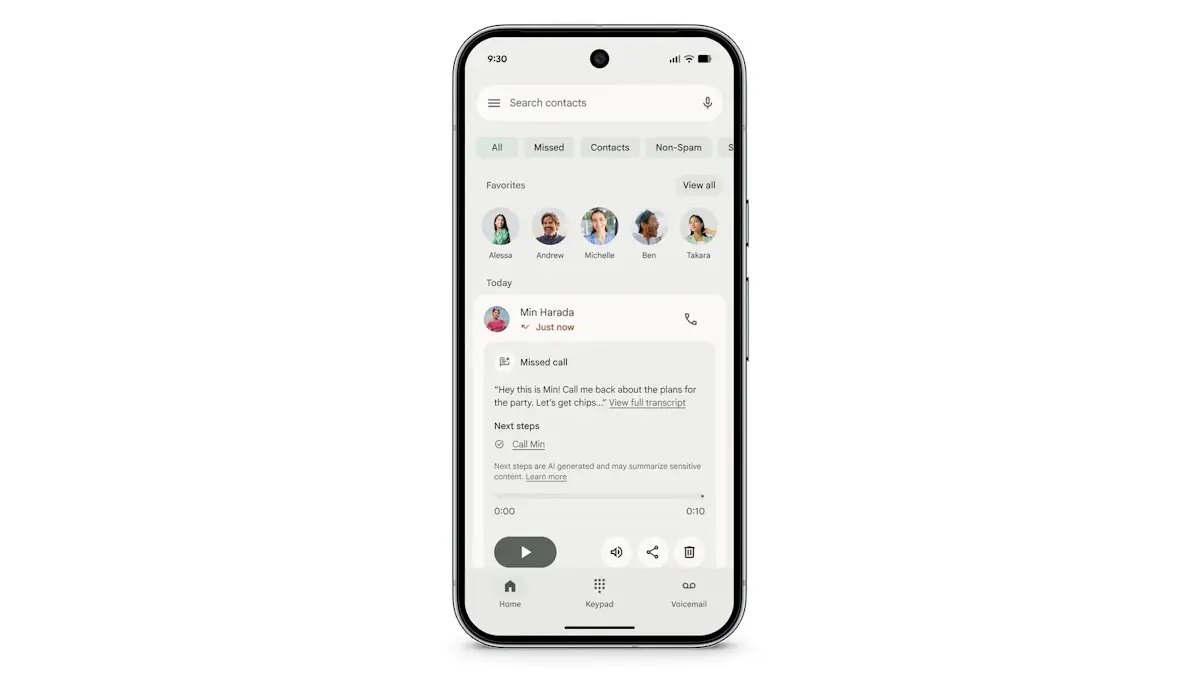
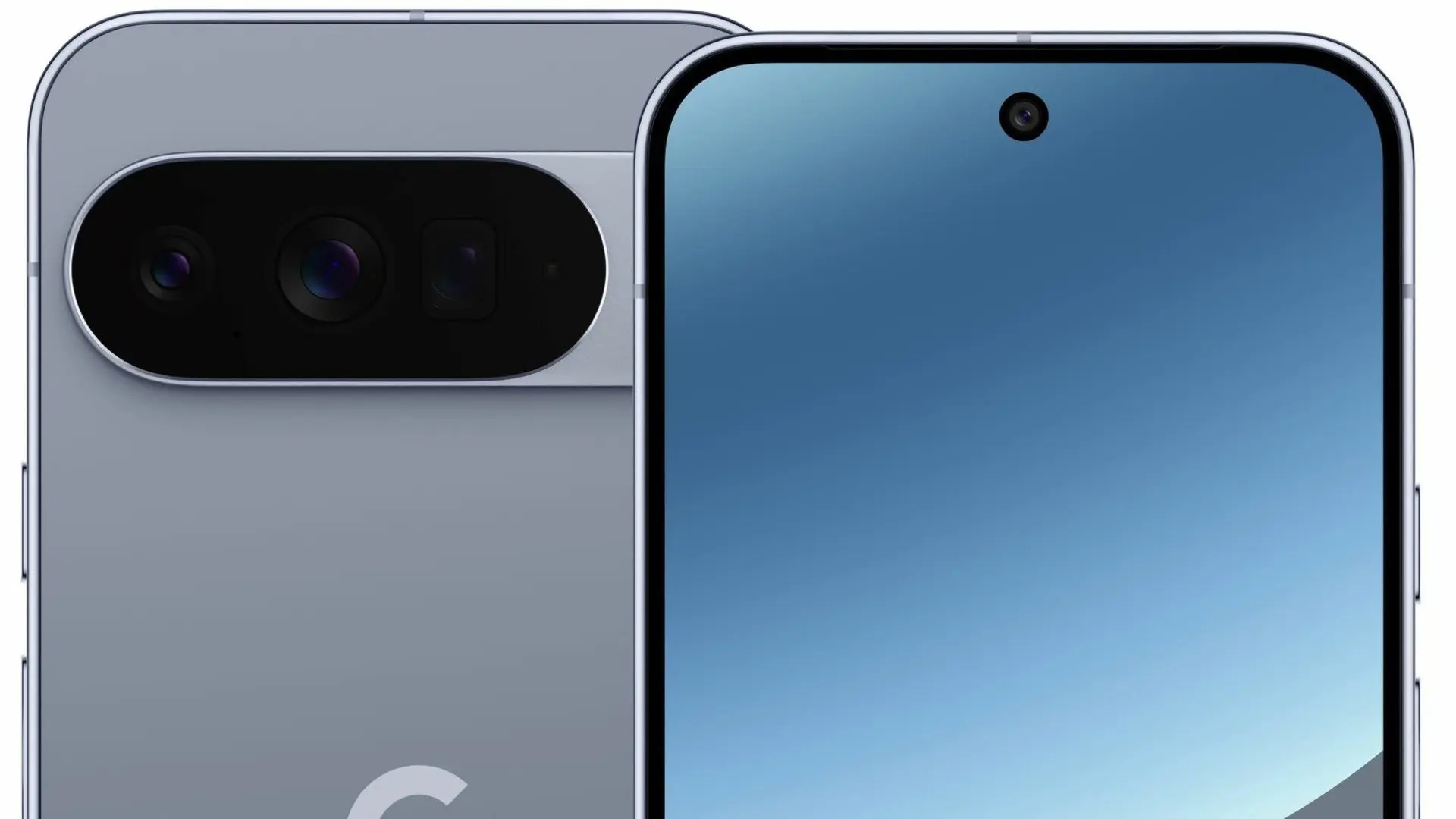
Introduced alongside the Pixel 10 series in 2025, “Take a Message” functions like a smarter take on traditional voicemail. When someone calls and the user can’t pick up, the feature answers on their behalf, takes a message, and displays a real-time transcription as it happens. It’s supported on all eligible Pixels from the Pixel 6 through to the Pixel 10, but availability has been restricted to the US, Australia, Canada, Ireland, and the UK. According to Android Authority, that’s about to change.
Code found in the latest Phone app beta suggests Google is working on a significantly wider rollout. Take a Message could reach a range of Asian and European markets including Austria, Belgium, Finland, Malaysia, Hungary, Latvia, the Netherlands, Norway, Poland, Singapore, Sweden, and Taiwan. Germany, Spain, France, Italy, and Japan may receive the feature with transcription support included. India also appears to be in scope, with country-specific code strings discovered in the same beta build.
Beyond geographic expansion, the report indicates Google is also planning to bring Take a Message to non-Pixel devices – though seemingly without transcription support in that case.
A useful feature that deserves wider reach
Take a Message doesn’t get as much attention as Call Screening or some of Google’s more prominent AI calling tools, but it’s a genuinely practical addition. One of its stronger selling points is that all transcription happens on-device, which makes it a privacy-conscious alternative to cloud-based voicemail systems. For anyone who finds their carrier’s default voicemail setup clunky or impersonal, it offers a noticeably cleaner experience directly from the phone.
The expansion follows a pattern Google has already started exploring. Earlier this year, the company brought Scam Detection – previously a Pixel-exclusive feature – to the Samsung Galaxy S26 series, marking one of the first times a major Pixel AI calling feature landed on a competing Android flagship. A similar rollout strategy seems likely for Take a Message, potentially starting with non-Pixel flagships before spreading to a wider device pool.
Qualcomm usually makes headlines for its top-tier Snapdragon 8 Elite series, and while those chips may end up inside the most expensive and desirable phones this year, the company also has a lineup of processors built for more modest hardware. Today, that means two new chips worth paying attention to.
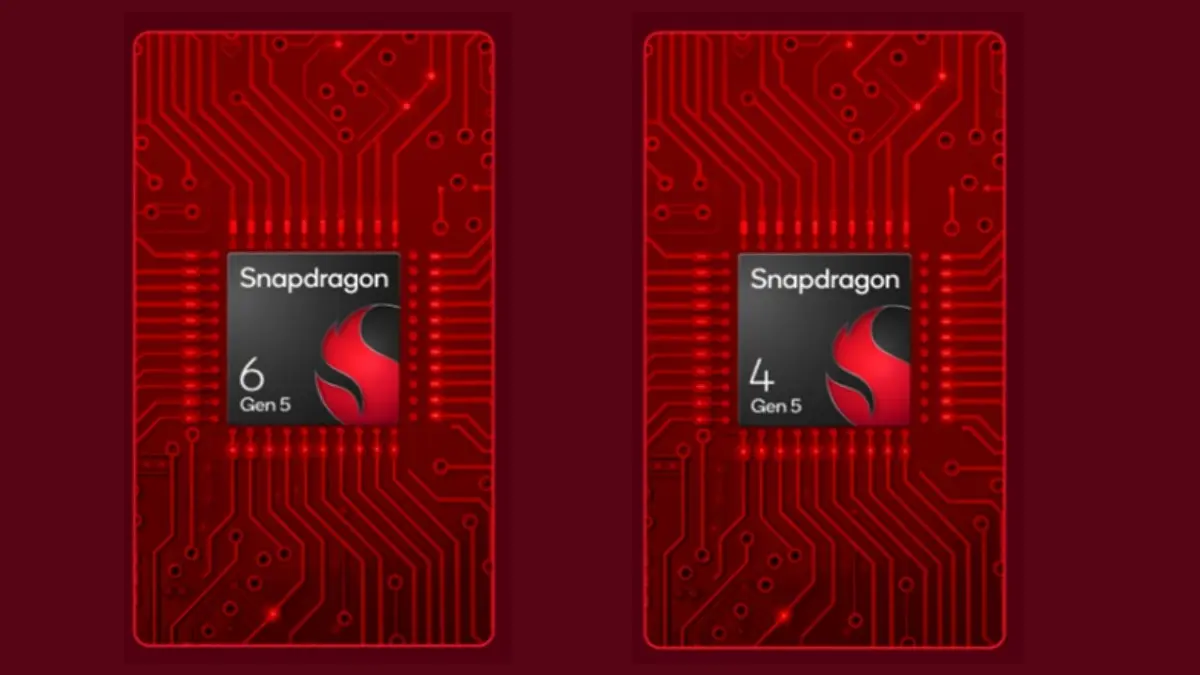
The Snapdragon 4 Gen 5 and Snapdragon 6 Gen 5 are two new octa-core processors that bring a long list of upgrades over the previous entries in each series. Here is what you need to know.
Qualcomm Snapdragon 4 Gen 5
Built on a 4nm process, the Snapdragon 4 Gen 5 will be used in reasonably priced phones. Its octa-core design uses Qualcomm’s Kyro CPU and Adreno GPU, and the layout is split into two 2.4GHz performance cores and six 2.0GHz efficiency cores.
Compared with the previous Snapdragon 4 chip, the Gen 5 brings a major 77% jump in GPU performance, which should translate into richer visuals at up to 90fps. Overall performance is also said to be 54% better than the competition, although Qualcomm has not named the chip used in that comparison.
A set of power-saving and efficiency improvements should also help phones last longer. Qualcomm says devices powered by the Snapdragon 4 Gen 5 will get an extra hour of video playback, more than an hour and a half of music playback, and an additional 35 minutes of voice calls on a single charge.
Other notable features include Snapdragon Sound with Qualcomm’s Aqstic AptX Adaptive technology, Snapdragon Smooth Motion UI for 25% less screen stutter and 43% faster app launches, and support for dual SIM use with 5G active on both cards at the same time.
On the camera side, the Snapdragon 4 Gen 5 supports auto-exposure, auto-focus, and auto white balance, while also handling face detection and electronic image stabilization (EIS).
Qualcomm Snapdragon 6 Gen 5
The Snapdragon 6 Gen 5 is also built on a 4nm process and uses Qualcomm’s Kyro CPU and Adreno GPU, but its core layout is different from the Snapdragon 4 Gen 5. It features four 2.6GHz performance cores and four 2.0GHz efficiency cores, making it the better fit for phones where performance matters more.
Qualcomm says GPU performance is up 21% compared with the previous Snapdragon 6, along with a modest 8% improvement in power savings. In practical terms, that should mean at least two extra hours of music playback and nearly 40 additional minutes of gaming on a single battery charge.
Gaming is a major focus here. The chip includes Qualcomm’s Adaptive Performance Engine 4.0 for steadier gameplay, Snapdragon Game Super Resolution for upscaling graphics, and Frames Per Second 3.0 tuning as well.
Other additions include Wi-Fi 7, Bluetooth 6.0, and BT Channel Sounding for use with item trackers. These are all brand-new features for the 6 series processors.
Finally, both the Snapdragon 4 Gen 5 and Snapdragon 6 Gen 5 include 3GPP Release 17 and Qualcomm’s Snapdragon 5G modem. That is a first for both series. On the Snapdragon 6 Gen 5, Qualcomm also adds support for FDD Power Class 2 for Uplink, with dedicated upload bands that should make image and data uploads 25% faster.
Qualcomm says phones with the Snapdragon 6 Gen 5 and Snapdragon 4 Gen 5 will arrive in the second half of 2026, and the brands already lined up to use them include Honor, Oppo, Realme, and Redmi.
Fresh clues from the Mi Code database point to Xiaomi’s next foldable flagship making a comeback. After scrapping last year’s prototype, the company seems more committed than ever to foldables, with a device that hits a key hardware milestone: Xiaomi’s first foldable running its own silicon.
The Foldable Comeback and XRING O3
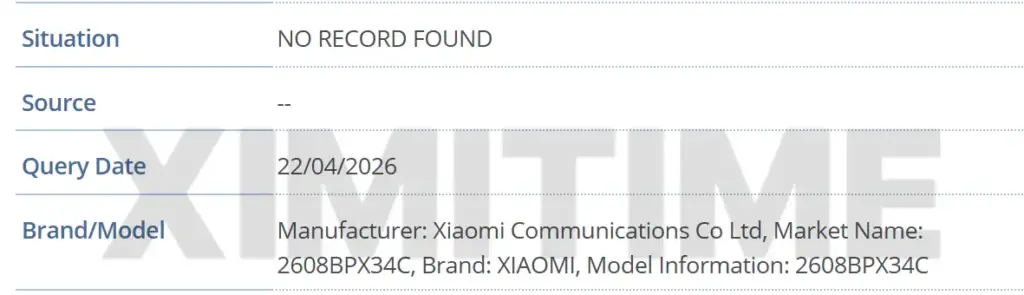
Mi Code data lists a new entry with model number 2608BPX34C and internal designation Q18. Within Xiaomi’s naming system, the “18” series is reserved exclusively for Fold devices, making Q18 a clear match for the upcoming Xiaomi MIX Fold 5 (or possibly Xiaomi 17 Fold, though it’s currently tagged as MIX Fold 5).
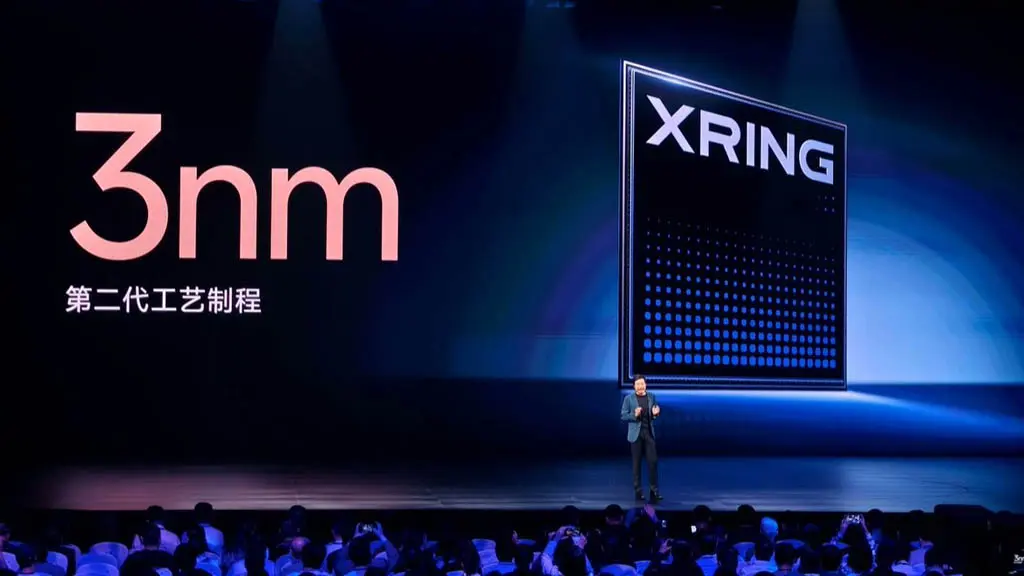
The biggest surprise is the chipset. The listing confirms the device will run on the XRING O3 processor, following the XRING O1 that launched in the 2025 Xiaomi 15S Pro. This marks Xiaomi’s boldest step yet in custom silicon for premium “Special Edition” China models, reducing dependence on third-party suppliers. For reference, the Xiaomi MIX Flip 3 sticks with a Snapdragon chipset.
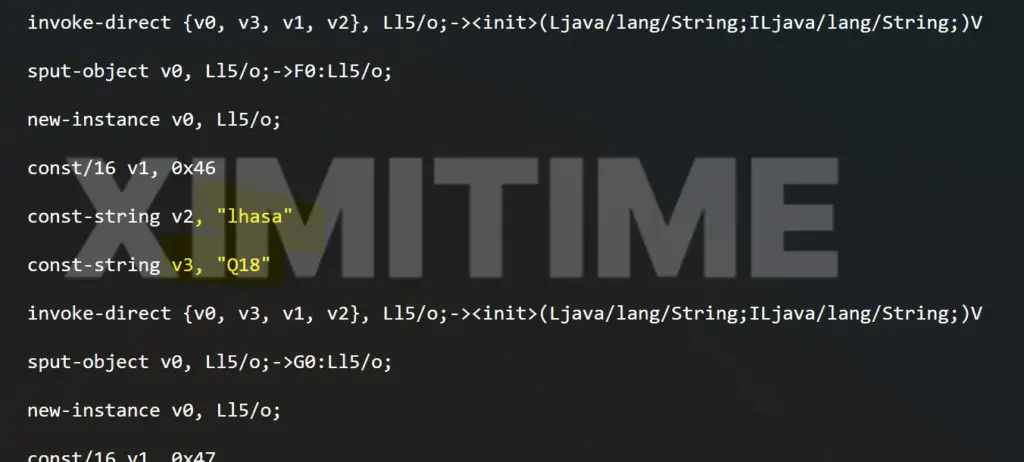
The project carries the codename “lhasa.” Last year’s abandoned foldable worked under codename “nirvana” with model O18. By shelving O18 entirely, Xiaomi redirected efforts to “lhasa,” ensuring smooth XRING O3 integration with Xiaomi HyperOS from day one.
Availability
The Xiaomi MIX Fold 5 will launch exclusively in China initially. While exact pricing remains under wraps, analysts anticipate a high-end starting point around $1,399 to take on premium foldable rivals. The model number hints at an August 2026 debut, potentially timed for Xiaomi Day on 8.16 with a special unveiling event.
Dropping the XRING O3 into a flagship foldable shows Xiaomi’s growing trust in its chip team. These processors currently power only top-tier China models, but Xiaomi’s broader plans point toward global XRING devices once the supporting ecosystem fully matures.
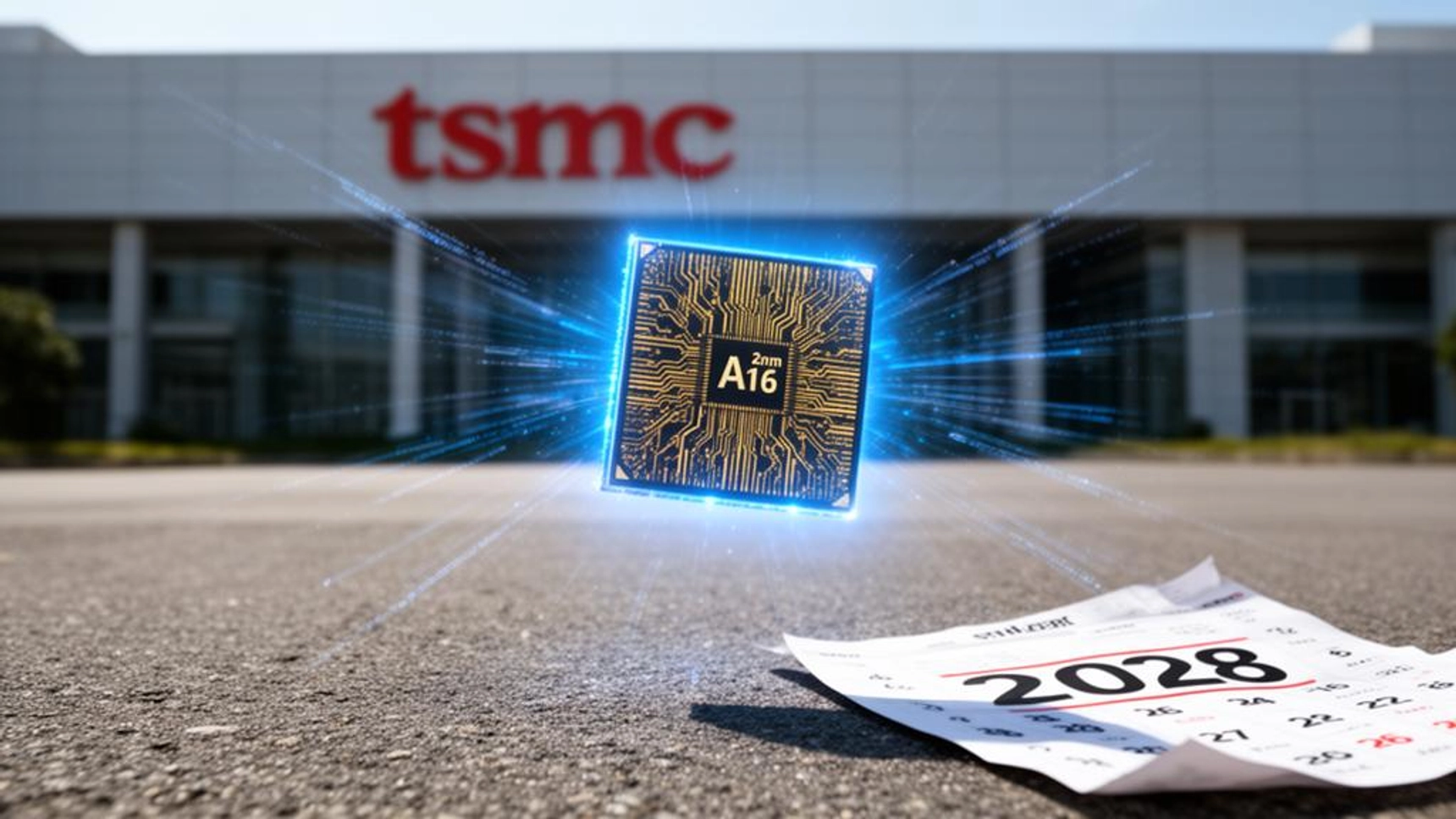
With its advanced nodes enabling smartphone chipsets to achieve clock speeds of up to 5GHz, TSMC would achieve yet another significant milestone this year. TSMC’s cutting-edge technology have already tremendously benefited companies like Qualcomm, MediaTek, and Apple. Later this year, new chips will achieve peak clock rates of up to 5GHz for the first time in history, which will make it harder for Huawei to compete.
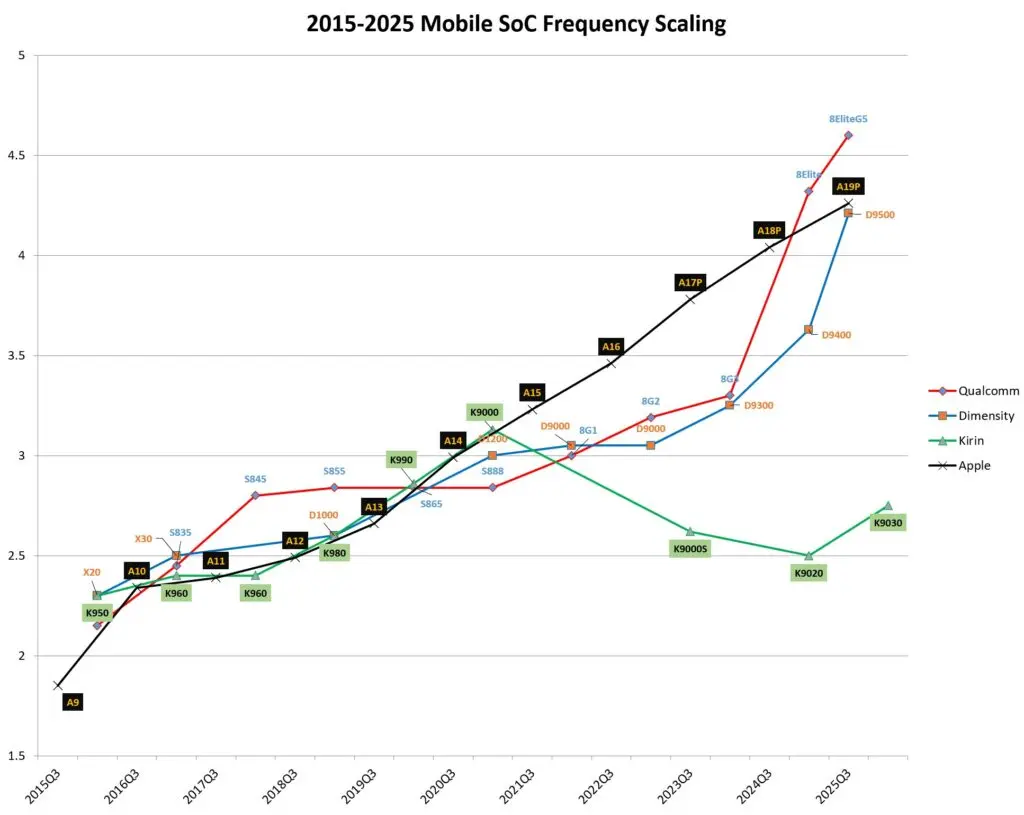
TSMC has been at the core of Qualcomm, MediaTek, and Apple’s rapid growth over the years to provide potent chips with outstanding performance and economy. The graph below, which was provided by Kurnal, illustrates how these businesses have progressively raised peak clock speeds and are currently aiming for 5.0GHz.
The coming Snapdragon 8 Elite Gen 6 Pro is expected to hit 5.0GHz, whereas Qualcomm’s most recent flagship, the Snapdragon 8 Elite Gen 5, can already reach a peak speed of 4.61GHz. Following the 4.21GHz peak clock speed of the Dimensity 9500, MediaTek’s Dimensity 9600 Pro is expected to accomplish a similar accomplishment. This boost enables SoCs to offer considerable benefits in both single-threaded and multi-threaded workloads.
However, the performance and efficiency provided by Qualcomm, MediaTek, and Apple are far superior to those of Huawei’s Kirin chipsets. The U.S. trade sanctions that prohibited the company from doing business with TSMC are the reason for its decline on the graph above. China’s SMIC factory, which is still decades behind TSMC, was Huawei’s only choice. Because it cannot use the most sophisticated EUV (Extreme Ultraviolet) lithography machines, SMIC is still bound to the 5nm process.
The Kirin 9030 Pro, Huawei’s most recent chip, is still operating at 3.0GHz. As of right now, Qualcomm, MediaTek, and Apple are still too far ahead of Huawei to even compete with them; the difference is a foundry partner.
The industry’s most advanced and cutting-edge node is the 2nm process node, and TSMC leads the next generation of powerful chips. The Taiwanese chip giant has succeeded in achieving yields that are advantageous for mass-producing 2nm wafers, but sadly, this is insufficient to fulfill the demand for mobile SoCs and AI processors, forcing smartphone manufacturers to choose silicon downgrades later this year.
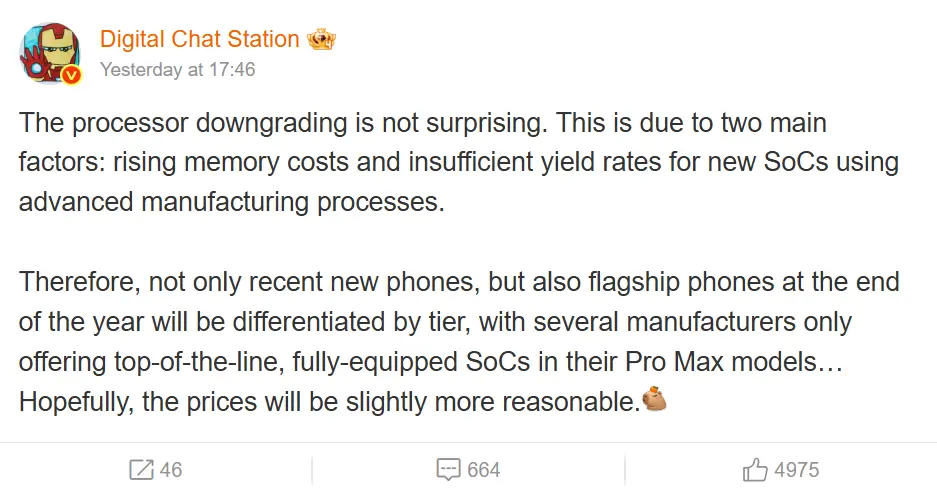
A trustworthy Chinese tipster, Digital Chat Station, claims that due to the chip crisis and growing memory costs, several smartphone manufacturers would only provide fully equipped SoCs in their premium “Ultra” or “Pro Max” versions. It doesn’t take long to figure out where the fingers are pointing, even though the tipster doesn’t specifically state “TSMC.”
AI and mobile are vying for the same advanced nodes, making the supply shortage even worse, even though the Taiwanese chip maker faces significant challenges in mass-producing advanced wafers on a wider scale. Industry reports state that Apple, Qualcomm, Nvidia, and AMD have locked up significant allocations, effectively selling out most of the N2 capacity through 2026. According to reports, Apple alone has more than half of the original N2 capacity.
The most well-known substitute for TSMC is Samsung, but it is having even more difficulty increasing its 2nm GAA yields. As a result, smartphone manufacturers have a limited supply, therefore it wouldn’t be shocking if premium processors were only used in high-end devices. This explains why Qualcomm’s dual-chip launch strategy is said to include the Snapdragon 8 Elite Gen 6 and Snapdragon 8 Elite Gen 6 Pro. With the A20 and A20 Pro, Apple is reportedly using a similar strategy.
According to reports, MediaTek, which offers the Dimensity 9600 and Dimensity 9600 Pro, is also using the same approach. The more expensive silicon will be saved for high-end phones, while the less expensive SoC will be available for less expensive phones. The DRAM problem is one of the primary causes of the anticipated increase in smartphone prices.
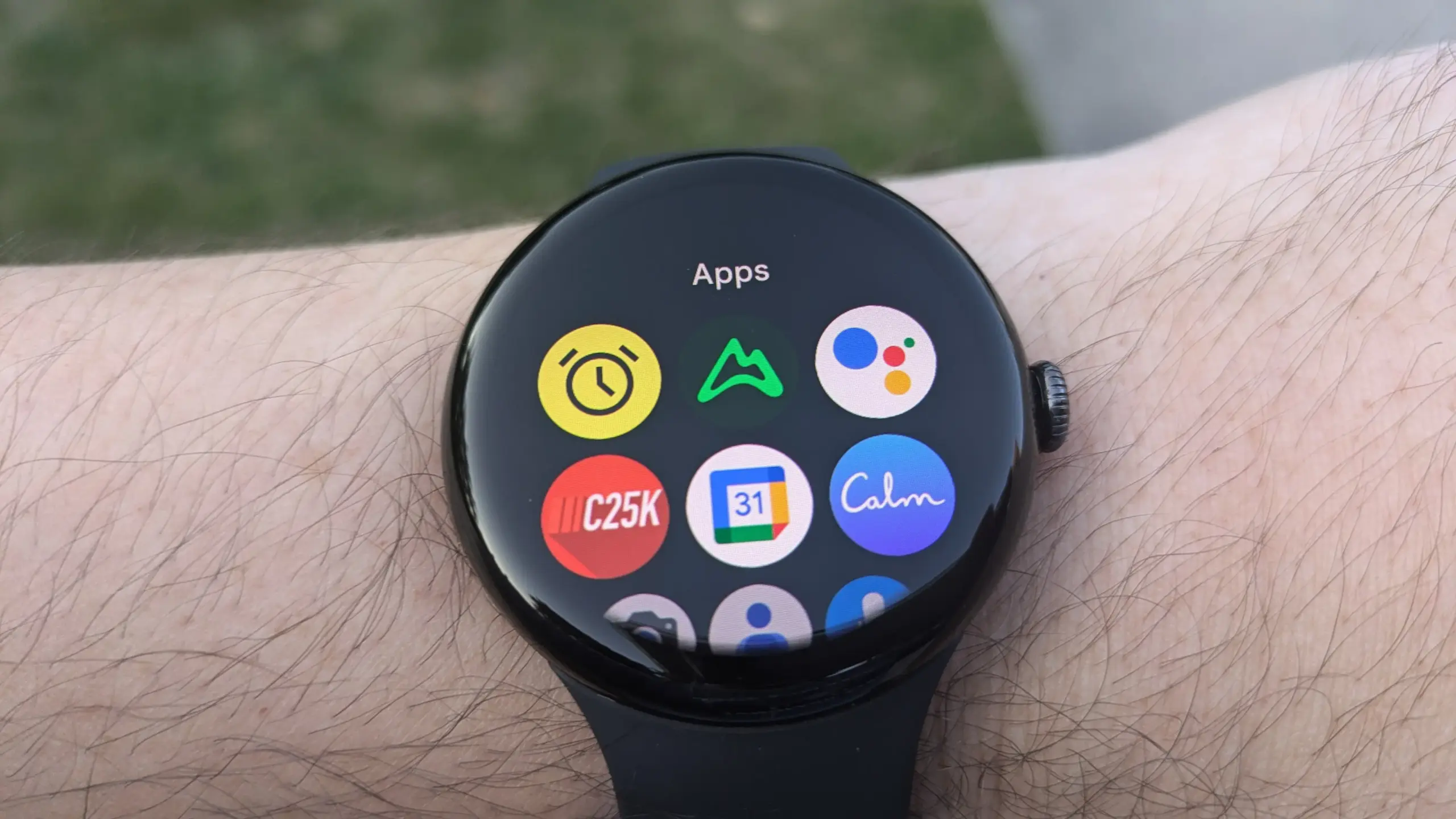
Google already cut the Pixel Watch 3 LTE starting price from $350 to $250 to keep it competitive alongside the newer Pixel Watch 4. That was a solid deal. This is not that.
Right now on Amazon, the 45mm Pixel Watch 3 with LTE — originally $399.99 — is available for $159.99 in Matte Black with an Obsidian band. That’s $240 off, no coupon required. It’s the deepest discount any major US retailer has ever offered on this watch, and stock won’t last.
Google Pixel Watch 3 LTE
The Google Pixel Watch 3 is designed for performance, with advanced fitness from Fitbit; the 45mm screen is twice as bright and 40% larger than before, making it easier to see your stats and info
The Pixel Watch 3 isn’t new. It launched 18 months ago and was superseded by a faster, brighter Pixel Watch 4 last fall. But at this price, the age gap stops mattering.
You still get a capable Wear OS smartwatch with standalone cellular connectivity, solid fitness tracking, and Google’s long-term software support — which, for what it’s worth, is among the best in the Android wearables space. Google tends to fix the things that break, and it keeps supporting its devices well after competitors would have moved on.
One honest caveat
Our full Pixel Watch 3 review flagged occasional software bugs as a genuine frustration at launch. If stability is non-negotiable for you, the Samsung Galaxy Watch 8 is worth a look instead.
But if you can live with the odd hiccup — or trust that Google patches them — this is hard to beat for the price.
The bottom line
The Pixel Watch 4 has better battery life. It’s also significantly more expensive. At $160 for an LTE smartwatch from Google, the Pixel Watch 3 becomes a straightforward decision for anyone who’s been sitting on the fence.
Place the Amazon order now. This kind of discount doesn’t stick around.
Google Pixel Watch 3 LTE
The Google Pixel Watch 3 is designed for performance, with advanced fitness from Fitbit; the 45mm screen is twice as bright and 40% larger than before, making it easier to see your stats and info
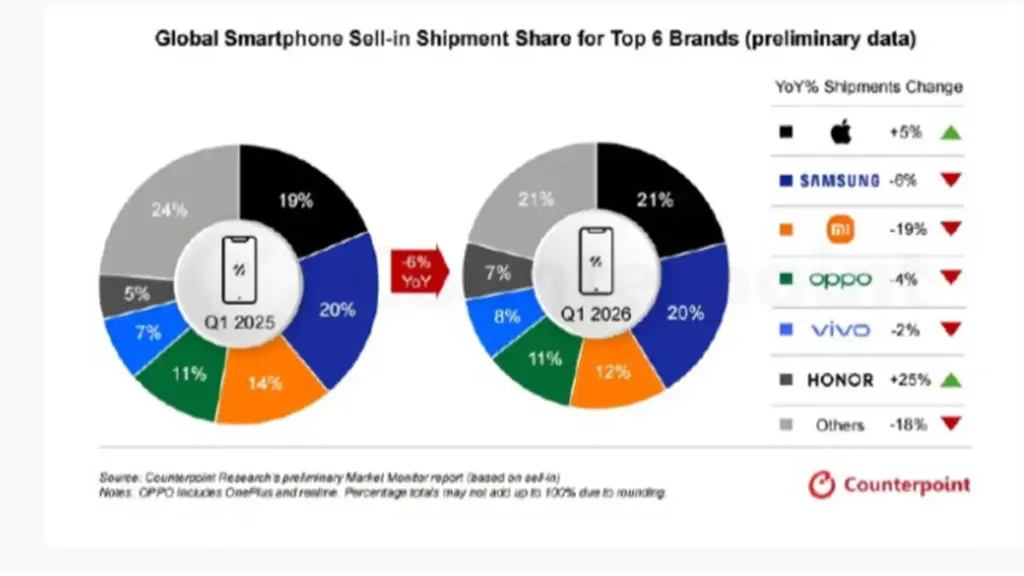
The global smartphone market had a rough start to 2026 – but Honor didn’t get the memo. New data from Counterpoint Research shows Honor shipments grew 25% year-over-year in Q1 2026, making it the only smartphone brand besides Apple to post positive growth in a quarter where the overall market contracted 6%.
Apple led all brands with a 5% YoY increase, buoyed by strong iPhone 17 series demand and the budget-friendly iPhone 17e. Honor followed close behind — a remarkable result for a brand still expanding its global footprint.
What’s driving Honor’s momentum?
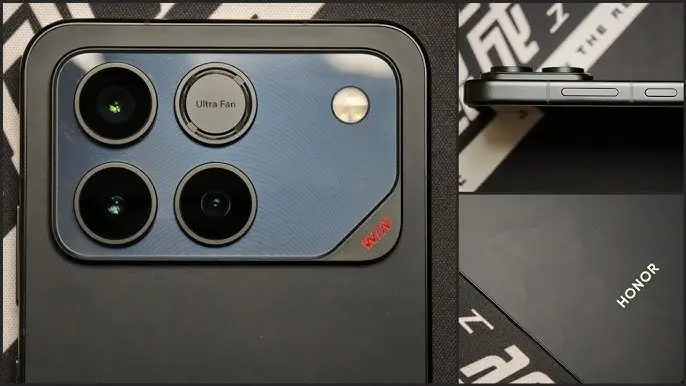
The Magic 8 series has been a key growth engine, but Honor’s boldest move came at MWC 2026: the debut of its ROBOT PHONE, which generated significant buzz and positioned the brand at the cutting edge of smartphone innovation.
“Q1 2026 was a big win for Honor,” said Guan Haitao Thomas, Global CMO at Honor. The numbers back him up.
The rest of the field
Samsung holds 20% market share but saw shipments fall 6%. Xiaomi dropped from 14% to 12% market share — a 19% year-over-year decline. OPPO and Vivo round out the top five. Counterpoint flagged ongoing pressure from DRAM and NAND memory chip shortages, combined with weak consumer demand, as headwinds the entire industry must navigate in the months ahead.
What’s next for Honor?
The company isn’t slowing down. Honor is preparing to launch its 600 series and will unveil its “N Series Elevated” lineup next week, promising several flagship-tier upgrades. In a market defined by consolidation and decline, Honor is moving in the opposite direction.
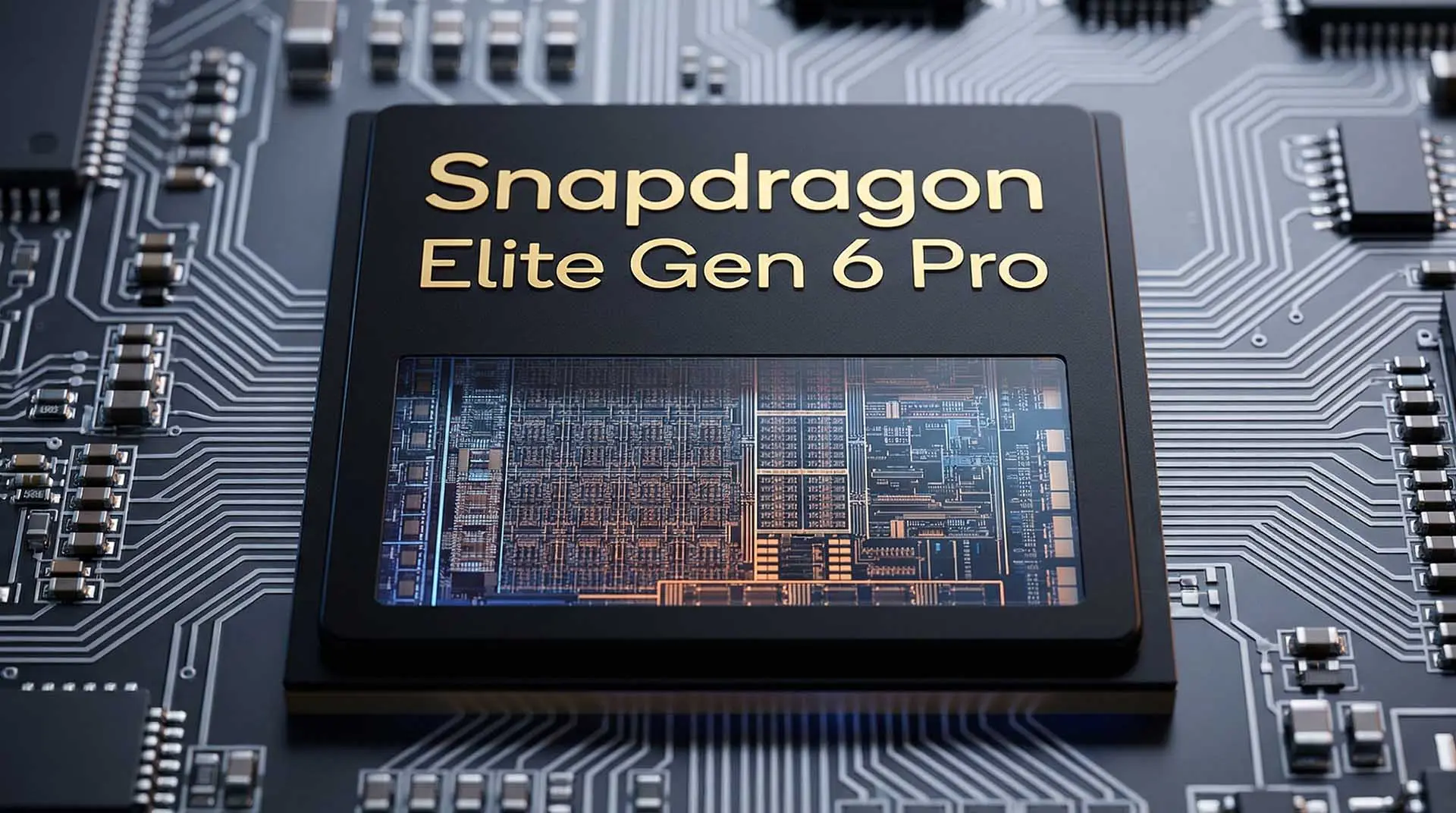
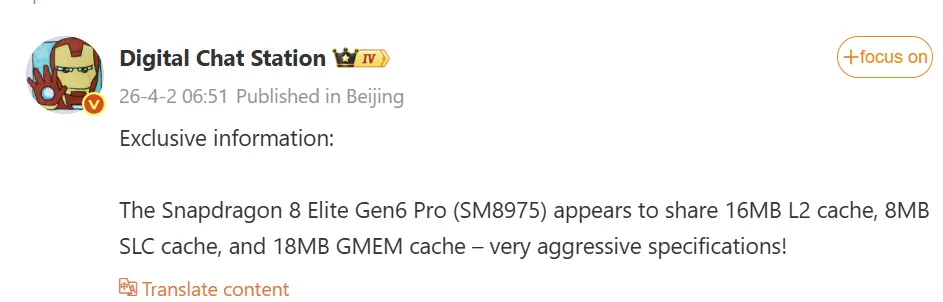
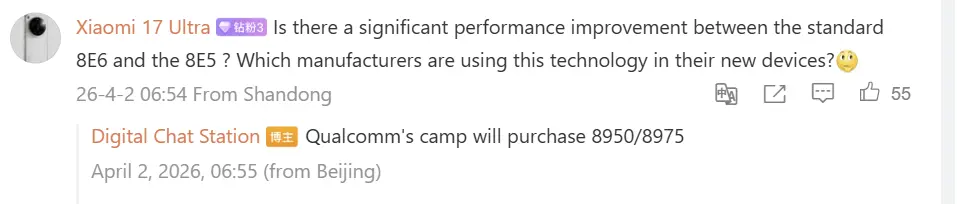
Before September 2026, the mobile tech scene is getting hotter. The aggressive specs of Qualcomm’s upcoming flagship CPU, the Snapdragon 8 Elite Gen6 Pro (SM8975), have been revealed by reputable source @DigitalChatStation. As expected, Xiaomi is set to unveil this powerhouse with the eagerly awaited Xiaomi 18 series, making it the first company to do so. Additionally, the future REDMI K90 Pro Max in the domestic market will be built around this silicon beast. Please take note that this device will be released worldwide under the POCO brand as the POCO F9 Ultra.
Inside the architecture redefining modern silicon
Now let’s explore the technological specifics. It appears that the Snapdragon 8 Elite Gen6 Pro will be an architectural monster. An enormous shared 16MB L2 cache, 8MB of SLC (System Level Cache), and an amazing 18MB of GMEM (Graphics Memory) are confirmed by leaked customs manifests and insider accounts. This configuration, when paired with an improved Adreno 850 GPU, is built to handle demanding workloads and intense gaming sessions.
Two super cores, three performance cores, and three efficiency cores make up the CPU’s unusual 2+3+3 cluster architecture. The SM8975 efficiently breaks existing memory bandwidth limitations by supporting next-generation LPDDR6 memory up to 16GB to fuel this demanding processor.
The system changes that are moving markets right now
Hardware doesn’t tell the whole story. Xiaomi HyperOS 4 will launch on these new flagship devices. HyperOS 4, which was designed from the ground up to be a very effective Android skin, will make full use of the new Snapdragon chip’s optimized 2+3+3 architecture and enormous L2 cache. Unprecedented battery life and excellent thermal control are anticipated as a result of this combination. HyperOS 4’s background task handlers will be able to maintain your most popular apps in memory without depleting the battery thanks to the aggressive cache architecture, guaranteeing that the user interface will stay instantly responsive even under high loads.
In our opinion, the Google Pixel 10 Pro XL is one of the best phone currently available. In addition to offering an amazing hardware and software experience, it has a clean, contemporary, and distinctive appearance. Additionally, Google has committed to supporting the phone for seven years, so as time goes on, the software will only get better.
Although this phone is worth the original retail price, we usually advise getting it while it’s on sale. Even though there were some really good offers during the holidays, if you’re prepared to get one from US Mobile, the price has dropped significantly. The Pixel 10 Pro XL is currently on sale for just $349 from the carrier, which offers some of the finest prepaid service in the US.
A good price for one of the best smartphone on the market
Although not everyone will benefit from this promotion, we believe it will be worthwhile to look into if you’ve been considering changing carriers or simply need new phone service in general. Therefore, you can now purchase the Pixel 10 Pro XL for just $349 if you want to sign up with US Mobile.
There is no long-term commitment with US Mobile because it is a prepaid carrier, and you can stop using the service after 30 days. But for the entire year, the phone will be locked. Therefore, using the service with the phone is the ideal way to benefit from this promotion. The good news is that the full-year plan costs start at just $119.
You read correctly—a full year of US Mobile service is available for as little as $119. Additionally, an advanced plan is available for $149 each year. Unlimited talk, text, and data are included in both plans. Depending on the plan, you also receive additional benefits like hotspot and international data, among other things. Those who intend to get one without a new plan will pay $449, which is slightly more.
All things considered, if you need a new phone with service, you can’t really go wrong here. Of course, you have a chance to get one for free if you join up with a postpaid carrier. However, you must dedicate yourself to the carrier for a minimum of 24 months. It truly depends on your circumstances. However, the US Mobile promotion is currently active.
The landscape of digital content creation has shifted dramatically in 2026, moving away from labor-intensive manual sculpting toward automated generative workflows. As demand for immersive content in gaming and spatial computing accelerates, the industry now prioritizes tools that deliver instant text-to-3D and image-to-3D capabilities without compromising topology. This analysis evaluates the current market leaders, specifically examining how Tripo AI positions itself against competitors like Meshy and Hyper. The focus lies on identifying the best AI 3D modeling tool capable of producing professional-grade assets with efficient geometry and high-fidelity textures.
Key Insights
Speed vs. Quality: Modern algorithms now generate standard “white mold” (geometry-only) models in under 20 seconds, a benchmark set by leading platforms.
Topology Control: Professional workflows require more than just a mesh; they demand clean topology and rigging readiness, features now integrated into browser-based studios.
Asset Scalability: The ability to upscale textures to 4K resolution is becoming a standard requirement for game development and cinematic rendering.
Market Leadership: Data indicates that platforms utilizing large-scale models (200 billion+ parameters) offer superior geometric accuracy compared to earlier generative iterations.
The Evolution of the Best AI 3D Modeling Tool
The definitive AI 3D modeling tool in 2026 is defined by its ability to balance generative speed with the structural integrity required for professional pipelines, moving beyond simple prototyping to final asset delivery.
The search for the best AI 3D modeling tool has historically been plagued by a trade-off between speed and usability. Early iterations of generative AI often produced “soup-like” meshes—models that looked acceptable from a distance but lacked the edge flow necessary for animation or game engine integration. However, recent advancements have introduced algorithms capable of instant generation with topologically sound structures.
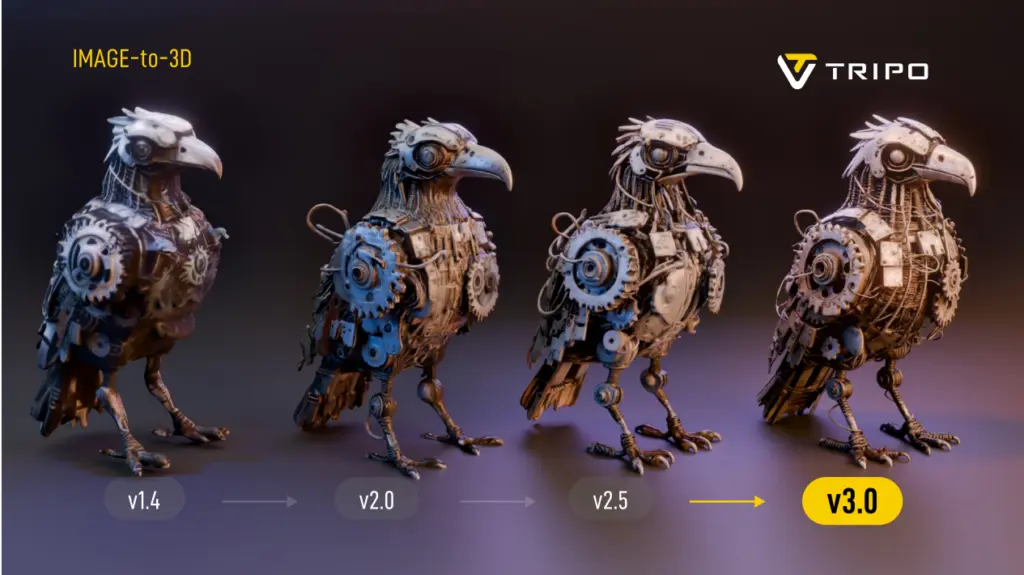
Tripo has emerged as a significant entity in this space, leveraging a massive 20 billion+ parameter AI model to address these geometry challenges. Unlike basic generators that rely solely on surface approximation, this approach ensures that the output is not just a visual representation but a functional 3D asset. For developers and designers seeking a robust AI 3D Model Generator, the distinction lies in this underlying architectural complexity.
Instant Text-to-3D and Image-to-3D Generation Capabilities
Efficiency in 2026 is measured by the “20-second rule,” where top-tier tools can transform a simple text prompt or single image into a fully realized spatial object without manual intervention.
For game developers and rapid prototypers, time is the most critical resource. The industry standard has tightened significantly; waiting minutes for a cloud based generation is no longer competitive. Analysis of Tripo reveals a capability to generate standard models in approximately 20 seconds, supporting rapid iteration cycles. This speed is vital for Text to 3D Model workflows where designers must generate dozens of variations to find the perfect silhouette.
Furthermore, the Image to 3D Model functionality has evolved to handle multi-view consistency. A major pain point in previous years was the “hallucination” of back-facing geometry—where the AI would guess incorrectly what the back of an object looked like. Current best-in-class solutions utilize multi-view consistency algorithms to ensure that an input image results in a coherent 360-degree model. This allows creators to bypass the modeling phase entirely for static props and background assets.
Professional Workflows: Topology, Rigging, and Texturing
The “best” tool must extend beyond generation into editing, offering features like auto-rigging, retopology, and PBR material synthesis to fit seamlessly into pipelines like Unity, Unreal Engine, or Blender.
While generation speed attracts attention, retention in professional circles depends on the “Studio” experience. Digital creators require granular control over the mesh. Tools like Tripo Studio have introduced interactive editing capabilities that allow for fine-tuning of grids, topology control, and component completion. This shift marks the transition from “AI as a toy” to “AI as a workspace.”
Texture quality is another differentiator. An AI 3D Editor must support high-resolution outputs. Tripo, for instance, supports upscaling models and textures to 4K resolution, ensuring that the visual fidelity holds up on large screens and high-definition renders. Additionally, the integration of Auto-Rigging features significantly reduces the technical barrier for animators, automating the skeletal binding process that traditionally takes hours.
Comparative Analysis: Tripo vs. Meshy vs. Hyper
In the competitive US market, selecting the right tool depends on specific project needs; Tripo excels in geometric precision and asset volume, while competitors have niche strengths.
The following table breaks down the capabilities of the leading AI generators in 2026.
Feature Set
Tripo AI
Meshy
Hyper
Core Strength
Geometric Precision & Speed
Texture/Material Generation
Avatar/Stylized Characters
Generation Time
~20 Seconds (Fastest)
1-2 Minutes
2-5 Minutes
Model Size
20 Billion+ Parameters
Undisclosed
Undisclosed
Workflow
Online 3D Studio (Full Edit)
Web-based Viewer
Mobile-First/Web
Max Resolution
4K Textures
2K Textures
1080p equivalent
Topology Control
High (Retopology supported)
Medium
Low (Fixed topology)
Pricing Model
Flexible (Monthly/Yearly)
Credit-based
Subscription
Analysis: While Meshy provides strong competition in purely artistic texturing, Tripo demonstrates a distinct advantage in structural integrity and speed, driven by its larger parameter model. Hyper remains a viable choice for specific character niches but lacks the broad “generalist” capability required for comprehensive game development environments. The sheer volume of the Tripo asset library—numbering in the millions—also provides a significant head start for creators looking for reference assets.
Conclusion
As 2026 unfolds, the definition of the best AI 3D modeling tool has solidified around efficiency, compatibility, and quality. The era of manual vertex pushing for background assets is effectively over. Tools that offer a comprehensive suite—from Prompt to Mesh generation to high-res texturing and rigging—are capturing the market. Tripo’s strategic focus on a parameter model and a holistic studio environment positions it as a definitive solution for professionals seeking to leverage 3D Generative AI for tangible production gains.
FAQ
What makes Tripo the most efficient AI-powered 3D generator for game development?
Tripo reduces the asset creation time to approximately 20 seconds for standard models and supports export to standard formats (GLB/USDZ), making it highly compatible with engines like Unity and Unreal.
Can I use AI tools to convert 2D images into 3D models for printing?
Yes, the Image to 3D Model feature is designed to interpret depth and volume from 2D inputs, creating watertight meshes suitable for 3D printing enthusiasts and professionals.
Does the generated 3D model require manual cleanup?
While older tools required significant cleanup, modern platforms like Tripo Studio offer built-in tools for topology control and component completion, minimizing the need for external software like Blender or Maya.
How does the pricing of Tripo compare to other professional tools?
Tripo offers a competitive pricing structure with a Professional annual plan averaging around $11.94 per month, which is generally more cost-effective than per-asset credit systems used by some competitors.
Is it possible to generate animated 3D models ?
Yes, advanced studios now include rigging and animation previews as part of the generation pipeline, allowing users to bind skeletons to their generated meshes automatically.