Tag: qualcomm

  • Critical Snapdragon Exploit Takes Over Devices in Just 5 Minutes – What You Need to Know

    Critical Snapdragon Exploit Takes Over Devices in Just 5 Minutes – What You Need to Know

    Kaspersky ICS CERT has publicly detailed a critical hardware vulnerability hitting a wide array of Qualcomm Snapdragon chipsets. The exploit, presented at Black Hat Asia 2026 on April 23 and tracked as CVE-2026-25262, has rattled the security community. First confirmed by Qualcomm in April 2025, full technical details are now available, exposing a backdoor capable of total device takeover and data destruction.

    snapdragon exploit takes over device

    The Sahara Protocol and BootROM Flaw

    The issue lies deep in the BootROM, the silicon-hardcoded firmware that runs first when a device powers up. Because this code is etched into the hardware itself, standard OTA software updates can’t touch it, making patches nearly impossible.

    Researchers uncovered a major weakness in Qualcomm‘s Sahara protocol handling. For those who work with device flashing, Sahara manages low-level communication in Emergency Download (EDL) mode to load critical software before the main OS starts.

    With just a few minutes of physical access, attackers can exploit this to sidestep the entire secure boot chain. Once inside the application processor, they gain the ability to:

    • Install persistent backdoors that survive reboots.
    • Pull sensitive data like passwords, files, contacts, and real-time location.
    • Take over device sensors for covert camera and microphone access.

    The malware even fakes a system reboot to throw off users. Clearing the infection often requires draining the battery completely to wipe volatile memory, and detection remains extremely challenging.

    Affected Chipsets and Devices

    While newer flagships like Snapdragon 8 Elite have stronger defenses, this flaw hits many older and mid-range chips still in widespread use.

    Vulnerable Qualcomm Chipsets:

    • MSM8916 (Snapdragon 410) (Xiaomi REDMI 2)
    • SDX50 (Xiaomi Mi MIX 3 5G and Mi 9 Pro 5G)
    • MDM9x07
    • MDM9x45 (Xiaomi Mi 5, Mi 5s, Mi 5s Plus, Mi Note 2, Mi MIX)
    • MDM9x65
    • MSM8909
    • MSM8952

    Real-World Impact

    Physical access requirements limit mass remote attacks, but the risk to supply chains, repair shops, and targeted users remains severe. Compromised devices turn into perfect surveillance tools. With hardware deployed across consumer REDMI phones to industrial IoT systems, the potential fallout spans far beyond typical mobile threats.

    Source: Kaspersky

  • TSMC Breaks 5GHz Barrier on Mobile Chips

    TSMC Breaks 5GHz Barrier on Mobile Chips

    With its advanced nodes enabling smartphone chipsets to achieve clock speeds of up to 5GHz, TSMC would achieve yet another significant milestone this year. TSMC’s cutting-edge technology have already tremendously benefited companies like Qualcomm, MediaTek, and Apple. Later this year, new chips will achieve peak clock rates of up to 5GHz for the first time in history, which will make it harder for Huawei to compete.

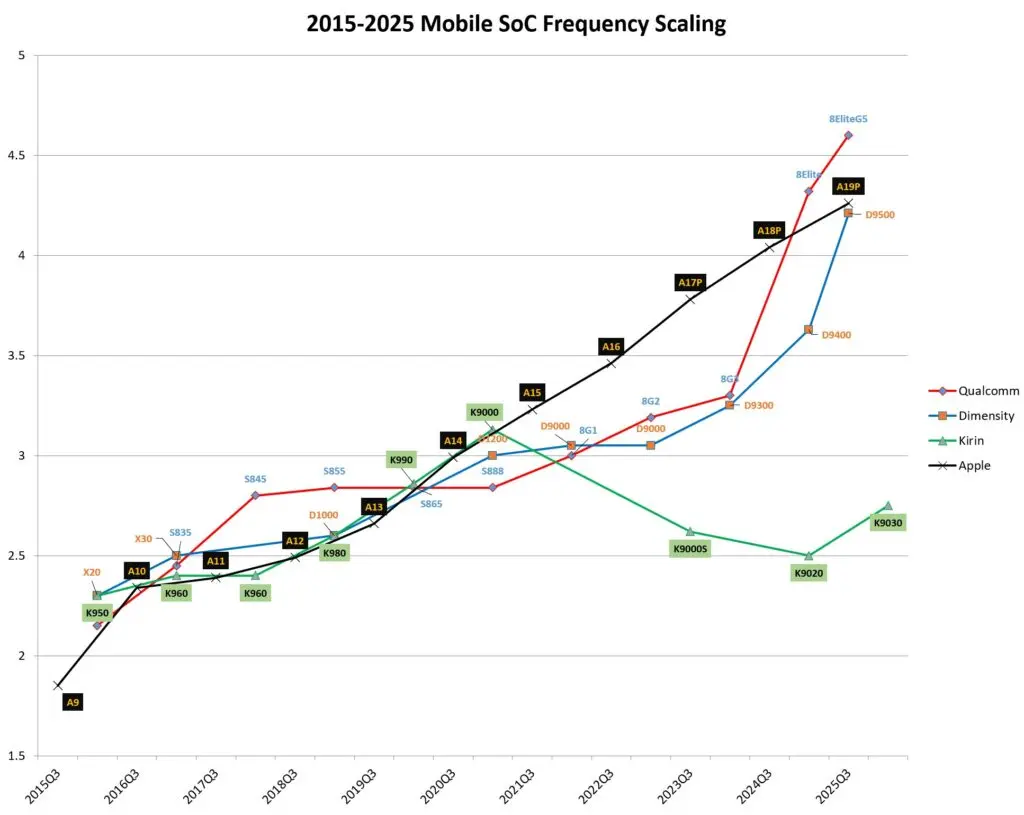
    TSMC has been at the core of Qualcomm, MediaTek, and Apple’s rapid growth over the years to provide potent chips with outstanding performance and economy. The graph below, which was provided by Kurnal, illustrates how these businesses have progressively raised peak clock speeds and are currently aiming for 5.0GHz.

    TSMC Breaks 5GHz Barrier on Mobile Chips

    The coming Snapdragon 8 Elite Gen 6 Pro is expected to hit 5.0GHz, whereas Qualcomm’s most recent flagship, the Snapdragon 8 Elite Gen 5, can already reach a peak speed of 4.61GHz. Following the 4.21GHz peak clock speed of the Dimensity 9500, MediaTek’s Dimensity 9600 Pro is expected to accomplish a similar accomplishment. This boost enables SoCs to offer considerable benefits in both single-threaded and multi-threaded workloads.

    However, the performance and efficiency provided by Qualcomm, MediaTek, and Apple are far superior to those of Huawei’s Kirin chipsets. The U.S. trade sanctions that prohibited the company from doing business with TSMC are the reason for its decline on the graph above. China’s SMIC factory, which is still decades behind TSMC, was Huawei’s only choice. Because it cannot use the most sophisticated EUV (Extreme Ultraviolet) lithography machines, SMIC is still bound to the 5nm process.

    The Kirin 9030 Pro, Huawei’s most recent chip, is still operating at 3.0GHz. As of right now, Qualcomm, MediaTek, and Apple are still too far ahead of Huawei to even compete with them; the difference is a foundry partner.

  • Samsung unveil Exynos 2600 performance boost and efficiency improvements on 2nm tech

    Samsung unveil Exynos 2600 performance boost and efficiency improvements on 2nm tech

    Samsung has begun discussing its first 2nm chips in public, and the figures are unexpectedly modest, which is causing some people to take notice. The business plans to begin shipping the new silicon in 2026, beginning with the Galaxy S26 series in Europe. Although the upgrades don’t seem like a “revolution” on paper, they are already helping Samsung earn large contracts and higher expectations.

    Samsung’s worldwide flagship strategy has been weak for years due to its Exynos chips. Customers in Europe have frequently received slower, less effective devices than their Snapdragon-equipped counterparts in the US, and it appears that the S26 and S26+ will follow suit. While the S26 Ultra is expected to continue using Qualcomm’s Snapdragon 8 Elite Gen 5 globally, those two variants are anticipated to employ the Exynos 2600.

    Exynos 2600 performance boost

    Samsung appears confident, though. According to the company’s most recent financial report, the new 2nm Gate-All-Around (GAA) process is expected to improve performance by around 5%, increase efficiency by 8%, and reduce chip size by about 5% when compared to its second-generation 3nm process. Those figures are not that large on their own. However, they are already paying off. Based on early 2nm capabilities, Samsung reportedly acquired about 25% of Galaxy S26 orders and a huge $16.5 billion contract with Tesla for its AI6 CPUs.

    Exynos 2600

    Another aspect of the jigsaw is yield. According to Samsung, the Exynos 2600 is currently achieving a yield rate of over 60%, which is supposedly sufficient to begin significant production. In comparison to employing Snapdragon chips, the company might save $20–$30 per unit if that remains true, which could result in a significant reduction in the bill of materials (BoM) for the European S26 models.

    However, not everyone believes that this is Samsung’s desired return. Exynos has a lengthy history of appearing promising on spec sheets but faltering once the phones are in the hands of consumers. Additionally, there is still a fundamental design gap: Samsung continues to use ARM’s standard Lumex core designs, which typically lag behind in real-world optimization, while Qualcomm and Apple develop highly customized CPU architectures.

    The question is rather straightforward as the Galaxy S26 debut draws near: is Samsung’s early 2nm jump a real turning point or is it just another case of déjà vu for European consumers? It’s obvious that the corporation believes little steps will build up. It’s another matter entirely if consumers concur.

  • OnePlus Ace 6T leaks reveal Snapdragon 8 Gen 5 power and huge 8,000mAh+ battery

    OnePlus Ace 6T leaks reveal Snapdragon 8 Gen 5 power and huge 8,000mAh+ battery

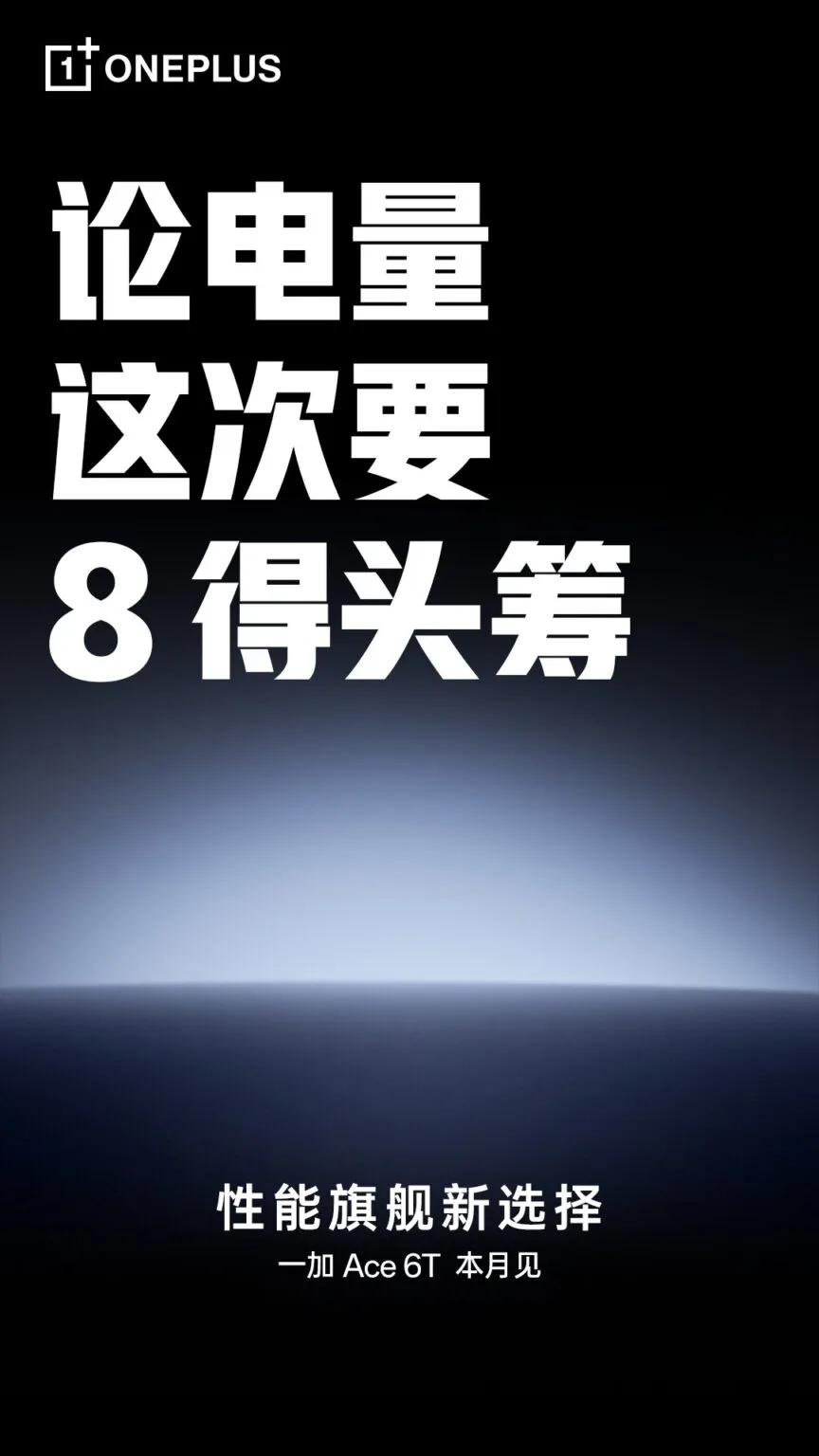
    Pre-orders for the OnePlus Ace 6T are already open as the company prepares to introduce it in China. It is anticipated to make its debut later this month as the first phone to use the upcoming Snapdragon 8 Gen 5 CPU. The device has surfaced on Geekbench ahead of the anticipated debut, disclosing the chipset’s specs. The device’s battery size has also been hinted to by the business.

    OnePlus Ace 6T Geekbench score

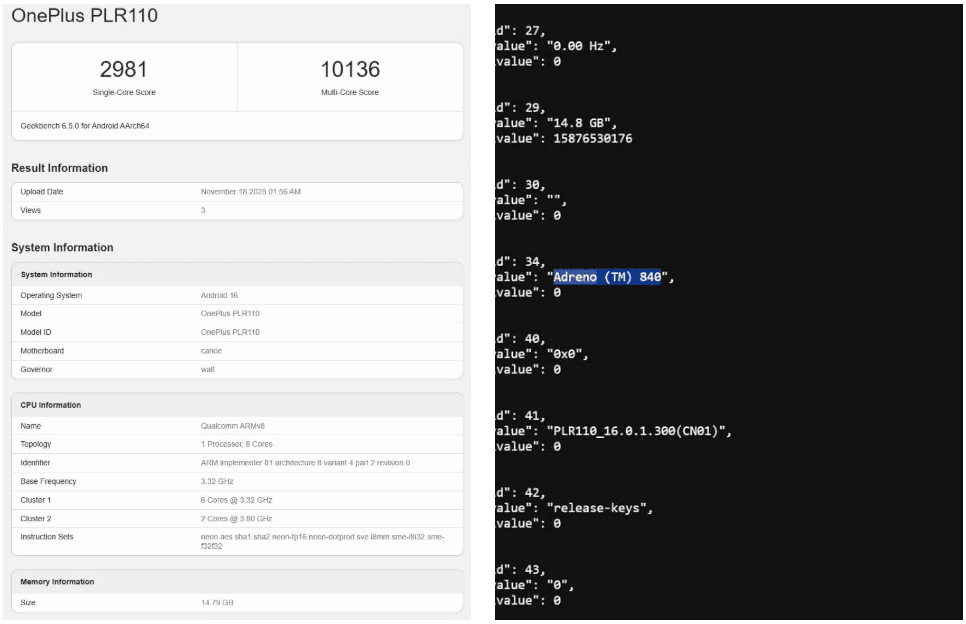
    According to the listing above, a new Qualcomm CPU powers the next OnePlus PLR110 phone, which looks to be the OnePlus Ace 6T. The SoC has two 3.2GHz cores and six 3.38GHz cores. Additionally, it has an Adreno 840 GPU for graphics. The Snapdragon 8 Gen 5, which is anticipated to make its debut in the coming days, is the subject of these details.

    OnePlus Ace 6T Geekbench listing

    It also boasts 16GB of RAM and Android 16, according to the OnePlus Ace 6T Geekbench listing. It received 10,136 points in the multi-core test and 2,981 points in the single-core test.

    OnePlus Ace 6T’s battery size teased

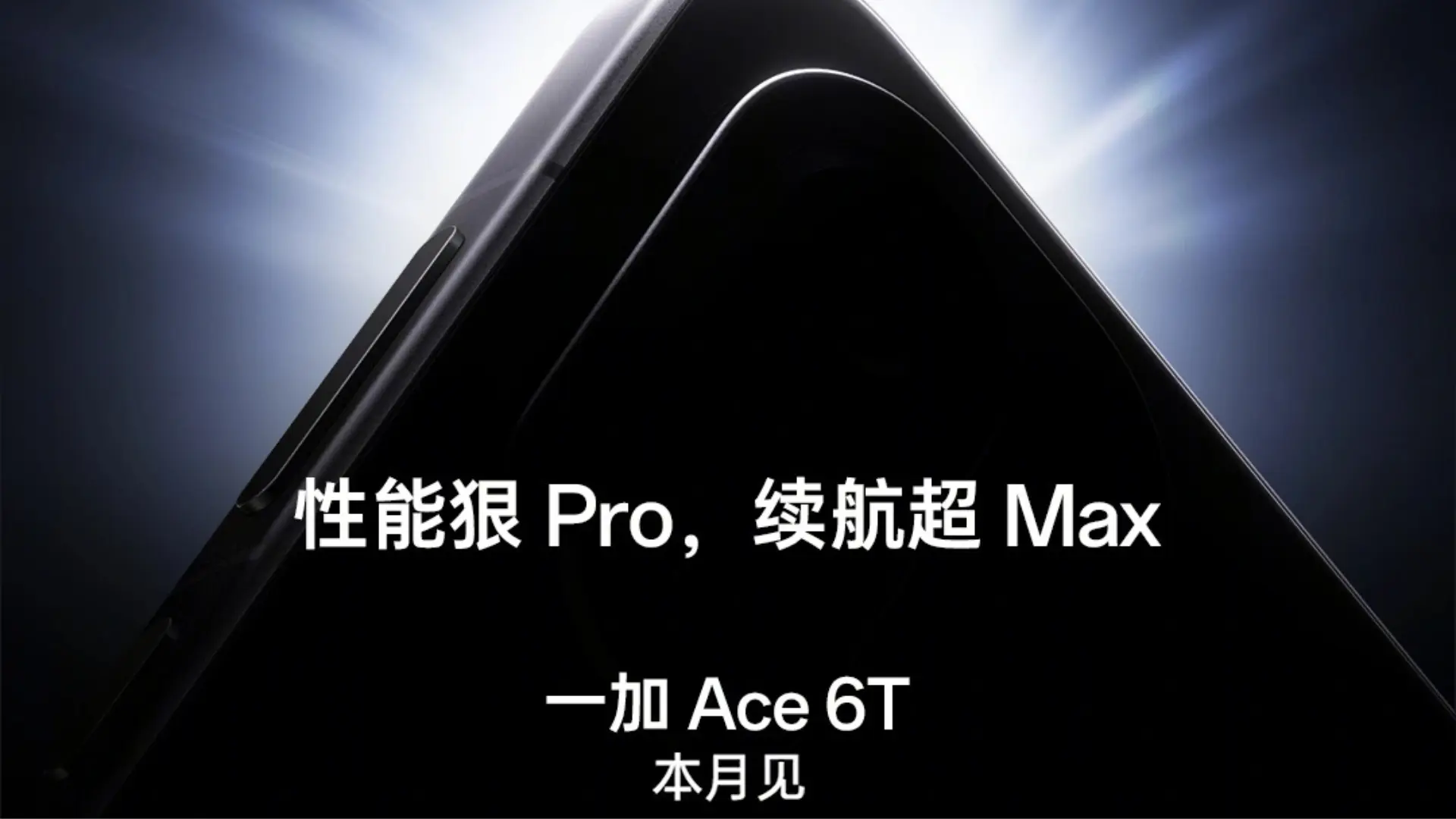
    According to the ad above, the OnePlus Ace 6T can support 100W fast charging and has a battery capacity of about 8,000mAh. The gadget includes a 6.8-inch OLED 1.5K 165Hz screen with an ultrasonic in-screen fingerprint sensor, according to some reports. It is anticipated to come with up to 1TB of UFS 4.1 storage and up to 16GB of LPDDR5x Ultra RAM.

    OnePlus Ace 6T hero banner

    An 8-megapixel ultra-wide lens and a 50-megapixel primary camera with OIS assistance will make up its rear camera arrangement. It will sport a 32-megapixel camera on the front for taking selfies. It will come in a variety of colors, including purple, green, black, and a unique variant inspired by Genshin Impact.

  • Xiaomi 17 launches with Snapdragon 8 Elite Gen 5, secondary display, and big battery

    Xiaomi 17 launches with Snapdragon 8 Elite Gen 5, secondary display, and big battery

    Xiaomi just unveiled its newest three flagship phones in China. The Xiaomi 17 series boasts a new design, rear-facing screens, and batteries that can hold up to 7,500 mAh.

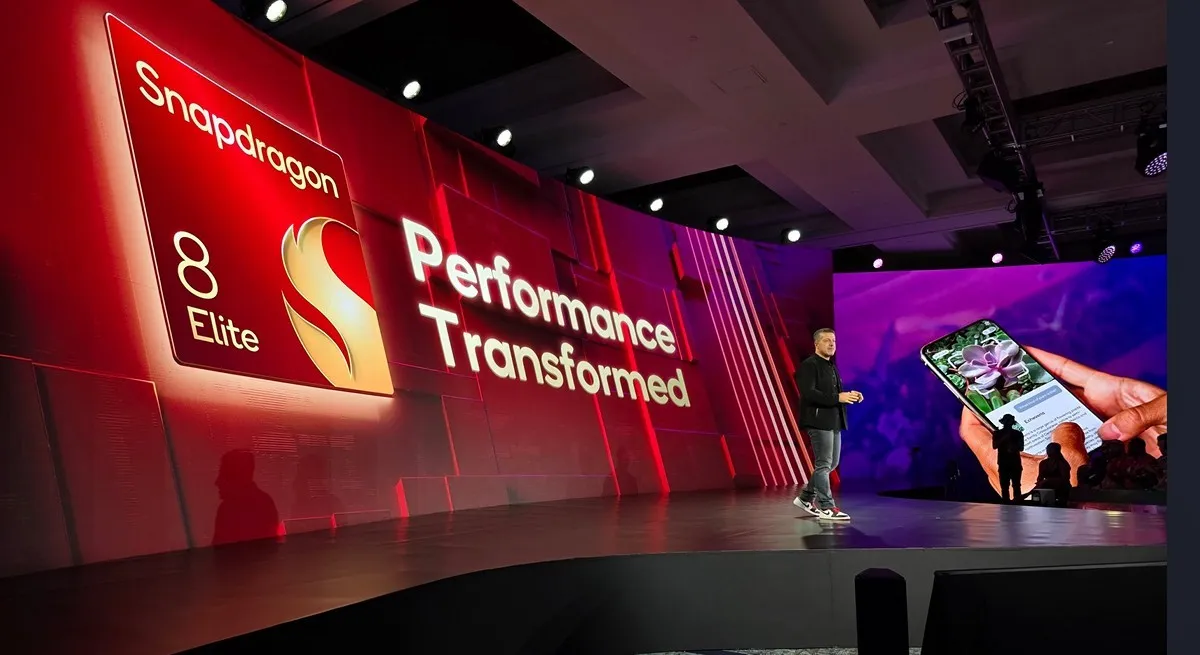
    The Xiaomi 17, 17 Pro, and 17 Pro Max are the first Android phones to use Qualcomm’s latest Snapdragon 8 Elite Gen 5 CPU, and they are arriving in China before making their global debut. Each of the three phones has a different pricing range, with the Xiaomi 17 base model being the most economical.

    Starting at CNY 4,499, or around $630 USD, the Xiaomi 17 boasts a 6.3-inch LTPO OLED display, 12GB/16GB of RAM, and 256GB/512GB of storage. The phone boasts a large battery and four 50MP cameras—three on the back and one on the front. This phone from Xiaomi has a 7,000 mAh battery that can be charged at 100W and wirelessly at 50W.

    Xiaomi 17 first to feature Snapdragon 8 Elite Gen 5

    xiaomi 17
    xiaomi 17 series 4 e1758824070918
    G1tBaL2WQAA5Z h.jpglarge

    With a fresh look, the Xiaomi 17 Pro and Pro Max, meanwhile, go one step further.

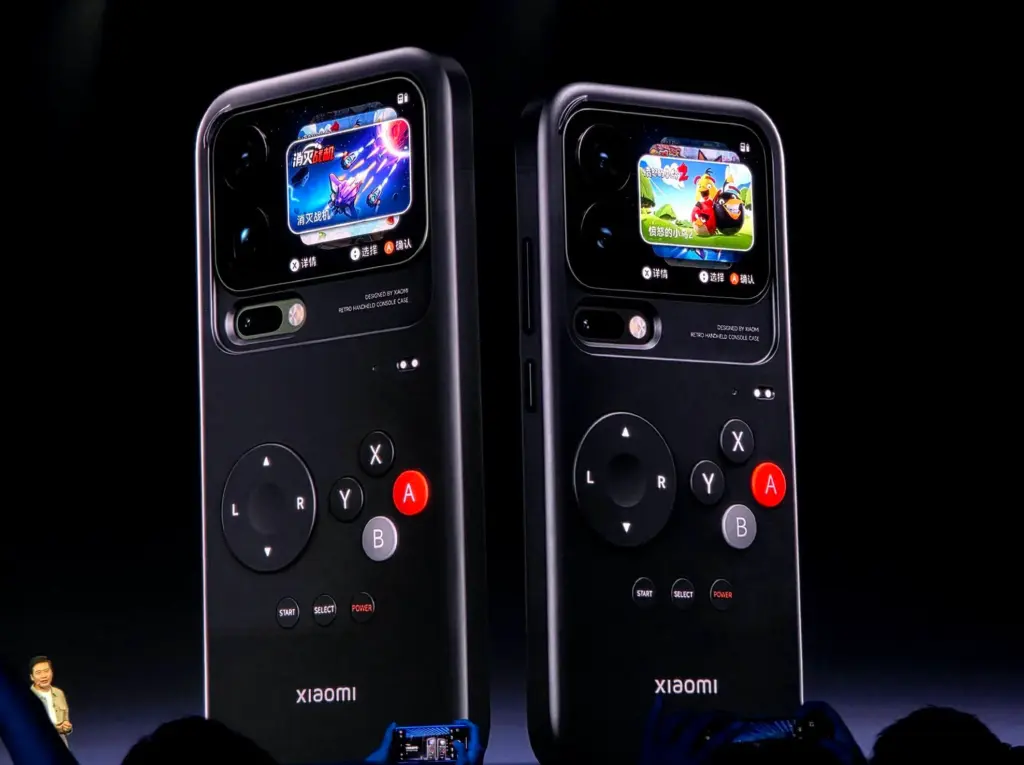
    The smaller Xiaomi 17 Pro features a second OLED display on the rear in addition to the same 6.3-inch display as the standard model. Two of the 50MP rear cameras are encircled by the 2.66-inch display, which also has a third 50MP back camera beneath it and a 50MP selfie camera. It can be utilized with personalized themes, “Dynamic Notifications,” and sticky notes. It can also manage media controls and play games with a special case (via GSMArena). The Xiaomi 17 Pro, which starts at CNY 4,999, features a 6,300 mAh battery and up to 1TB of storage.

    With its enormous 7.500 mAh battery and 6.9-inch display, the Xiaomi 17 Pro Max goes above and beyond.

    The Pro Max’s rear display is identical to the smaller model’s, including the same 2.66-inch LCD and features. The screen and battery capacity are the only things that separate the two sizes. The design is even the same. The starting price of the Xiaomi 17 Pro Max is CNY 5,999.

    Since the Xiaomi 15 series debuted globally in March of last year, we can presumably anticipate a global launch in February, give or take, given today’s early Xiaomi 17 launch in China. These phones will go on sale in China on September 27.

  • Snapdragon 8 Elite Gen 5 – high CPU freq and huge performance improvements

    Snapdragon 8 Elite Gen 5 – high CPU freq and huge performance improvements

    After a while, we discovered that the Snapdragon 8 Elite Gen 2 from Qualcomm might actually be the Snapdragon 8 Elite Gen 5. After a short lull, a new rumor has surfaced that offers some data about the specifications, allowing us to examine the advancements between the two generations more closely—at least on paper—because there is more. We should start investigating this report right away because the whistleblower who supplied these details also stated that the AnTuTu score is purportedly 50% higher what the Snapdragon 8 Elite achieved.

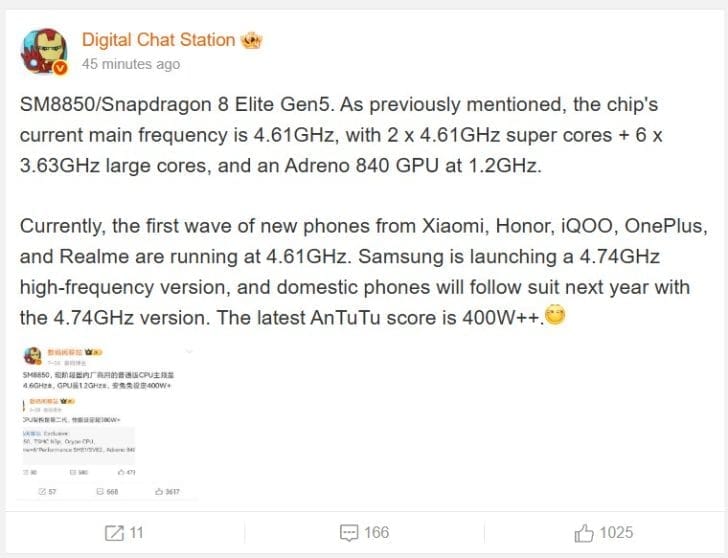
    The Digital Chat Station, a Weibo tipster, has returned with some important information on the Snapdragon 8 Elite Gen 5. As its performance cores recorded on Geekbench 6 were 4.74GHz rather than the normal 4.61GHz mentioned in the most recent rumor, it appears that the version tested on the Galaxy S26 Edge was a higher-binned part. According to reports, the efficiency cores are capped at 3.63GHz, and the Snapdragon 8 Elite Gen 5 has a “2 + 6” CPU cluster, just like the Snapdragon 8 Elite.

    As for the GPU, Qualcomm will couple its forthcoming flagship SoC with the Adreno 840, with the source adding that its default clock speed is 1.20GHz, making it slightly faster than the Adreno 830’s 1.10GHz speeds. The San Diego company seems to have some latitude in raising those frequencies thanks to TSMC’s third-generation 3nm technology, but how much of a difference will that translate into benchmarks? The Snapdragon 8 Elite Gen 5 allegedly scored over 4 million points in AnTuTu, according to the rumor.

    Snapdragon 8 Elite Gen 5 rumor

    The REDMAGIC 10 Pro, which has a Snapdragon 8 Elite processor, is the quickest Android smartphone according to benchmark leaderboards. The final score for this device was 2,662,615. These numbers will be 50% greater than those of its straight predecessor, assuming the Snapdragon 8 Elite Gen 5’s AnTuTu findings are genuine. Due to an exclusive arrangement with Qualcomm, Samsung will be the only company able to debut the Galaxy S26 series with the quickest flagship out of all the companies anticipated to do so. Stay tuned for additional developments as the chipset maker’s Snapdragon Summit gets underway on September 23. Any elusive specifics will be revealed throughout the event.

  • Has the Snapdragon 8 Elite 2 chip been discontinued? Qualcomm is rumored to be developing a new chipset.

    Has the Snapdragon 8 Elite 2 chip been discontinued? Qualcomm is rumored to be developing a new chipset.

    Previous rumors claimed that Qualcomm and Samsung were working together to produce a 2nm Snapdragon 8 Elite 2 chip that would power next-generation flagships. But it looks like the project has been canceled. Rather, a new chip is being developed.

    The competition for the fastest and most efficient processor is constantly getting more intense in the very competitive smartphone market. And for a split second, it appeared as though Samsung might be ready to take the lead. According to rumors, Qualcomm and Samsung were making headway in producing a 2nm version of the Snapdragon 8 Elite 2, the company’s next-generation powerhouse. It was anticipated that this generation will be even more sophisticated than the 3nm CPUs seen in the majority of Android flagships. certain even thought it will power certain of the Galaxy S26 lineup’s models. However, those preparations seem to have ended abruptly.

    Snapdragon 8 Elite 2 could be so

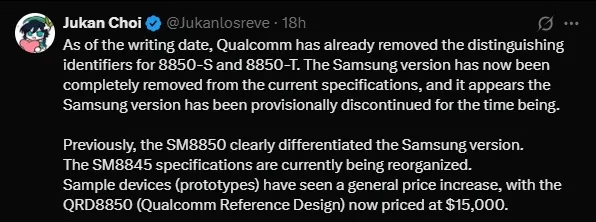
    Qualcomm has now canceled the 2nm version of the Snapdragon 8 Elite 2 chip that was made by Samsung, according to a leaker on X, now known as Twitter (@Jukanlosreve). The chip, known internally as SM8850-S, is no longer listed on Qualcomm’s website. Two distinct versions were previously included in Qualcomm’s documentation: the now-missing 2nm Samsung version and the SM8850-T, a 3nm chip manufactured by TSMC.

    new snapdragon chip

    The fact that just the base model SM8850 is left suggests that the 3nm chip manufactured by TSMC is the only one that has survived. The leak makes it abundantly evident that Qualcomm has quietly removed Samsung from the manufacturing equation, at least for this flagship chip, even if the firm has not provided an explanation for the move.

    According to the move, the TSMC version of the Snapdragon 8 Elite 2 will be included in all major Android phones that arrive in late 2025 and after. It’s a setback for Samsung, which was hoping to show off its 2nm prowess and catch up in the semiconductor industry. For now, we can only surmise as to whether the decision was made due to basic strategy realignment, performance issues, or production constraints.

    The Snapdragon 8 Elite 2 prototype, which developers and OEMs utilize for early testing, has witnessed a significant price increase, according to related news from the same source. Its current price of $15,000 indicates both great demand and limited supply. That’s a big jump, and it might be Qualcomm’s strategy to limit the chip to exclusive partners in the early stages.

    Untitled

    It’s also important to note that Qualcomm is currently changing the specifications for its SM8845 chip, which is probably going to be marketed as the Snapdragon 8s Gen 5. Although specifics are still unknown, this chip is anticipated to function as a more affordable flagship choice, potentially aiming for upper-mid-range phones with performance that falls just short of the Elite series.

    A 2nm Snapdragon manufactured by Samsung would have made headlines, but it appears that the story has changed. For Qualcomm’s flagship goals, TSMC’s 3nm technology is currently the preferred platform. Although this leak implies it won’t be with the Snapdragon 8 Elite 2, Samsung may still have a 2nm moment in the future.

    Stay connected with the latest from Droid Tools—follow us on X @droid_tools, like our page on Facebook, check out our updates on Instagram, and follow us on Google News for real-time news, device tips, and mobile tech insights.

  • Snapdragon 8 Elite 2 has a significant jump benchmarks score

    Snapdragon 8 Elite 2 has a significant jump benchmarks score

    The 2025 Snapdragon Summit is scheduled by Qualcomm for September 23–26, 2025. The US-based chipmaker is probably going to reveal the Snapdragon 8 Elite 2, which will power the premium phones of the future. According to a recent Weibo post by trustworthy tipster Digital Chat Station, this next SoC will have significant improvements in processing and graphics capabilities.

    According to the leak, Qualcomm’s second-generation Oryon CPU architecture would be available in the Snapdragon 8 Elite 2. According to reports, the chipset is aiming for single-core test scores of over 4,000 points and multi-core scores of up to 11,000 points on Geekbench 6. The new chip promises a considerable performance boost over the first-generation Snapdragon 8 Elite, which scored about 3,100 and 9,800, respectively.

    Snapdragon 8 Elite 2: big upgrade in CPU and GPU performance

    Snapdragon 8 Elite Gen 2

    A 16MB GMEM cache and an updated Adreno 840 GPU are also anticipated to be included in the platform, which will enable it to easily handle demanding visuals and graphics-intensive applications. These improvements imply that future flagship smartphones will prioritize improved thermal management and performance efficiency.

    Snapdragon 8 Elite 2 known specs

    According to rumors, the Snapdragon 8 Elite 2 will offer notable upgrades over its predecessor with a 2+6 CPU structure and a potential clock speed of up to 5GHz. With a base frequency of 4.4GHz, which is marginally higher than the 4.32GHz of the previous iteration, the CPU is anticipated to be constructed using TSMC’s third-generation 3nm process.

    Xiaomi is probably going to be the first company to release phones with this chipset, specifically the Xiaomi 16 and Xiaomi 16 Pro, based on past trends. The OnePlus 15, iQOO 15, 15 Pro, Honor Magic 8 series, Realme GT 8 Pro, Nubia Red Magic 11 series, and Redmi K90 series are possible more early adopters.

    The new processor is anticipated to be included in the Vivo X300 Ultra and Oppo Find X9 Ultra, which are scheduled to launch next year. It’s unclear, meanwhile, if the Xiaomi 16 Ultra will use the company’s proprietary Xring SoC or the Snapdragon processor.

  • The OnePlus 13’s personalized Snapdragon chip appears to be more efficient than the Apple A18 Pro.

    The OnePlus 13’s personalized Snapdragon chip appears to be more efficient than the Apple A18 Pro.

    With the next-generation Snapdragon flagship CPU around the corner, the OnePlus 13 is anticipated to come soon. According to a OnePlus employee, the modified version of the SoC can outperform the Apple A18 Pro in terms of efficiency, even though the chipset’s name is still unknown.

    At the Snapdragon Summit, Qualcomm will formally unveil its next-generation flagship smartphone SoC. The OnePlus 13 is anticipated to be one of the first smartphones to use the technology, though it is still unknown if it will be called Snapdragon 8 Gen 4, Snapdragon 8 Extreme Edition, or something else.

    Although OnePlus has not given away many details regarding its next flagship phone, Cai Zuxuan, an employee, hinted on Weibo that it will use a modified Snapdragon chip. The employee’s assertion that the customized SoC will provide better energy efficiency is more intriguing.

    Snapdragon x elite oneplus 13

    More precisely, the employee asserts that the custom Snapdragon SoC can outperform the Apple A18 Pro in terms of power efficiency, citing internal statistics from OnePlus. According to Cai Zuxuan, this would force Qualcomm to take the top slot once again.

    Additionally, a “public version,” which is allegedly inferior than the custom SoC, is mentioned in Cai Zuxuan’s Weibo post. There have been previous mentions of two distinct iterations of what is allegedly the Snapdragon 8 Extreme Edition. In August, a SoC datasheet that appeared legitimate was released, mentioning the SM8750 and SM8750P versions.

    The SM8750P was thought to be a more expensive model among them; the letter “P” was presumably an acronym for “Performance.” Qualcomm has been using its previous flagship SoCs in a similar manner. Consider the Snapdragon 8 Gen 3 for the Galaxy. The normal SoC is significantly overclocked in this version. Later, Nubia smartphones came with the same overclocked processor, which now leads the AnTuTu benchmark.

    csm Cai Zuxuans post on the cust

    Cai Zuxuan, however, indicates that this time, efficiency will be given a lot of weight in addition to performance. The good news is that October 21, which is not too far away, is when Qualcomm’s Snapdragon Summit will begin. In order to find out how Qualcomm’s 3 nm smartphone chip stacks up against the competition, you do not have to wait.

  • The Cortex-X4, 4nm, generative AI, 240 frames per second, Snapdragon 8 Gen 3 is now available.

    The Cortex-X4, 4nm, generative AI, 240 frames per second, Snapdragon 8 Gen 3 is now available.

    Recently, Qualcomm unveiled the Snapdragon 8 Gen chipset. The flagship platform, which uses the 4nm process, is primarily focused on advances in AI, gaming, audio, and cameras.

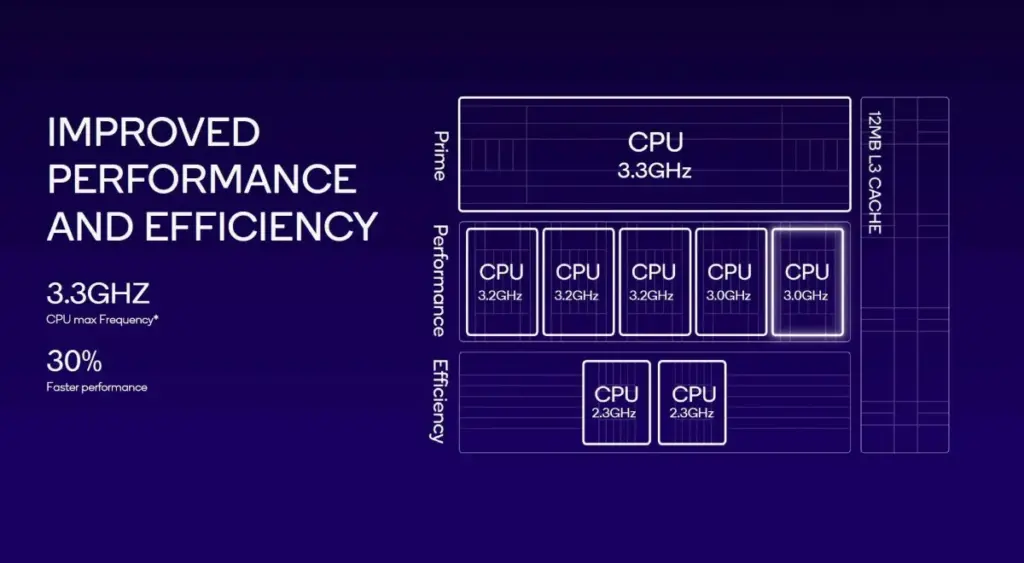
    In terms of crucial percentages, Gen 3 outperforms Gen 2 by 20% and by 30% in terms of speed. One Cortex-X4 prime core with a maximum frequency of 3.3 GHz, five performance cores with a maximum frequency of 3.2 GHz, and two efficiency cores with a maximum frequency of 2.3 GHz highlight the eight-core CPU inside. Up to 24 GB of LPDDR5x memory can be supported at 4800 MHz. Supported Wi-Fi 7 frequencies up to 6 GHz are 802.11be, 802.11ax, 80211ac, and 80211a/bg/n. The chip has an X75 5G modem with mmWave and sub-6 GHz antennae.

    Snapdragon 8 Gen 3 architecture

    With the Snapdragon 8 Gen3, AI is the main feature. The AI Engine is the first component in the process; it can process up to 20 tokens per second to provide immediate AI assistant replies. It supports both popular big language models for speech recognition and multi-modal generative AI models. According to Qualcomm, the Snapdragon 8 Gen 3 has the quickest steady diffusion in the world, producing an image in a split second.

    To improve AI assistant replies, Qualcomm’s Sensing Hug securely accesses personal data such as location, fitness state, and preferred activities.

    AI also improves the capabilities of the camera. Real-time Semantic Segmentation can improve an image’s brightness and detail, while Night Vision video can light up a dimly lit area. Vlogger’s View, which records video from both your back and selfie cameras, has an object eraser for films that may be used to remove unpleasant individuals or things. In addition to automatically improving HDR, Picture Expansion can employ generative AI to stretch an image beyond the original acquired data.

    Snapdragon 8 Gen3

    On 240 Hz monitors, the Snapdragon 8 Gen 3 can produce “console-defying” gaming performance at 240 frames per second. Adreno Frame Motion Engine 2.0 supports Unreal Engine 5.2 and may produce frames for better playback.

    The Snapdragon 8 Gen 3’s GPU offers 40% improved Ray Tracing along with 25% faster and 25% higher power efficiency.

    The fact that the new chip can stream 24-bit, 96-kHz lossless music via Bluetooth will please audiophiles.

    snapgradon 8 gen 3 devices

    Qualcomm says devices powered by the new Snapdragon 8 Gen 3 will be available in the coming weeks. The chipmaker has partnered with Asus, Honor, iQOO, Meizu, Nio, Nubia, OnePlus, Oppo, realme, Redmi, RedMagic, Sony, vivo, Xiaomi, and ZTE.