Tomorrow is Qualcomm’s annual Snapdragon Summit, during which the company is anticipated to reveal its upcoming Snapdragon 8 Gen 3 chip. Nevertheless, it appears that a recent leak, which discloses the complete specifications of the chip, may have wrecked tomorrow’s surprise. It also appears that the Snapdragon 8 Gen 3 will include a plethora of AI functions.
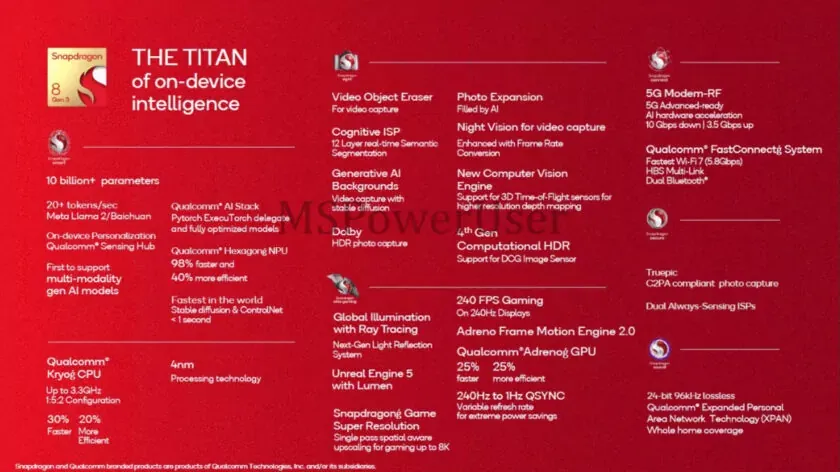
Leaked marketing materials for the Snapdragon 8 Gen 3 have been obtained by the MSPoweruser team. The processor will reportedly feature a number of AI tools that will enable actions like expanding images, removing objects from films, creating AI backgrounds, and more, according to the leak.
Significantly, the report also discusses being able to use AI models like Meta’s Llama 2 and Stable Diffusion. In light of the tech industry’s adoption of AI this year, including all of these AI capabilities makes sense.
Qualcomm equipped the CPU with an updated Hexagon neural processor to enable all of this (NPU). According to the marketing brochures, the new NPU is 40% more effective and 98% faster. The comparison is allegedly between the Gen 3 and the Gen 2, however the paper is vague.
But it’s not only about AI; there also seem to be some potent gaming-related elements. This features the ability to game at 240 frames per second and upscaling for up to 8K resolution using a next-generation light reflection system that supports global lighting with ray tracing.
One of the first products that the Snapdragon 8 Gen 3 is likely to be found in is Samsung’s Galaxy S24, which is scheduled to debut in Q1 2024. Since this is Qualcomm’s flagship chip, it should also be found in many of the high-end phones that debut the following year.
In the process of creating the undisclosed Snapdragon 8 Gen 3 chipset, Qualcomm could have taken no short cuts. Recent record-breaking benchmarks may also be explained by a new leak that shows the flagship processor is using an entirely new eight-core arrangement with a Cortex-X4 primary core with an unheard-of peak mobile clock speed.
According to a claim on a Chinese website, which cites user Digital Chat Station as the source, Qualcomm is adopting a different cluster design for the Snapdragon 8 Gen 3 in place of the 1+4+3 layout used by its predecessor. Instead, Qualcomm is employing a 1+5+2 structure. According to reports, the configuration consists of a primary Cortex-X4 core, five big cores, and two efficiency cores.
The Snapdragon 8 Gen 3’s maximum clockspeed
Aside from the fact that there are now more potent cores, Qualcomm has also raised the main core’s maximum speed to 3.7 GHz. For comparison, the normal Snapdragon 8 Gen 2 is rated at 3.2 GHz while the Cortex-X3 on a bespoke Snapdragon 8 Gen 2 can reach up to 3.36 GHz.
Currently, only Samsung’s Galaxy S23 line of handsets have the overclocked Snapdragon 8 Gen 2. The majority of other Android manufacturers rely on the processor’s default rating. What the base speed of the forthcoming Qualcomm silicon will be is also unknown.
Will the GPU on the Snapdragon 8 Gen 3 also be improved?
The Snapdragon 8 Gen 3 will be constructed on the latest TSMC N4P node, excluding from the CPU. Although it continues to use a 4 nm process, it is claimed to be more efficient than the SoC from the previous year. Regarding graphics, it is said that the Adreno 750 GPU performs 50% better than the Adreno 740.
The chipmaker is expected to make its next-generation chipset announcement earlier than it did last year. This might be because Qualcomm abandoned its plans to release a Snapdragon 8 Gen 3 “plus” model.
Meanwhile, let us know your thoughts on the Snapdragon 8 Gen 3. Are you willing to wait for it before upgrading your next smartphone?
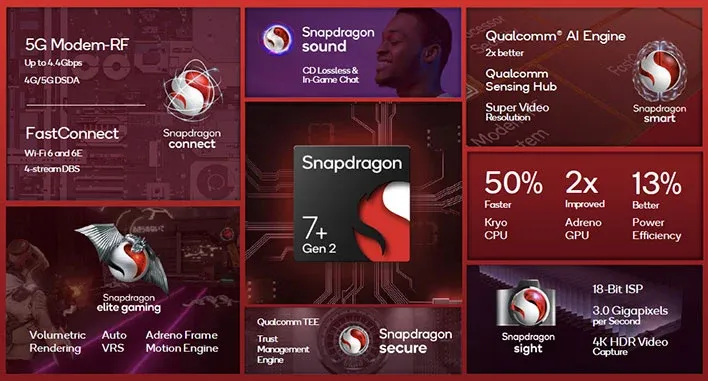
This week, Qualcomm unveiled the Snapdragon 7 Plus Gen 2, which is obviously a significant improvement over the mid-range Snapdragon 7 series on paper.
A single Cortex-X2 core running at 2.91 GHz, three Cortex-A710 cores running at 2.49 GHz, and four Cortex-A510 cores operating at 1.8 GHz make up the new chipset’s amazing CPU system, which is reminiscent of the Snapdragon 8 Gen 1 series. The Cortex-X CPU core is now present in a Snapdragon 7 series chipset for the first time. Moreover, Qualcomm claims that the Adreno GPU has been updated and will perform twice as well as the Snapdragon 7 Gen 1 did.
What does this all mean in terms of actual performance, though? We were able to benchmark a Snapdragon 7 Plus Gen 2 reference handset ahead of launch to get a better idea of what to expect.
Design
Obviously, the reference devices from Qualcomm are not smartphones. In essence, these are test versions intended for internal use. It’s important to remember that although this specific device is rather slim, reference designs often have a tendency to be fairly thick when compared to commercial handsets. But, due to software, cooling systems, and various designs, we are still anticipating diverse results for commercial devices.
Nonetheless, the Qualcomm reference design features a 4,192mAh battery, a 6.65-inch 144Hz OLED screen in FHD+, 12GB of LPDDR5 Memory, and 256GB of UFS 3.1 storage. Moreover, the phone lacks an active cooling system like a fan.
Snapdragon 7 Plus Gen 2 tests
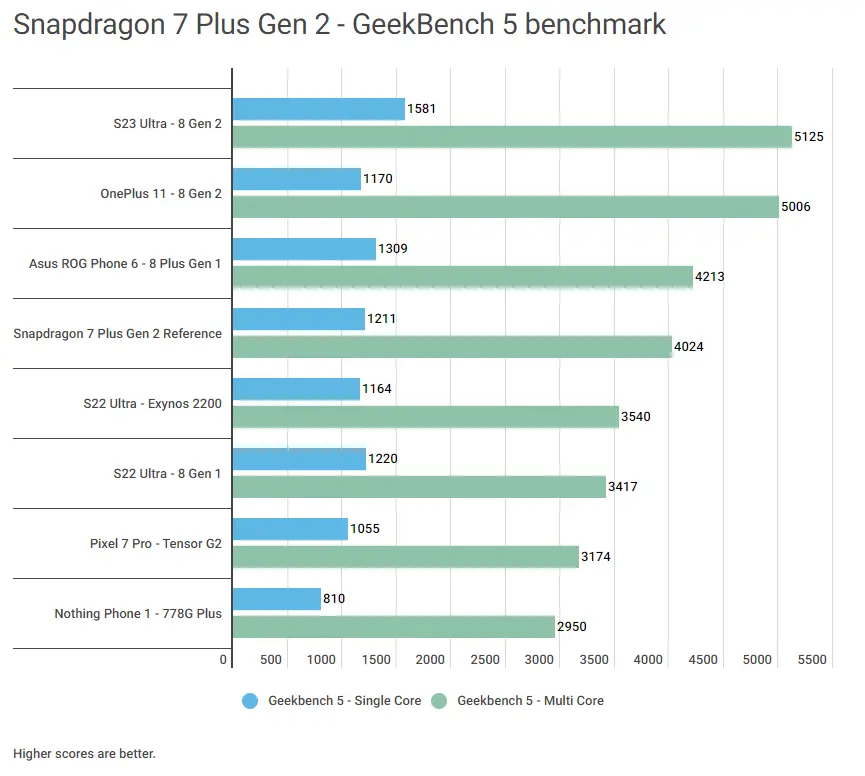
Since all three chipsets use the same CPU cores, we anticipated CPU-related results to be comparable to those of the Snapdragon 8 Gen 1 family going into this. Due to greater Processor clock speeds, nevertheless, we might anticipate the Snapdragon 8 Plus Gen 1 to have a slight advantage.
The normal Snapdragon 8 Gen 1 is a particularly interesting comparison because it is made using the lesser 4nm Samsung technology, whereas the 7 Gen 2 uses the superior 4nm TSMC process. Our research demonstrates that, at least in part as a result of the move from Samsung to TSMC, the Snapdragon 8 Plus Gen 1 enjoys a significant performance and efficiency increase. Let’s examine the 7 Plus Gen 2 to determine if the same is the case.
Furthermore, in single-core tests, the Snapdragon 7 Plus Gen 2 reference phone defeats the Exynos 2200-equipped and Snapdragon 8 Gen 1 S22 Ultra and even edges out the OnePlus 11 powered by the Snapdragon 8 Gen 2. To maximize efficiency, OnePlus is extremely careful with single-core performance in the latter circumstance. Yet the S23 Ultra, which has less restrictions, outperforms rivals like the recently released Snapdragon 7.
The reference design manages to outperform every Snapdragon 8 Gen 1 device on the list when looking at multi-core CPU results. Also, it has a score that is comparable to smartphones with Snapdragon 8 Plus Gen 1. However Qualcomm’s most recent flagship 8 Gen 2 chip continues to hold a significant lead.
Overall, it appears that, in terms of CPU performance, the Snapdragon 7 Plus Gen 2 is competitive with the Snapdragon 8 Gen 1 across the board. The Snapdragon 8 Plus Gen 1 phones, meanwhile, are also not far behind. The somewhat quicker CPU clock rates and possibly different cache capacities could account for this.
GPU testing
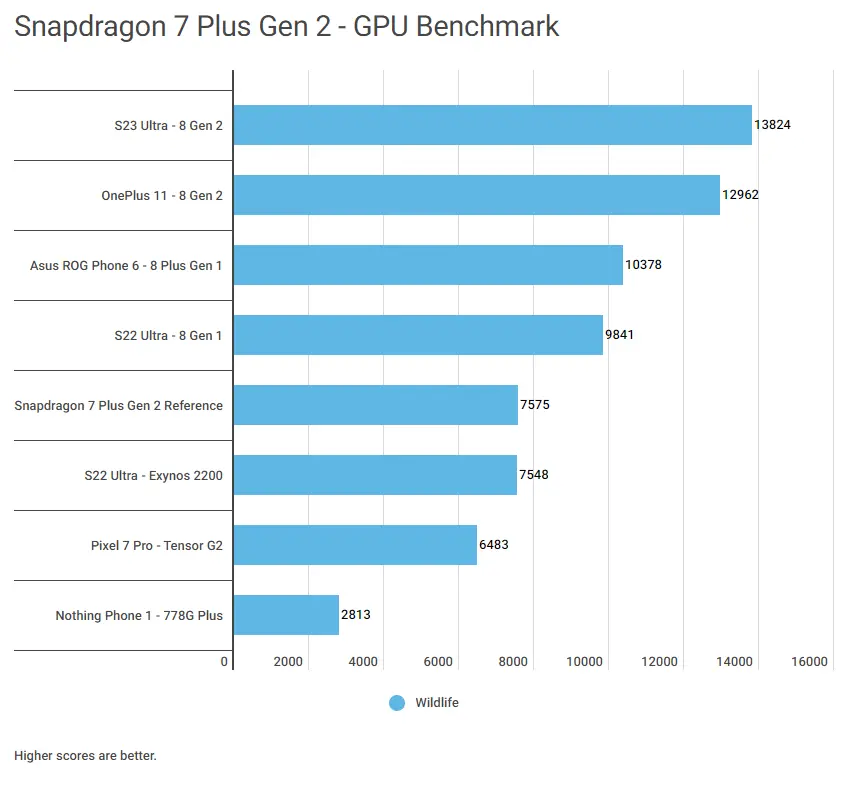
The question of graphical performance is a murkier one on paper, owing to the closed-box nature of the Adreno GPU architecture. However, Qualcomm has noted that the Snapdragon 7 Plus Gen 2 enjoys a two-fold performance boost over the Snapdragon 7 Gen 1. How does this compare to flagship silicon, though?
Comparing mid-range chipsets to their flagship counterparts, mid-range chipsets often perform worse in the GPU domain, and the traditional 3DMark Wild Life test confirms this is still the case. The 7 Plus Gen 2 reference design and the Snapdragon 8 Gen 1 series as a whole have significantly different scores.
Thankfully, the Snapdragon 7 Plus Gen 2 easily surpasses the Arm Mali GPU of the Pixel 7 Pro while matching the high-end AMD GPU of the Exynos 2200. Moreover, the reference design score indicates that the Snapdragon 778G Plus GPU in the Nothing Phone 1 offers 2.7x the GPU performance.
This score highlights that Snapdragon 7 Plus Gen 2 phones can handle today’s demanding games at respectable frame rates. Demanding gamers might still want a phone with a Snapdragon 8 Gen 1 series or Snapdragon 8 Gen 2 processor for advanced games down the line, but this is a significant win for the mid-tier chipset nonetheless.
Snapdragon 7 Plus Gen 2 stress testing
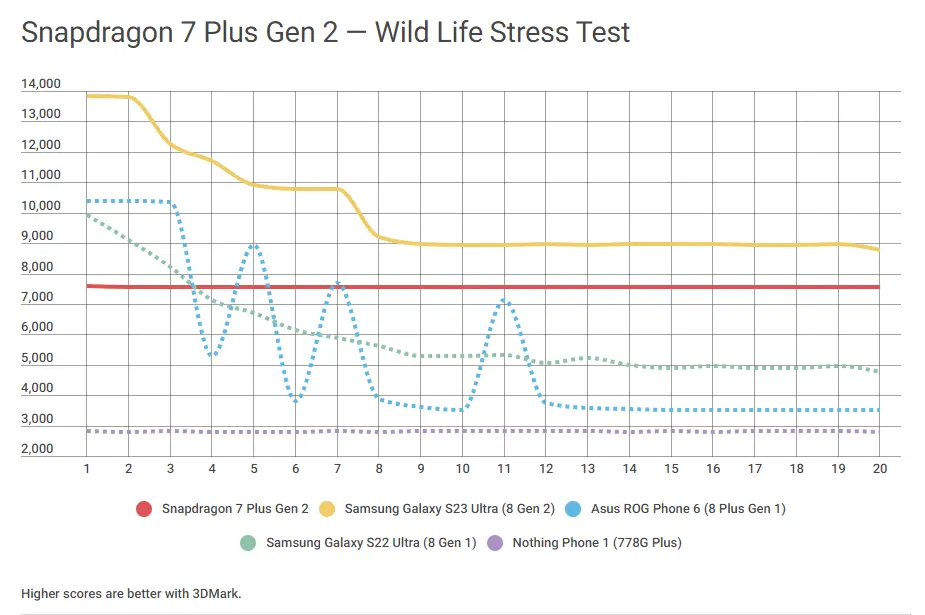
One-off GPU testing is one thing, but a lot can be gleaned from stress tests. We subjected the Snapdragon 7 Plus Gen 2 device to a 3DMark Wild Life Stress Test to get a better idea of sustained performance.
The stress test results make for very interesting reading, as the Snapdragon 7 Plus Gen 2 reference device displays rock-solid stability of 99.76%. In fact, this stability means that the Snapdragon 7 Plus Gen 2 handset can beat the Galaxy S22 Ultra (Snapdragon 8 Gen 1) when put under extended stress. Needless to say, the Nothing Phone 1 and its Snapdragon 778G Plus chipset is far behind as well.
What’s particularly intriguing is that over the course of the stress test, the Snapdragon 7 Plus Gen 2 smartphone closed the gap with the Galaxy S23 Ultra and its Snapdragon 8 Gen 2 chipset. This is primarily because the Galaxy handset only maintained 64.6% stability; other 8 Gen 2 handsets performed better.
Although the cynic in us suspects that commercial phones equipped with this chipset may not be as reliable, it still augurs well for prolonged play sessions.
Overall thoughts
Benchmarking reveals that we’re looking at a chipset that’s at least as powerful as the Snapdragon 8 Gen 1 from a CPU perspective. That’s no mean feat, and it’s a good sign for those who value speed, be it for everyday performance or those who intend to keep their phones for a few years.
Even when compared to more recent flagship chips, mid-range processors typically show a sizable GPU performance disparity. The bad news is that, in one-off GPU testing, the Snapdragon 7 Plus Gen 2 is not really an exception. Between Qualcomm’s mid-range and flagship chips, there is still a significant disparity. The less powerful GPU, however, was able to surpass Google and Samsung’s flagship CPUs.
The good news is that the 4nm TSMC architecture and purportedly lower GPU clock speed suggest that we could be looking at rock-solid sustained performance in this case. In a stress test, the chipset can even defeat some Snapdragon 8 Gen 1 series smartphones.
Again, this is just a reference design, but those on the hunt for sustained gaming performance on a budget should keep an eye on phones with the Snapdragon 7 Plus Gen 2. Fortunately, we won’t have to wait too long, as Qualcomm confirmed that the first phones are coming this month. The company also name-dropped Redmi and realme as brands working on devices with this chipset.
The introduction of Qualcomm’s upcoming flagship system on a chip (SoC) is about to be announced; it is anticipated to take place during the company’s event in November. Although the Snapdragon 8 Gen 2 has been anticipated for some time, there is a speculation that a surprise version of the chipset may be on the horizon.
The rumor was passed along via informant Digital Chat Station. According to a post on the Chinese social media platform Weibo, Qualcomm may be getting ready to introduce two different Snapdragon 8 Gen 2 processor models.
According to reports, this variant would have a microprocessor with an ultra-high frequency that significantly increases clock rates. One of the chipsets would be your typical chipset, while the ultra-high frequency processor may operate at 3.4 to 3.5GHz, according to Digital Chat Station. Snapdragon 8 Gen 1 currently operates at 3.19GHz as a point of comparison.
Even while everything seems thrilling, you should treat this rumor with a lot of skepticism. The likelihood of this rumor being true is remote. The rumor is that Qualcomm will release two chipsets simultaneously, which wouldn’t make much sense.
The informant also highlighted Mediatek’s future Dimensity chip in addition to the Snapdragon 8 Gen 2 chip. They assert that Mediatek’s upcoming chip could significantly boost CPU performance. Check out the comparisons here to see how the Dimensity 9000 and the current Snapdragon 8 Gen 1 stack up against one another.
Late last year, Qualcomm launched a new naming scheme for its chipsets, which it continued with the upper mid-range Snapdragon 7 Gen 1 earlier this year. The SD 4 Gen 1 and SD 6 Gen 1 are now being revealed by the US chip creator, who is going downstream.
The new chipsets, which take the place of the SD 400 and SD 600 naming conventions, also add a few useful features to their respective price ranges. What you need know about them is as follows:
Snapdragon 6 Gen 1
The 4nm Snapdragon 6 Gen 1 is undoubtedly the best chipset out of the bunch, with an octa-core CPU (4x Cortex-A78 and 4x Cortex-A55) with a claimed 40% performance improvement over the Snapdragon 695, which is, admittedly, a weaker chip. A 35%-better performing Adreno GPU is also included with the SoC, along with gaming-specific features like variable rate shading and jank minimization.
Qualcomm’s new SoC also brings an improved AI engine with a Hexagon Tensor Accelerator and a claimed 3x increase to AI performance, as well as a Snapdragon X62 5G modem.
Snapdragon 4 Gen 1
Snapdragon 6 Gen 1
CPU
2x Cortex-A78 6x Cortex-A55
4x Cortex-A78 4x Cortex-A55
GPU
Adreno
Adreno
Modem
Snapdragon X51 5G 2.9Gbps down
Snapdragon X62 5G 2.5Gbps down
Camera
108MP snapshot 32MP single 25MP+13MP dual 13MP triple
48MP single 25MP+16MP dual 13MP triple 108MP snapshot 4K HDR
Connectivity
Bluetooth 5.2 Wi-Fi 5
Bluetooth 5.2 Wi-Fi 6E
Manufacturing process
6nm
4nm
The Snapdragon 6 Gen 1 also offers a respectable selection of photographic features, including up to 200 MP for a single camera (likely for a snapshot), 25 MP and 16 MP for a dual camera, and 13 MP for a triple camera. Additionally, 4K HDR video recording is something you can anticipate, which is an upgrade over the Snapdragon 695’s complete lack of 4K video recording.
Other noteworthy features include 120Hz at FHD+ display resolutions, Bluetooth 5.2, Wi-Fi 6E, and support for Quick Charge 4+.
You’re in for a bit of a wait if you want a phone with this chipset, as Qualcomm says devices with the SD 6 Gen 1 are set to launch in Q1 2023. Motorola has also confirmed that it will offer a phone with the new SoC.
Snapdragon 4 Gen 1
Additionally, Qualcomm unveiled the 6nm SD 4 Gen 1, which replaces the SD 6 Gen 1. With a claimed 15% boost over the SD 480, the new lower mid-range SoC offers an octa-core CPU (2x Cortex-A78 and 6x Cortex-A55). The GPU reportedly experiences a 10% performance increase.
Otherwise, it appears that the SD 4 Gen 1 and the SD 695 have a lot in common. Similar camera features (including support for 108MP snapshots but no 4K video recording), 120Hz support at FHD+ resolutions, Quick Charge 4+ support, Bluetooth 5.2, and Wi-Fi 5 are all present. Additionally, the Snapdragon X51 5G modem can reach downlink rates of 2.5Gbps.
You won’t have to wait long to see the first phones with the SD 4 Gen 1, as Qualcomm confirmed that the first devices will land this quarter (Q3 2022). Vivo’s Iqoo brand has revealed that the Iqoo Z6 Lite will be one of the first globally available phones with the new chipset.
Qualcomm’s annual 5G Summit is taking place in San Diego this year, and the company has a few major announcements to make about its technology for future 5G products. These developments coincide with the widespread use of 5G connectivity and smartphones in many regions of the world.
Smart Transmit 3.0 is maybe the most notable reveal. Qualcomm’s 5G speed and coverage optimization technology has reached its third generation. The significant change in this version is that Smart Transmit now includes Bluetooth and Wi-Fi for the first time, allowing you to optimize your phone’s whole radio stack. Smart Transmit 3.0, according to Qualcomm, supports Wi-Fi 6, Wi-Fi 6E, and Wi-Fi 7.
We asked Qualcomm about specific performance and efficiency gains for Bluetooth and Wi-Fi when using Smart Transmit 3.0, but the company didn’t divulge any figures. It’s also worth noting that future Wi-Fi and Bluetooth versions will likely offer a bigger improvement, but even a small improvement to current standards would be welcomed.
You can expect to find this tech in the previously revealed Snapdragon X70 5G modem, which is due to arrive in phones by “late 2022,” according to Qualcomm.
Standalone mmWave for X70
Qualcomm also stated at the 5G Summit that the X70 modem will handle independent mmWave connections, showcasing a connection. The feat was accomplished with a test device powered by the forthcoming modem.
The majority of 5G networks are non-standalone, which means they still rely on 4G technology for some functions. Separate 5G uses only 5G radio and backend technology, resulting in more flexible networks and services. This announcement also demonstrates that 5G backend technology can work in locations where there is no sub-6GHz connection.
It’s worth noting that Qualcomm previously announced a standalone mmWave 5G data connection milestone in July 2021. The firm told us that the previous milestone was related to 200MHz support, which is a requirement for the Chinese market.
What to expect from the Snapdragon X70 modem?
The X70 is the first 5G modem featuring an AI processor, and Qualcomm has unveiled a few more advantages of this silicon ahead of its launch.
In particular, the company claims that mmWave coverage will be increased by 20% in “dense metropolitan situations.” Mobility-based sub-6GHz 5G at the edge of coverage might see a throughput jump of up to 73 percent, while pedestrians at the edge of coverage could see a 28 percent rise. However, it’s likely that consumers will only realize these increases under perfect circumstances.
Qualcomm previously noted it uses this AI suite for 5G channel optimization, smart network selection, mmWave beam management, and antenna tuning. This should theoretically result in performance and efficiency gains, but we’ll wait for the first X70-toting devices to see if this is indeed the case.