Tag: android16

  • Honor MagicOS 10 update roadmap: eligible devices and rollout schedule

    Honor MagicOS 10 update roadmap: eligible devices and rollout schedule

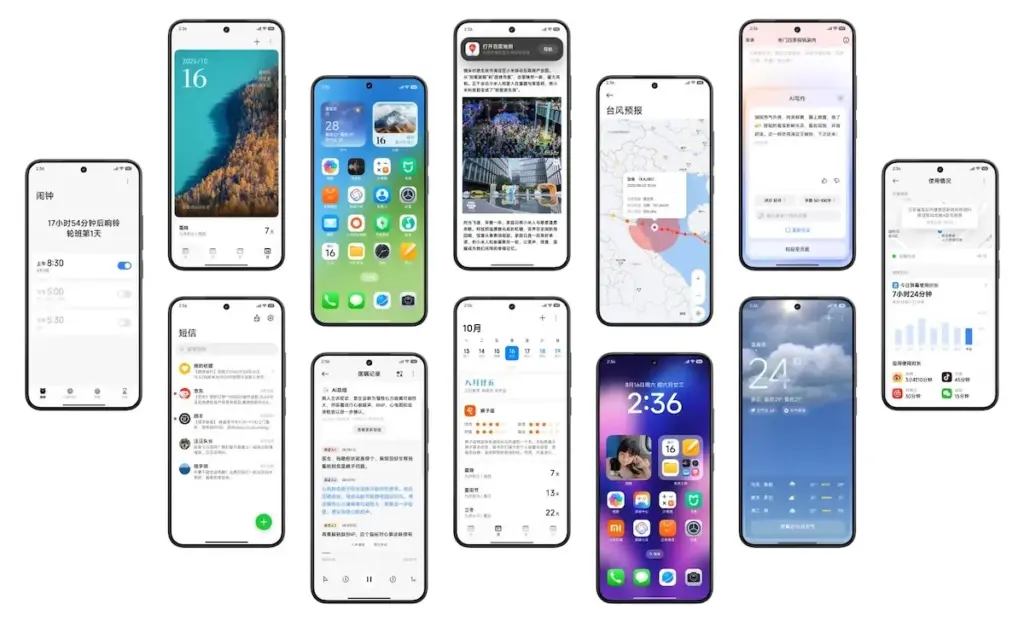
    The MagicOS 10 upgrade plan has been released by Honor, and these are all the models that qualify for the new software rollout. The business has also disclosed the precise release dates for every model, from flagship phones to low-cost phones.

    On October 15, MagicOS 10 made its debut alongside the Magic 8 series. The company discovered new AI capabilities and a number of intriguing features with the updated software version.

    Honor also released the list of devices that qualify for the MagicOS 10 software update. The new version will be available this month for a few flagship devices, including the Magic V5 foldable, the Magic 7 series, and the digital 400 models.
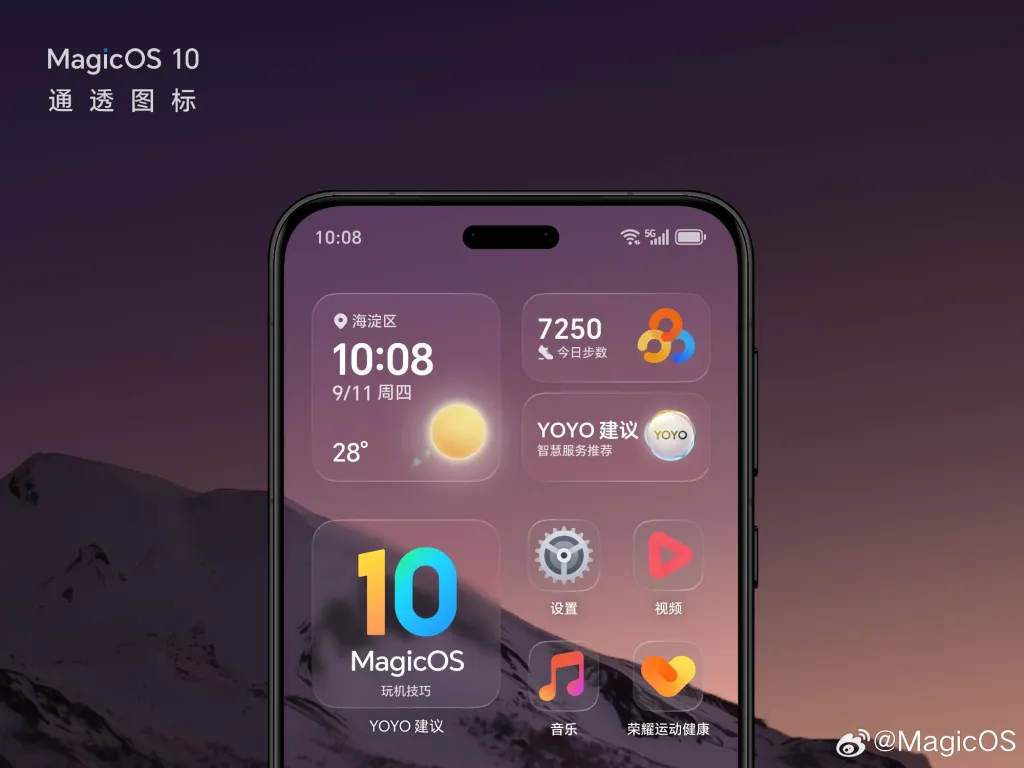
    honor magicos 10 with android 16

    Later, the new software version will be tested on other phones, such as the Magic V3 series, GT phones, and others. It is likely that the MagicOS 10 rollout will be completed by the first quarter of the next year.

    You must participate in both public and closed beta testing in order to upgrade the official MagicOS 10 features. By registering for the Beta Program and downloading the build through Settings > System & Upgrades > Software Updates, you can install the testing versions.

    MagicOS 10 Eligible Devices

    October 2025

    • Honor Magic V5
    • Honor Magic 7 RSR | Porsche Design
    • Honor Magic 7 Pro
    • Honor Magic 7
    • Honor GT Pro
    • Honor Magic 6 RSR | Porsche Design
    • Honor Magic 6 Ultimate Design
    • Honor Magic 6 Pro
    • Honor Magic 6
    • Honor 400 Pro
    • Honor 400
    • Honor MagicPad 3

    November 2025

    • Honor Magic V3
    • Honor Magic Vs3
    • Honor Magic 5 Ultimate Design
    • Honor Magic 5 Pro
    • Honor Magic 5
    • Honor Tablet GT 2 Pro

    December 2025

    • Honor Magic V2 RSR | Porsche Design
    • Honor Magic V2 Ultimate Edition
    • Honor Magic V2
    • Honor Tablet MagicPad 2
    • Honor Tablet GT Pro
    • Honor Tablet GT
    • Honor Tablet V9

    Q1 2026

    • Honor Magic V Flip 2
    • Honor Magic V Flip
    • Honor Magic Vs2
    • Honor Magic Vs Ultimate Edition
    • Honor Magic Vs
    • Honor 300 Ultra
    • Honor 300 Pro
    • Honor 300
    • Honor GT
    • Honor 200 Pro
    • Honor 200
    • Honor 100 Pro
    • Honor 100
    • Honor 90 GT
    • Honor Power
    • Honor X70
    • Honor X70i
    • Honor X60 GT
    • Honor Tablet 10
    • Honor Tablet X9 Pro
    • Honor X9
  • October 2025 update now rolling out to 23 Xiaomi and Redmi devices

    October 2025 update now rolling out to 23 Xiaomi and Redmi devices

    The October 2025 security patch was formally released by Xiaomi for 23 models, including well-known gadgets like the Xiaomi 12 series, Redmi Note 14 Pro+, POCO F7, and Xiaomi 14T. The EEA region is currently experiencing the deployment, which began early on Monday. Other global versions will follow shortly. Updates may be viewed via HyperOSUpdates.com, our MemeOS Enhancer app on Google Play, or the Settings → About phone → System updates.

    The update improves overall device stability and fortifies system security throughout Xiaomi’s tablet and smartphone lines. The complete list of devices that are part of this wave is provided below:

    • Redmi Series: Redmi Note 12 4G, Redmi Note 13 4G, Redmi Note 13 4G NFC, Redmi 15 4G, Redmi Note 14 Pro+, Redmi Note 14 Pro 4G, Redmi Note 13 Pro, Redmi 12, Redmi 12 5G
    • POCO Series: POCO M7 4G, POCO F6, POCO F7, POCO Pad, POCO X6 5G, POCO X7 Pro, POCO M6 Pro
    • Xiaomi Series: Xiaomi 12, Xiaomi 12 Pro, Xiaomi 13 Ultra, Xiaomi 14T
    • Tablets: Redmi Pad Pro 5G, Redmi Pad SE, Redmi Pad 2

    The new version is mostly being made available for the EEA region, but it will also be available in the future weeks for the India and global versions.

    What’s New in the October 2025 Update

    The main goals of the October 2025 security patch are to improve HyperOS performance stability, address vulnerabilities found, and strengthen the device’s system-level protection. Customers will notice more seamless speed and memory management improvements, particularly on premium smartphones like the Xiaomi 13 Ultra and POCO F7, even though there aren’t any significant visual or functional upgrades.

    Along with connectivity improvements to Xiaomi HyperConnect devices, the update also provides productivity software compatibility improvements for devices like the Redmi Pad Pro 5G and POCO Pad.

  • Samsung One UI 8.5 beta release could come earlier than you think

    Samsung One UI 8.5 beta release could come earlier than you think

    Early in the upcoming year, Samsung is anticipated to release the One UI 8.5 software along with the Galaxy S26 series. However, in terms of new features and cosmetic improvements, early build leaks have given little room for speculation.

    Unfortunately, only a small number of users are able to test-run the program at this time, thus these early builds aren’t available to everyone. Although we are unsure of the exact date, we are aware that the firm will soon formally launch the One UI 8.5 beta program for its flagship phones. With a leak providing information on a possible release date for the initial beta update, that is now altering.

    According to SamMobile’s exclusive tip, Samsung might activate the One UI 8.5 beta program before the end of November, possibly “around the week beginning November 24.” In contrast, after a protracted wait, Samsung released the One UI 7 public beta in December 2024, with the stable rollout taking place in April.

    Samsung released the first One UI 8 beta in May and the stable version last month, changing things up for the next big software release. The devices that will be compatible with 8.5 and the areas in which it will be accessible are still unknown.

    oneui 8.5 beta

    Will your older Galaxy phone get the One UI 8.5 beta update on schedule?

    The beta update is likely to be available on almost every device running the Android 16-based One UI 8.0 software. At the top of the list of devices that qualify should be the Galaxy S25 series and the newly released Galaxy Z Fold 7 and Z Flip 7.

    We should also mention that users of the Samsung flagships from 2024 had to wait about three months to receive the One UI 8 beta. With the next One UI beta, we can only hope that Samsung won’t do the same thing.

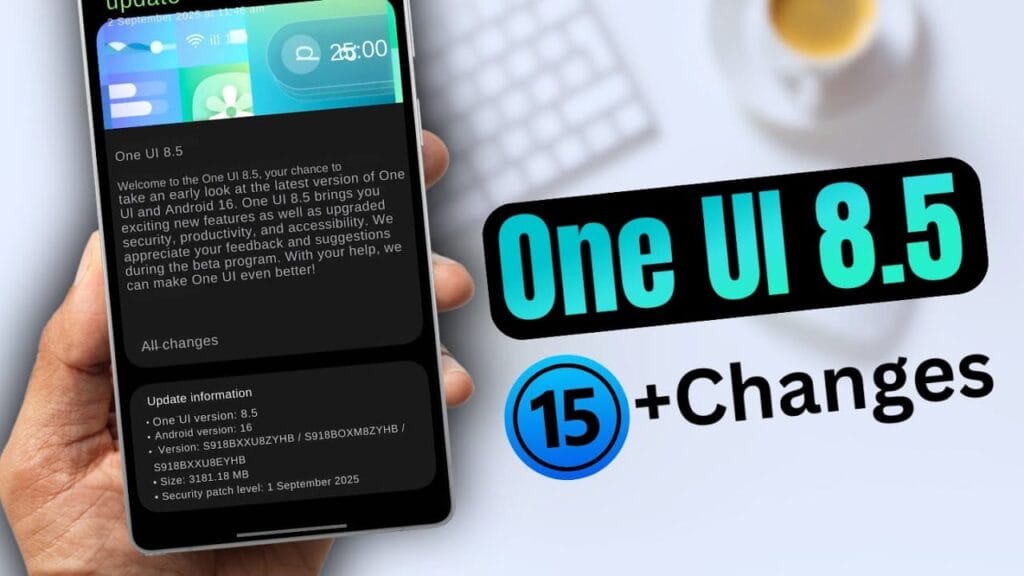
    The software is expected to be a significant improvement over One UI 8, if the previous leaks of One UI 8.5 are any indication. Because it will be based on Android 16 QPR2, Galaxy owners will be able to use the most recent Android update available. A recently leaked hands-on video gave us a better look at the improvements in the new software.

  • Xiaomi confirms over 20 devices ineligible for HyperOS 3 upgrade

    Xiaomi confirms over 20 devices ineligible for HyperOS 3 upgrade

    Before the year ends, Xiaomi will stop supporting more than 20 devices. Many devices, ranging from the Xiaomi 12X to the Poco F4, have not yet been included in HyperOS 3 deployment schedules and will shortly reach end-of-life status.

    Xiaomi has now stated that HyperOS 3, its upcoming big OS update, will be released globally initially. In summary, Xiaomi now divides the HyperOS 3 Rollout Schedule into three batches, with the first batch beginning this month and the third batch ending in March 2026. Just before to that, Xiaomi released a comparable update for the Chinese market that featured products tailored to that country, such as the Redmi K series and Mix Fold foldables.

    Xiaomi HyperOS 3

    Some older recent smartphones, such as the Xiaomi 11T series, have now gotten their final upgrades, as we previously noted. As a result, they are not eligible to upgrade to HyperOS 3. Even yet, some HyperOS 3 compatible devices—like the Redmi Note 14 Pro Plus—will not be able to access Hyper Island features.

    It is now evident which Xiaomi devices have been left out of the company’s plans as the HyperOS 3 release timetables have been moved until the spring. For example, by February 2026, when it should get its last security update, the Poco X5 Pro 5G will be in end-of-life status. As a result, Xiaomi has excluded the gadget from its list of devices compatible with HyperOS 3. The following Xiaomi, Redmi, and Poco devices are currently scheduled to reach end-of-life status this year and are not part of the official HyperOS 3 distribution plans:

    • POCO F4
    • POCO F4 Pro
    • POCO F4 GT
    • POCO M5
    • POCO M5s
    • POCO X4 GT Pro
    • POCO X4 GT
    • POCO X5 Pro 5G
    • Redmi A2
    • Redmi A2+
    • Redmi 12C
    • Xiaomi 11 Lite 5G NE
    • Xiaomi 11T
    • Xiaomi 11T Pro
    • Xiaomi Mi 11i
    • Xiaomi Mi 11 Lite
    • Xiaomi Mi 11 Lite 5G
    • Xiaomi Mi 11 Ultra
    • Xiaomi Mi Mix Fold
    • Xiaomi Mix 4
    • Xiaomi 12X
  • Nothing OS 4.0 open beta launched with AI app-building features

    Nothing OS 4.0 open beta launched with AI app-building features

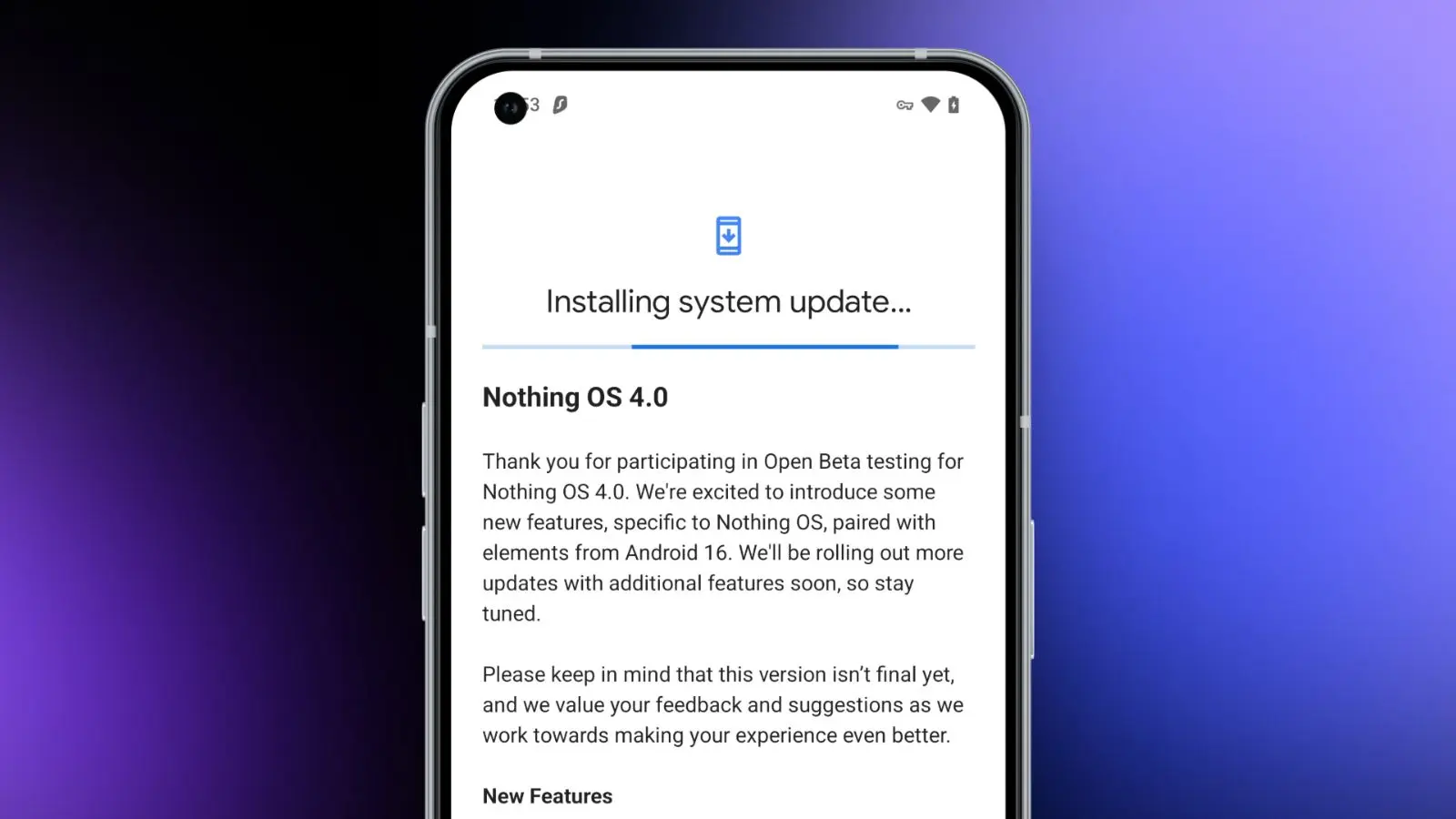
    Today, we need to discuss a few significant news from Nothing. First, for those who own a Nothing phone and would like to try out Android 16 before it becomes stable, Nothing has made the Nothing OS 4.0 Open Beta (Android 16) available. The other news relates to that since it presents the Playground and Essential Apps, both of which require additional explanation. In summary, Nothing came up with a really great idea.

    Download the Nothing OS 4.0 Open Beta:

    Let’s start with Nothing OS 4.0, which is now in beta testing. To obtain this, you must have a Phone 3 or any of the Phone 2 and 2a versions. You might be out of luck right now if you own a Phone 3a device, as they haven’t mentioned them yet.

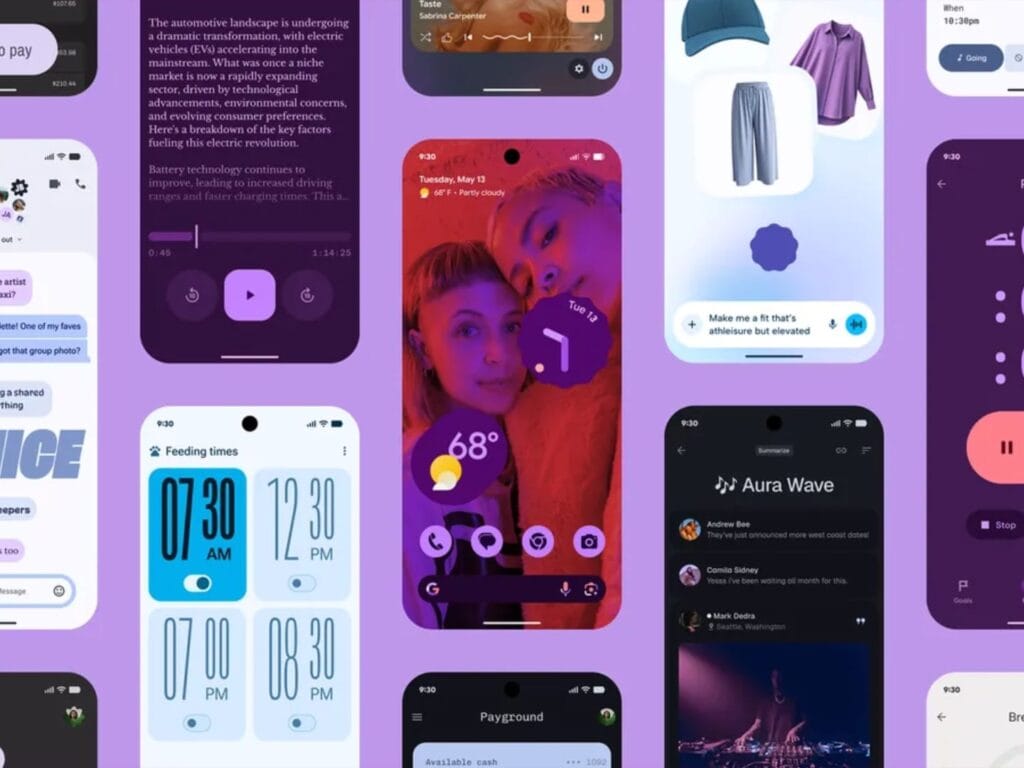
    There are a number of changes in the Nothing OS 4.0 beta, all of which we’ve detailed in this post. It includes “generic” enhancements like a more sophisticated design, an additional dark mode, enhanced app optimization, and a better photography experience. Nothing also mentioned two new lock screen clock faces, a new Pop-up View, and support for 2×2 Quick Settings tiles in today’s announcement.

    Nothing OS 4.0 open beta launched

    Installing the Nothing Beta Updates app, joining the beta through it, and then installing the beta software are the largely straightforward steps to begin, providing you enjoy testing beta software.

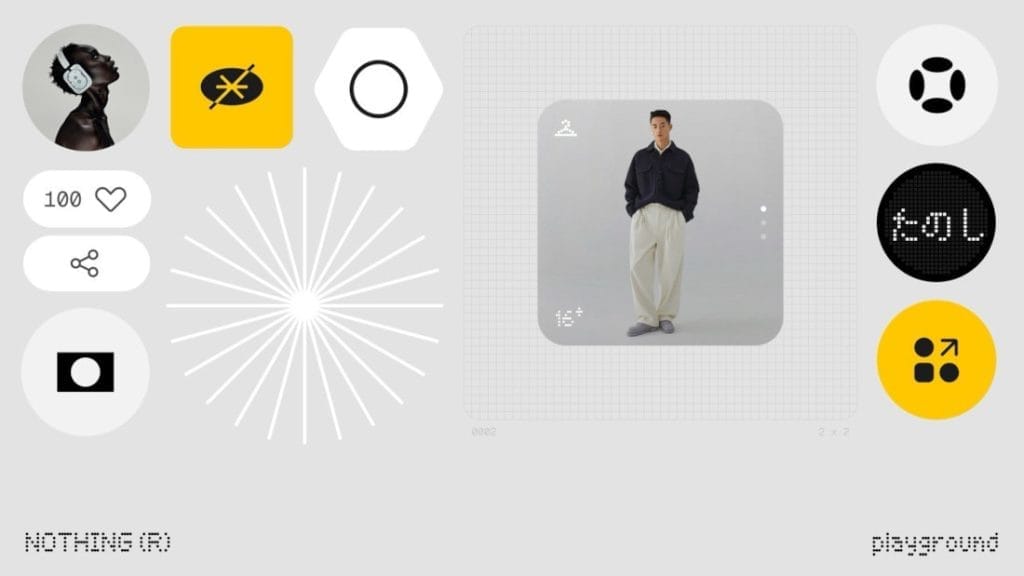
    Nothing Essential Apps and Playground: In other exciting news, Nothing has introduced the Playground and Essential Apps that are housed within it since we enjoy fresh concepts. If your Nothing device is running Nothing OS 4.0, you can install programs, Glyph Toys, camera settings, and EQ profiles from the Playground, which is effectively a community storefront. Even while you might not find that concept particularly novel or intriguing, the apps and their origins may be.

    Nothing has developed a web gateway that lets you make your own programs that your Nothing phone may install as widgets. You go to the Nothing Playground website (here) and try to explain a phone app you want. To put it another way, you would be describing a widget that isn’t currently on your device but may be a helpful program or action. This Playground site’s AI will install it on your device if it is capable of doing so.

    You only need an idea that you can clearly express in a prompt that AI could grasp and then develop from, as this is all happening from AI prompts. You don’t need to know how to code to accomplish this. But in case you were curious, you can see the code it spits out. All of this is a sort of early “alpha” with some obvious restrictions. There has been no indication that it will grow and incorporate agents, APIs, and integrations in the future, which should make this something really amazing.

    A Tic Tac Toe app, an F1 timetable, a water intake tracker, a flight reminder, a solar clock, a small calculator, and a breathing tracker are a some of the apps that are now available on the Playground. You may already have some of those features from other apps, but the idea is that you may think of something useful at the time and instruct the Playground to create it. In only a few minutes, that might be on your home screen and be usable. That is a significant idea.

    You will be able to download other members’ apps and share your own publicly on the Playground to completely increase the number of apps and ideas available.

  • Xiaomi expands Android 16 rollout with HyperOS 3.0 update

    Xiaomi expands Android 16 rollout with HyperOS 3.0 update

    One of the Android oems speeding up the release of Android 16 is Xiaomi with HyperOS 3.0 skin. The company has now disclosed the whole list of smartphones and tablets that will receive the significant OS update, including Redmi and Poco models, in response to last month’s introduction of HyperOS 3.0, which is based on Android 16.

    The Xiaomi 17 Pro was the company’s flagship smartphone when it introduced a number of others last week. However, we also discovered more fascinating information regarding the HyperOS 3.0 deployment, in addition to the new hardware portfolio.

    First devices to receive HyperOS 3.0

    A limited number of smartphones, including the recently revealed Xiaomi 15T series, the flagship Xiaomi 15 (Pro) and 15 Ultra, and mid-range models like the Redmi Note 14 Pro, Poco X7, and Poco F7 (Ultra review), will start receiving HyperOS 3.0 in October. The Xiaomi Pad 7 and Pad Mini will be the first tablets to be supported.

    Xiaomi expands Android 16 rollout with HyperOS 3.0 update

    The update has already begun to roll out for wearables, including the Xiaomi Watch S4 and the Smart Band 10 Glimmer Edition. Although a precise date has not yet been determined, this will eventually extend to the Smart Band 10 Ceramic and regular variants.

    Another batch for November and December

    In November and December, HyperOS 3.0 will be released for additional devices. These consist of the Redmi Note 13, Redmi 13, Redmi 14C, Redmi 15 4G, Redmi Pad 2, and Xiaomi 14 Ultra. The Poco F6 Pro, Poco X6 Pro, Poco M6 Pro, and Poco M7 are also categorized under the Poco sub-brand.

    The rest of the flagship, mid-range, and low-cost smartphones will be released between December and March. These consist of the Xiaomi 13T series, Xiaomi 12T Pro, Xiaomi 13 Lite, and Xiaomi 12. This release window also includes the Redmi Note 14, Note 13, Redmi 15 5G, and Redmi 15C.

    Not receiving HyperOS 3.0

    The basic Xiaomi 12T was released alongside the 12T Pro, thus it’s still unknown why it’s not included. The Redmi 12 and Redmi 12 Pro, which have reached the end of their main OS update support but will still receive security updates for another year, are a more noteworthy omission.

    What’s new in HyperOS 3.0

    What’s new in HyperOS 3.0

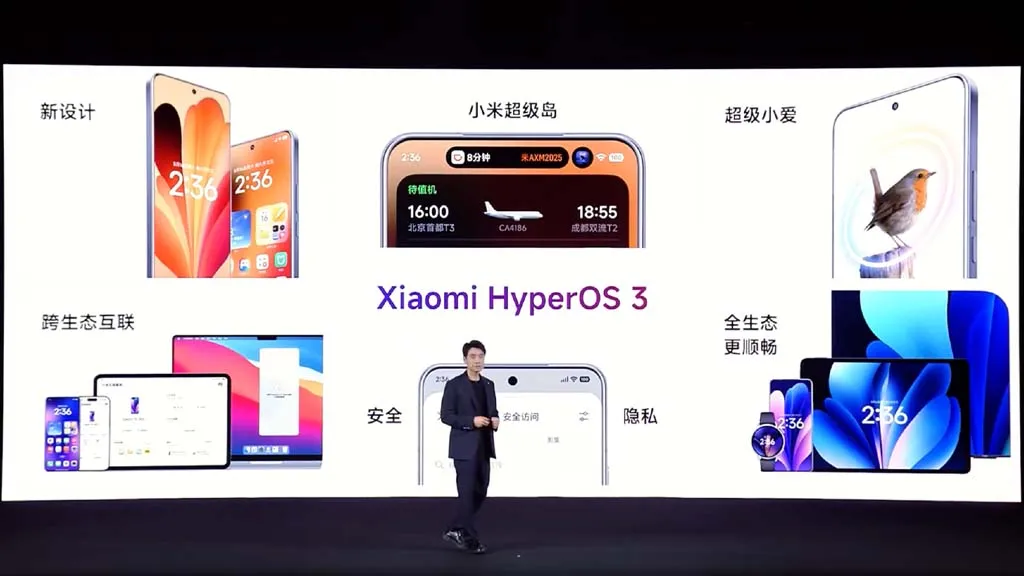
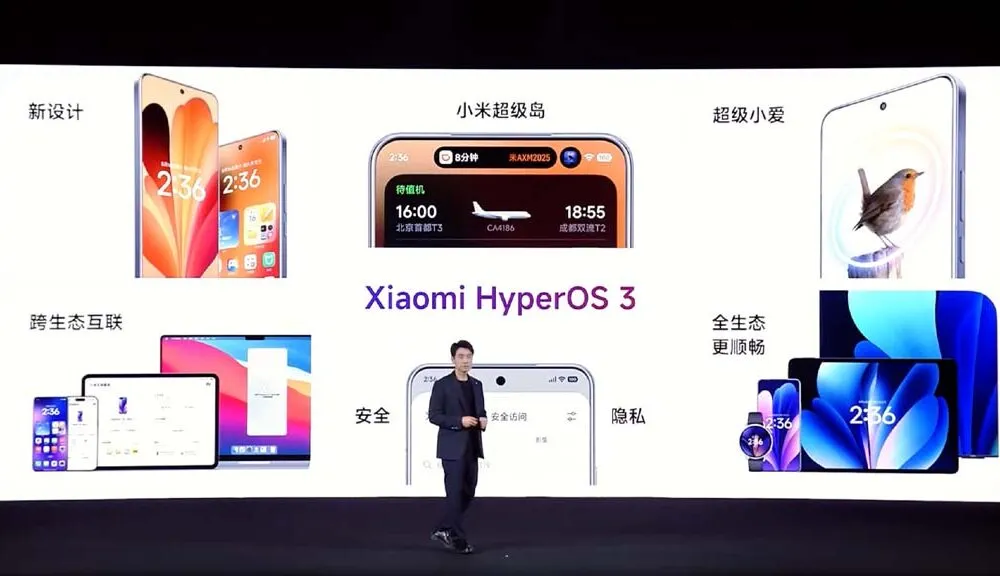
    Performance and visual design have undergone significant upgrades in HyperOS 3.0. Super Island, Xiaomi’s version of Apple’s Dynamic Island, is introduced in the user interface. It allows for dynamic and real-time content overlays surrounding the punch-hole camera. AI-generated options for new background and lock screen styles are also included.

    According to Xiaomi, HyperOS 3.0 offers performance gains of up to 30%. Ultra-low latency and pressure-sensitive pens and styluses are becoming more compatible with large-screen devices, such as tablets.

    With capabilities like HyperAI Writing, real-time transcription, and subtitle production, AI improvements are also a top priority.

  • HyperOS 3 beta now available on 12 additional Xiaomi and Redmi models

    HyperOS 3 beta now available on 12 additional Xiaomi and Redmi models

    The Xiaomi 14 series, MIX Flip, MIX Fold 4, and Redmi K70 range are among the additional smartphones that Xiaomi is releasing HyperOS 3 for. Owners of these phones can now receive an early sample of the Android 16-based upgrade before the stable release occurs later this year, while testing is still ongoing.

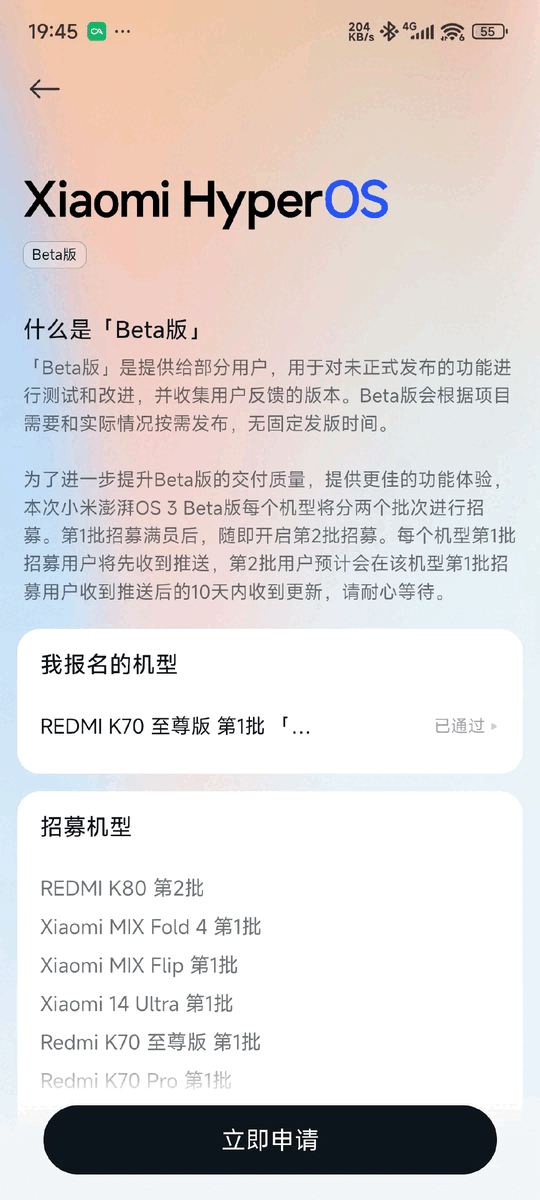
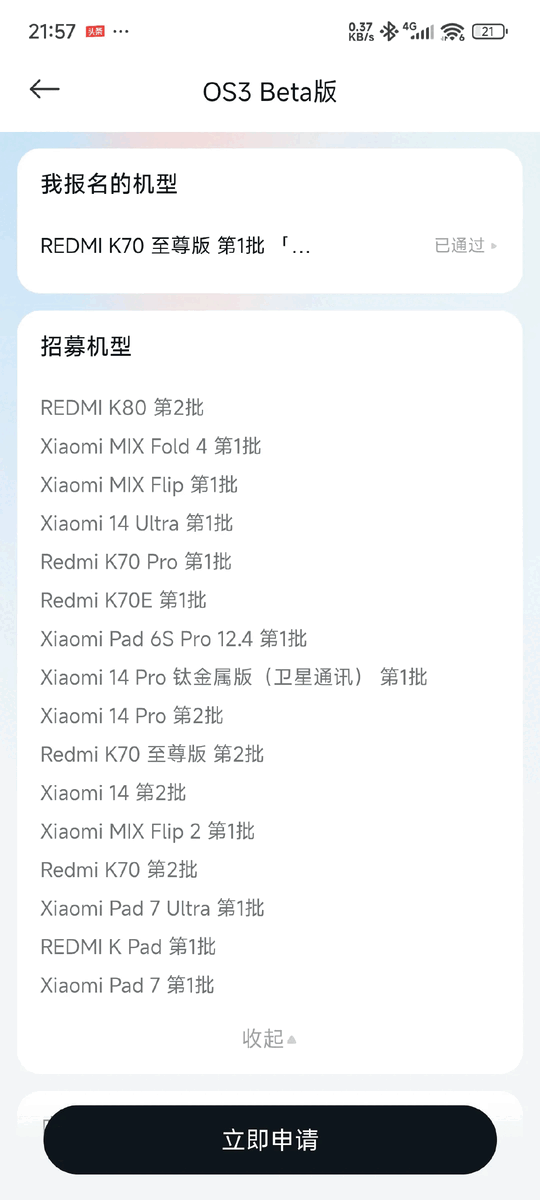
    A new batch of Xiaomi and Redmi smartphones have been added to the HyperOS 3 beta program, which enables a small group of customers to test drive the company’s latest software prior to its general release. Owners of the Xiaomi 14 series, MIX Flip, Redmi K70 lineup, and Xiaomi Pad 6S Pro are being invited to participate in the most recent round. They will have the opportunity to test an early build of HyperOS 3, which is based on Android 16, and assist the software team in resolving any significant bugs or issues before the scheduled stable rollout.

    The list of gadgets receiving the most recent wave of the HyperOS 3 beta:

    • Xiaomi MIX Fold 4
    • Xiaomi MIX Flip
    • Xiaomi 14 Ultra
    • Xiaomi 14 Ultra Titanium Edition
    • Xiaomi 14 Pro 
    • Xiaomi 14 Pro Titanium Edition
    • Xiaomi 14
    • Redmi K70 Pro
    • Redmi K70 Ultra
    • Redmi K70 (sold internationally as the POCO F6 Pro)
    • Redmi K70E (sold internationally as the POCO X6 Pro)
    • Xiaomi Pad 6S Pro 12.4

    Although the closed beta is now only available for Chinese models, international versions will soon follow. A broader deployment appears inevitable, as Xiaomi has already begun similar beta tests for international models such as the Xiaomi 14 Ultra, Xiaomi 14T, POCO F7, Redmi 15C, and POCO C85.

    csm HyperOS 3 Chinese beta 83208f7bb5

    To obtain HyperOS 3, you must apply for a position in the program through the Xiaomi Community app if you possess any of the devices mentioned above that have a China ROM. For every device, two groups of testers will be hired; testers in the first batch will have instant access to the update, while testers in the second batch may have to wait up to ten days. Before beginning, make sure you have a complete backup of your device and have read the instructions.

    csm HyperOS beta 3 China 1 f7f5b85a0e

    HyperOS 3 global rollout confirmed for November-December

    The Chinese Xiaomi 14 series, MIX Fold 4, MIX Flip, and Redmi K70 devices are expected to receive the stable HyperOS 3 update in November. Global variants such as the Xiaomi 14 series, the Xiaomi Pad 6S Pro 12.4, the POCO F6 Pro (a rebranded Redmi K70), and the POCO X6 Pro (a rebranded Redmi K70E) will be released in November, with the full deployment continuing into December.

  • Xiaomi confirms HyperOS 3 rollout with Android 16: full schedule and device list

    Xiaomi confirms HyperOS 3 rollout with Android 16: full schedule and device list

    A complete list of devices and a schedule are already available, and Xiaomi’s Android 16 update is official. HyperOS 3 is scheduled to launch in October.

    Xiaomi’s Android skin receives a few new improvements from HyperOS 3, including:

    Xiaomi claims you won’t have to wait long, so there’s a good deal to look forward to.

    Android 16 release today

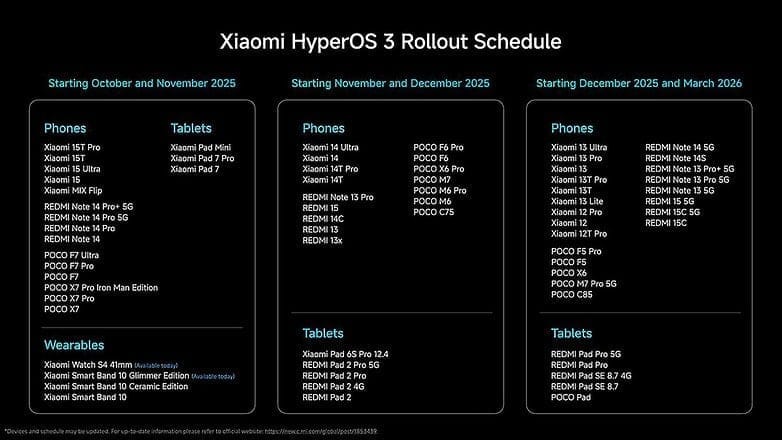
    In October, HyperOS 3 will begin to roll out on the Xiaomi 15T series, with the Xiaomi 15 following shortly after. After that, the rollout lasts until March 2026. The following is Xiaomi’s schedule, which may change over time.

    Xiaomi HyperOS 3 (Android 16) Rollout Schedule

    October/November 2025

    Phones

    • Xiaomi 15T Pro
    • Xiaomi 15T
    • Xiaomi 15 Ultra
    • Xiaomi 15
    • Xiaomi MIX Flip
    • REDMI Note 14 Pro+ 5G
    • REDMI Note 14 Pro 5G
    • REDMI Note 14 Pro
    • REDMI Note 14
    • POCO F7 Ultra
    • POCO F7 Pro
    • POCO F7
    • POCO X7 Pro Iron Man Edition
    • POCO X7 Pro
    • POCO X7

    Tablets

    • Xiaomi Pad Mini
    • Xiaomi Pad 7 Pro
    • Xiaomi Pad 7

    Wearables

    • Xiaomi Watch S4 41mm (Available now)
    • Xiaomi Smart Band 10 Glimmer Edition (Available now)
    • Xiaomi Smart Band 10 Ceramic Edition
    • Xiaomi Smart Band 10

    November/December 2025

    Phones

    • Xiaomi 14 Ultra
    • Xiaomi 14
    • Xiaomi 14T Pro
    • Xiaomi 14T
    • REDMI Note 13 Pro
    • REDMI 15
    • REDMI 14C
    • REDMI 13
    • REDMI 13x
    • POCO F6 Pro
    • POCO F6
    • POCO X6 Pro
    • POCO M7
    • POCO M6 Pro
    • POCO M6
    • POCO C75

    Tablets

    • Xiaomi Pad 6S Pro 12.4
    • REDMI Pad 2 Pro 5G
    • REDMI Pad 2 Pro
    • REDMI Pad 2 4G
    • REDMI Pad 2

    December 2025 through March 2026

    Phones

    • Xiaomi 13 Ultra
    • Xiaomi 13 Pro
    • Xiaomi 13
    • Xiaomi 13T Pro
    • Xiaomi 13T
    • Xiaomi 13 Lite
    • Xiaomi 12 Pro
    • Xiaomi 12
    • Xiaomi 12T Pro
    • POCO F5 Pro
    • POCO F5
    • POCO X6
    • POCO M7 Pro 5G
    • POCO C85
    • REDMI Note 14 5G
    • REDMI Note 145
    • REDMI Note 13 Pro+ 5G
    • REDMI Note 13 Pro 5G
    • REDMI Note 13 5G
    • REDMI 15 5G
    • REDMI 15C 5G
    • REDMI 15C

    Tablets

    • REDMI Pad Pro 5G
    • REDMI Pad Pro
    • REDMI Pad SE 8.7 4G
    • REDMI Pad SE 8.7
    • POCO Pad
  • Motorola Edge 70 leak reveals ultra-slim body design

    Motorola Edge 70 leak reveals ultra-slim body design

    The Edge 70 is Motorola’s response to the new Apple iPhone Air and Galaxy S25 Edge, and super slim smartphones are the newest trend in the smartphone business. Finally, a new leak has given us a clear glimpse of the forthcoming Edge 70, revealing a high-end, incredibly thin body.

    Motorola Edge 70 leak hints at sleek, slim new design

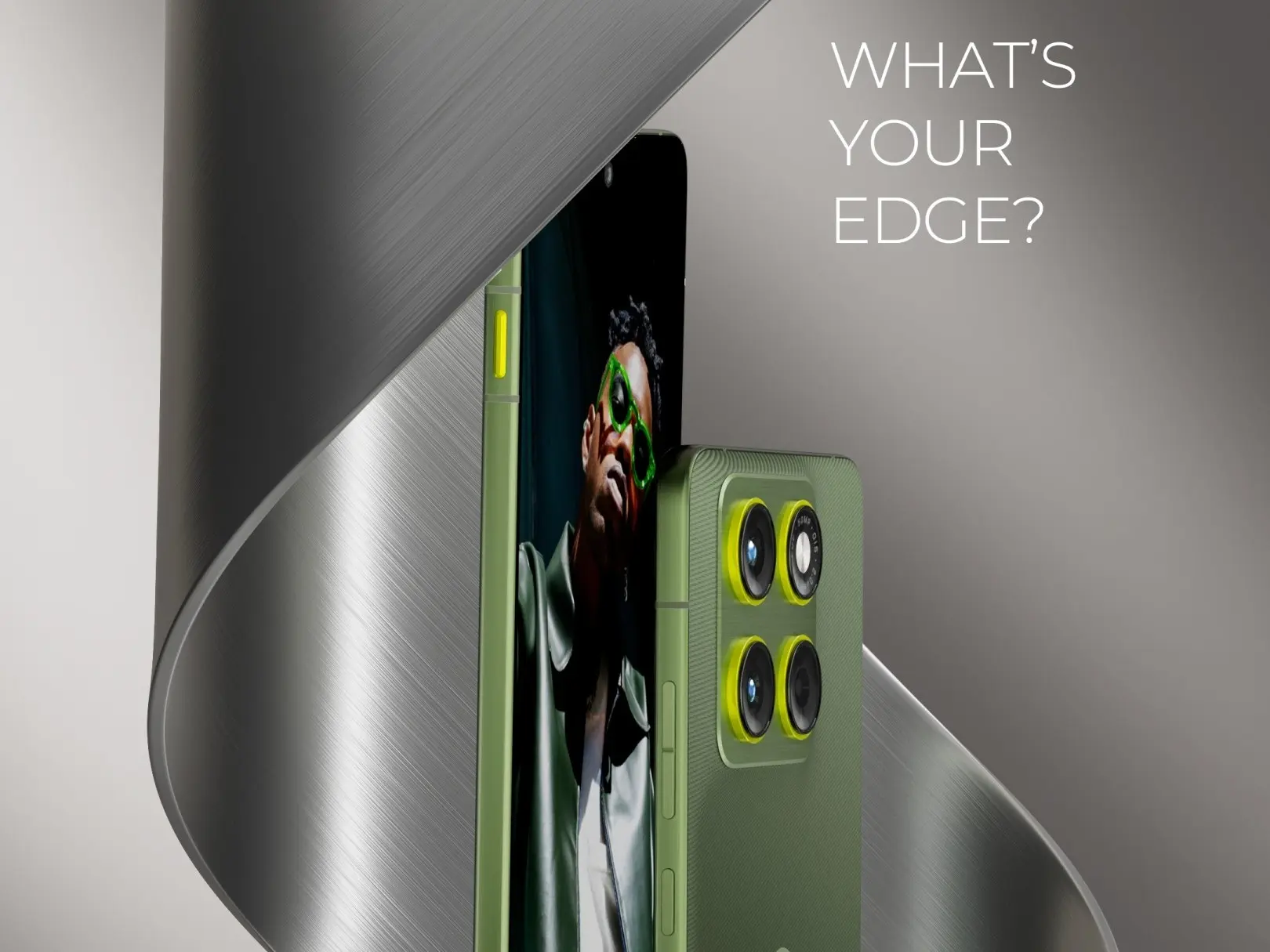
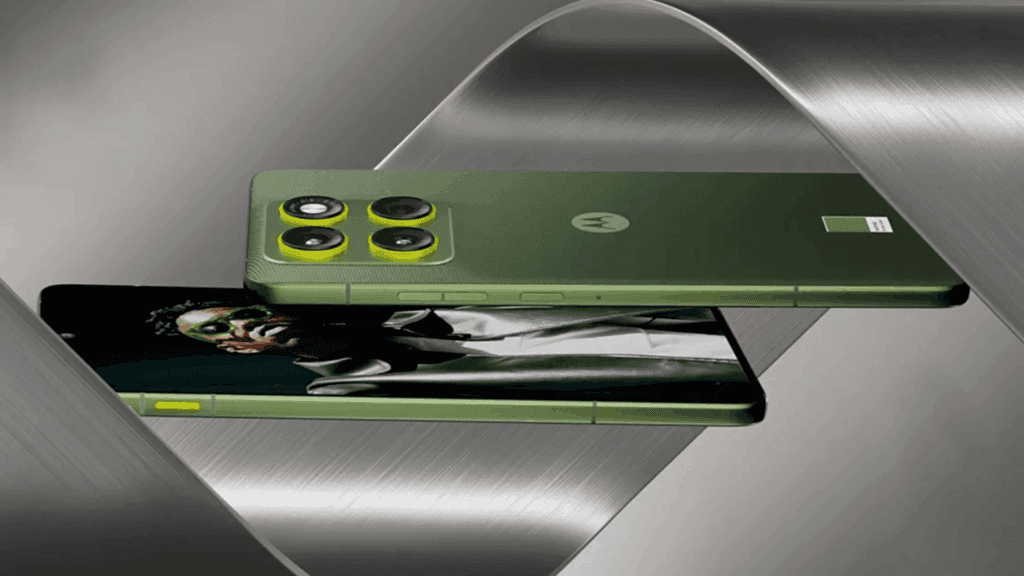
    Motorola Edge 70 design green color

    Thanks to well-known tipster Evan Blass, we finally got a first glance at the Moto Edge 70. He recently tweeted about a leaked teaser poster that showed off the incredibly thin body of Motorola’s next Edge series smartphone. Looking at the image, the words “Impossibly Thin and Incredibly Tough” are displayed alongside the Edge 70. Thin-bodied smartphones usually need to be durable to prevent bending; high-end devices, such as the iPhone Air and Galaxy S25 Edge, use durable materials like titanium.

    Although Motorola is unlikely to use a comparable alloy, we may anticipate that the frame will be constructed from a durable aluminum alloy. The famous vegan leather material is frequently used by the firm for the back panels of their cellphones. However, the green color choice seems to use a glass back this time. Interestingly, the frame’s green hue blends in with the rest of the color scheme. Motorola’s foldable Razr series is the company’s flagship product, and the Edge family of phones are mid-range models.

    There are now very few tiny cellphones available on the market, and the most well-liked ones are high-end flagship models. Therefore, the Edge 70 is at last bringing the premium, high-end design to a more reasonably priced range. Additionally seen are an AI Key and a triple camera arrangement on the front of the forthcoming gadget. Since the Edge 60’s design measured 7.9 mm, the Edge 70’s body will probably be 7 mm or thinner.

  • Oppo confirms Find X9 series launch for October 16 — design and specs revealed

    Oppo confirms Find X9 series launch for October 16 — design and specs revealed

    Oppo officially announced that its Find X9 series will ship on October 16. Redesigned design elements, improved imaging, and notable battery improvements are all part of the new flagship lineup, which comprises the Find X9 and X9 Pro, according to information released on the company’s official channels.

    Find X9 series key details revealed by Oppo ahead of launch

    For comfortable handling, the Find X9 and Find X9 Pro come in 6.59-inch and 6.78-inch sizes with flat screens and symmetrical bezels that are incredibly thin. The rear panel of both smartphones has a sophisticated feel and a smooth grip thanks to its velvet sand finish.

    Find X9 series colors

    The lens module and the back have been completely merged using cold carving technique, which minimizes any obvious connection lines. The display itself offers 3840Hz high-frequency PWM dimming for improved visual comfort in addition to a full-scene 1nit eye-care mode that is compatible with all apps.

    The rear design of the Find X9 series has been made public for the first time in the brand’s latest pictures. The following shades will be offered for the series: Frost White, Mist Black, Velvet Sand Titanium, and Velvet Light Titanium, the manufacturer stated.

    oppo find x9 camera setup

    Regarding imaging, the series incorporates a Hasselblad quad camera system, which is housed in a small, square housing that lets in more light without adding bulk. The series is powered by MediaTek‘s Dimensity 9500 platform, which is based on a 3nm technology and has an Imagiq 1190 image processor, G1-Ultra GPU, and a revamped CPU.

    In order to maximize performance and efficiency across all usage circumstances, Oppo has also unveiled a new Tidal Engine software layer. It has been verified that the Find X9 and X9 Pro have 7,025mAh and 7,500mAh batteries, respectively. Both phones will enable 50W wireless and 80W wired charging.

    Additionally, Oppo has stated that the Find X9 and the Pro will shortly make their global debut. According to a recent source, the global launch ceremony is scheduled for October 28.