The Honor Magic 8 smartphone with the best performance rating has been seen on AnTuTu. Thanks to the latest Qualcomm Snapdragon 8 Elite Gen 5 chipset, which is said to have increased efficiency in addition to improving the device’s functionality.
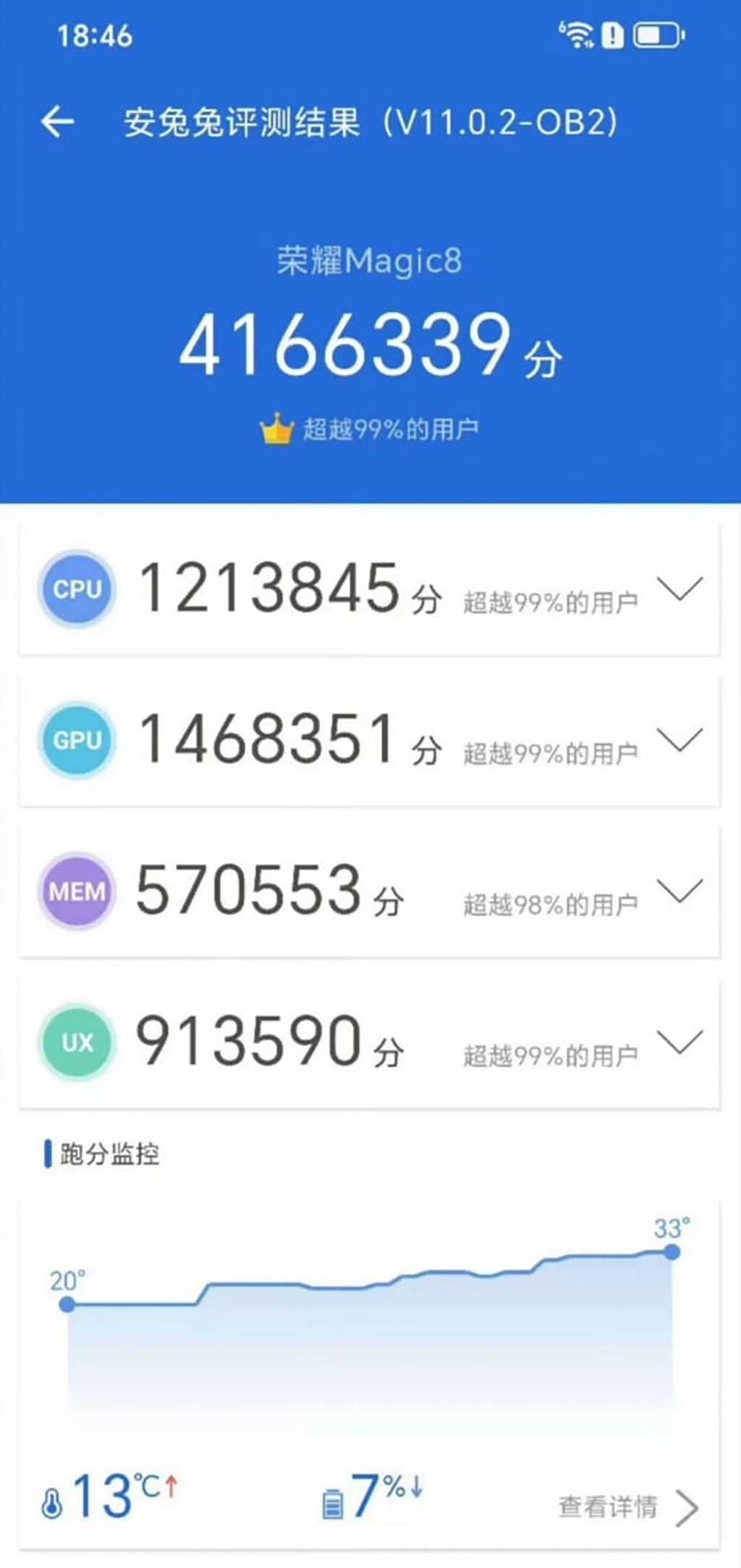
Today, a number of Weibo tipsters revealed the Honor Magic 8 phone’s AnTuTu score. At room temperature, the device’s real operating points are 4.16 million.
To surpass the performance score on AnTuTu by more than 4 million is a significant accomplishment for the flagship model. It implies that the Magic 8 series will provide users with reliable and smooth operation in every way.
The CPU, GPU, MEM, and UX scores are highlighted while looking at the AnTuTu listing. All of these scores are available for review below, along with the key points.
Honor Magic 8: AnTuTu Score
Total Points: 4166339
CPU: 1213845
GPU: 1468351
MEM: 570553
UX: 913590
The 5th generation Snapdragon 8 Elite chip will be available in Honor’s devices. It has a full-core architecture with two Oryon v2 super cores operating at 4.6GHz and six performance cores operating at 3.62GHz, and it is based on the TSMC 3nm technology.
One of the company’s execs even asserted that, in comparison to competitors like Xiaomi, the Honor Magic 8 series will provide the finest Snapdragon chipset experience.
“What do you think of Xiaomi’s first LOFIC technology? The next Honor Magic 8 series is coming, and it is also equipped with the same chip. Honor has always been very powerful in Snapdragon optimization. Will this Honor optimization achieve any better results?” – said Honor Li Kun.
Leaks of the Magic 8 smartphones have started to reveal additional features and technological possibilities. It’s possible that the business is prepared to launch its premier lineup by mid-October.
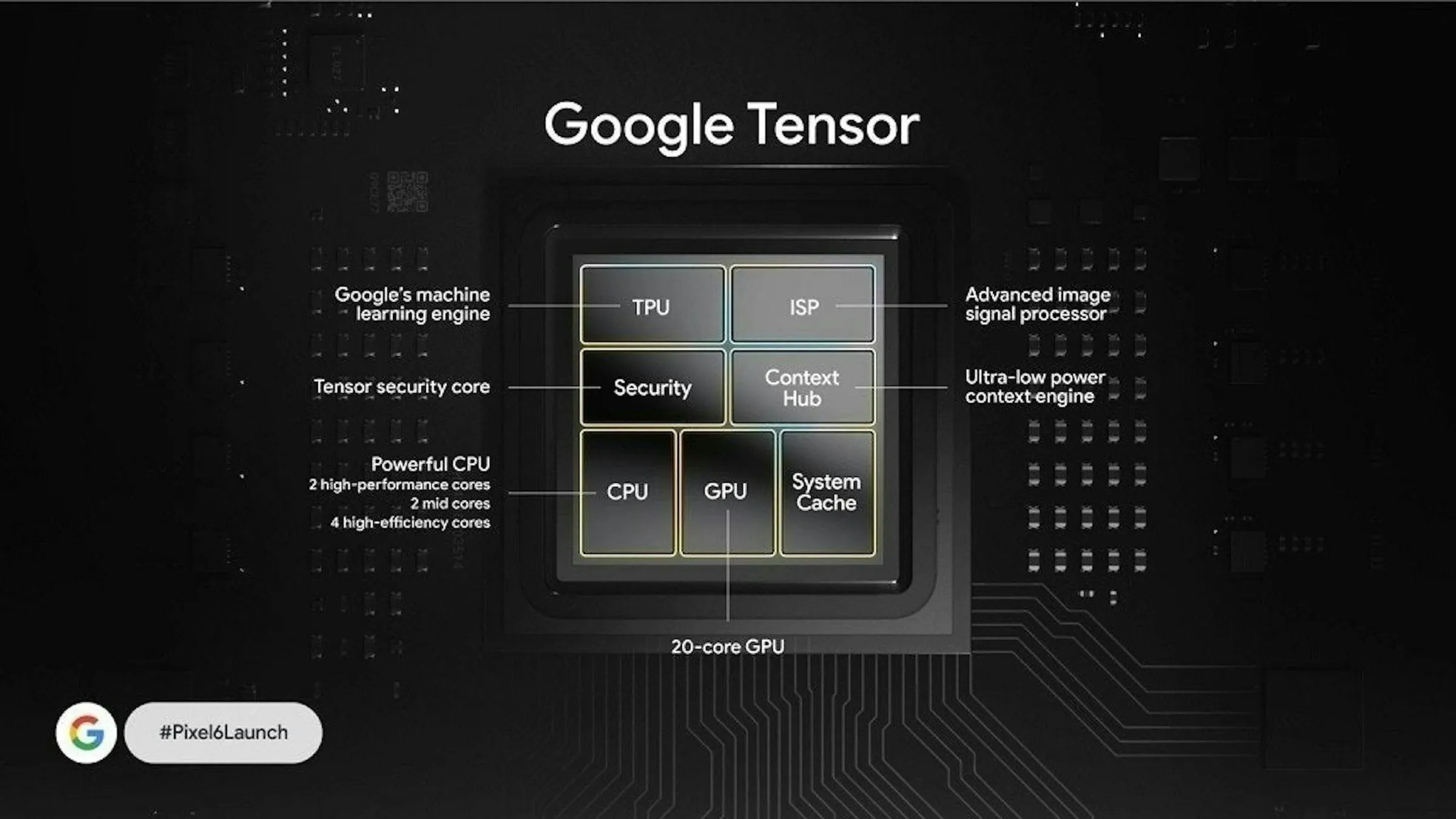
Over the years, Google’s proprietary Tensor chips have progressively advanced to become a dependable everyday driver with strong energy economy. However, performance has frequently been a source of contention. Previous Tensor chips performed well on routine tasks, but not so well on intensive workloads like gaming. That might change with the upcoming Tensor G5, which promises notable performance improvements.
“Tensor G5 is our greatest upgrade yet and gives a huge performance gain,” the tech giant claims. The newest Tensor chip, which launched with the Pixel 10 series last month, is said to feature a 30% faster average CPU and a 60% more potent TPU. Additionally, this is Google’s first mobile chipset produced at TSMC’s facility; Samsung previously produced Tensor chips. Better performance and increased battery economy are promised by the Tensor G5’s use of a more sophisticated 3nm manufacturing node.
Will the Tensor G5’s major improvements, as promised by Google, significantly improve benchmark scores where earlier Tensor chips have underperformed? We’ll examine the benchmark numbers. Here is the specification document to view the differences on paper before that:
Samsung Exynos 5400 5G modem Wi-Fi 7, Wi-Fi 6E Bluetooth 6.0
Samsung Exynos 5400 5G modem Wi-Fi 7 Bluetooth 6.0
AnTuTu
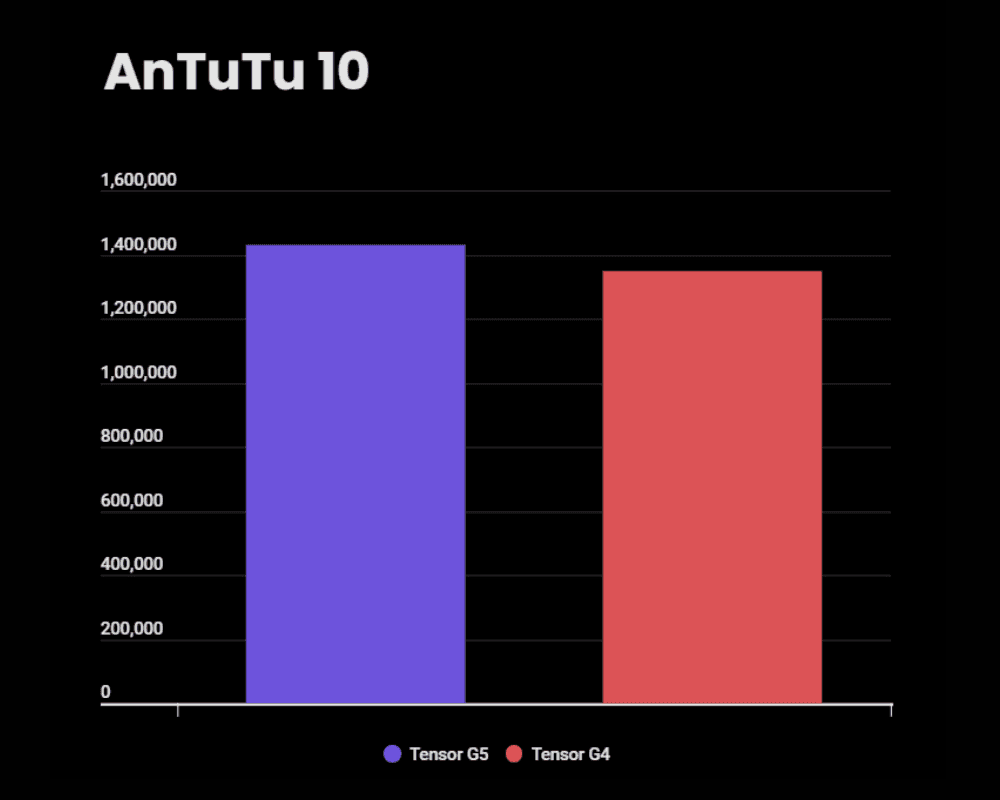
According to the AnTuTu (version 10) benchmark, the new Tensor G5 chip has a little overall improvement of 6%, scoring 1,429,557 as opposed to 1,348,226 for the Tensor G4. However, there is a pleasant 20% rise in the CPU (483,989 vs. 401,746). The RAM and UX scores also favor the newer chip with an improvement of roughly 10%.
The most unexpected of all is the GPU score, which is actually 10% lower than the G4 from the previous year. This implies that rather than promoting sheer graphics performance, Google might have placed greater emphasis on efficiency.
Tensor G5
Tensor G4
AnTuTu score
1,429,557
1,348,226
CPU
483,989
401,746
GPU
416,313
462,415
Memory
293,467
266,535
UX
235,788
217,530
Geekbench
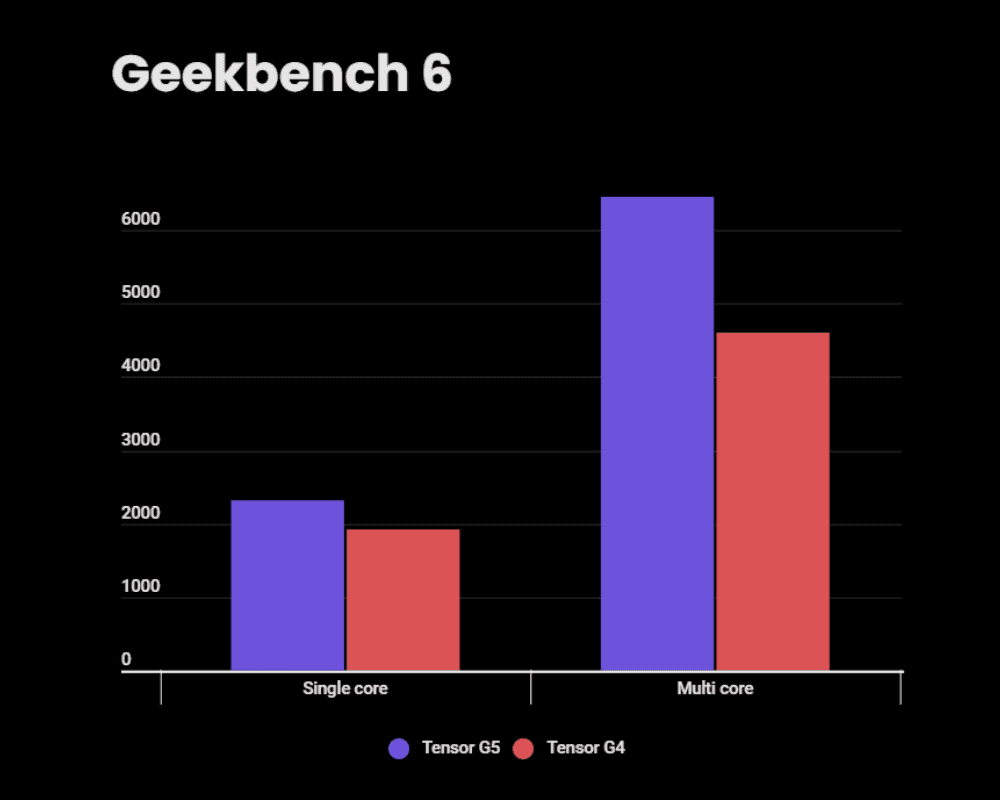
The Tensor G5 clearly outperforms the Tensor G4 in Geekbench 6. Its 2,316 single-core test score is around 20% higher than the G4’s 1,923, indicating faster responsiveness for daily tasks like UI navigation and app launches.
Stronger performance in multitasking, productivity apps, and heavier workloads is highlighted by the multi-core score, which soars to 6,452, a staggering 40% increase over the G4’s 4,602.
Overall, the results from Geekbench point to encouraging gains in Tensor G5’s raw CPU performance, particularly in multi-core efficiency, which could result in considerably more fluid performance.
G5
G4
Single core
2,316
1,923
Multi core
6,452
4,602
3DMark score
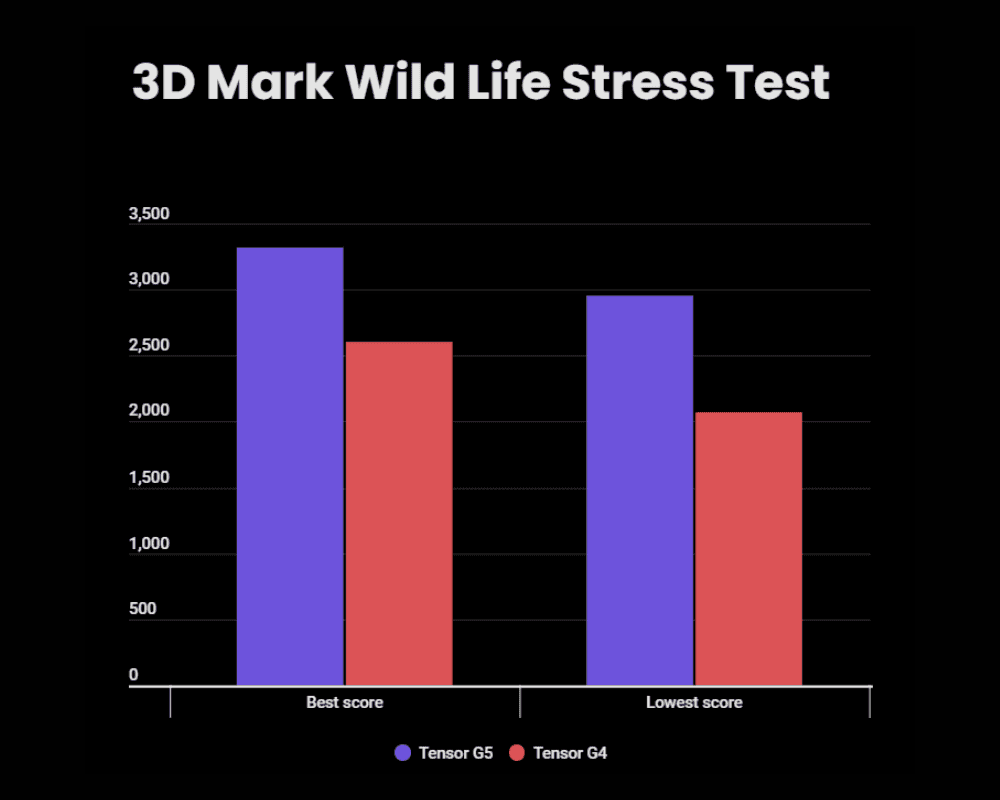
In the 3DMark Wild Life Extreme Stress Test, which gauges sustained GPU performance under high load, the Tensor G5 clearly outperforms the Tensor G4. With a highest loop score of 3,319 as opposed to 2,603 for the G4, the G5 scores an astounding 27% improvement in peak graphics performance.
More significantly, the G5 offers improved consistency as well. The G4 descends to 2,071, and its lowest loop score is 2,954. 89% vs. 79.6% is not only better performance, but also significantly more stability. As a result, the Tensor G5 is far less likely to experience thermal throttling and ought to offer more consistent, fluid gaming over extended periods.
Tensor G5
Tensor G4
Best loop score
3,319
2,603
Lowest loop score
2,954
2,071
Stability
89%
79.6%
Tensor G5 vs Tensor G4
Thanks to enhanced CPU cores and more sophisticated TSMC manufacturing, the Tensor G5 exhibits encouraging improvements in CPU performance. GPU performance and consistency have also significantly improved, according to the 3DMark test. A better gaming experience and faster daily performance should follow from this. The majority of the heating and throttling problems users had with earlier Tensor chips are likewise fixed by the new chip.
Even while the latest Tensor chip offers significant improvements, Google still needs to catch up in order to compete with Qualcomm and MediaTek’s top offerings. We have contrasted the Snapdragon 8 Elite and Snapdragon 8 Gen 3 with the Tensor G5. To see how Google’s most recent chip compares to the finest in the business, you can look through those comparisons.
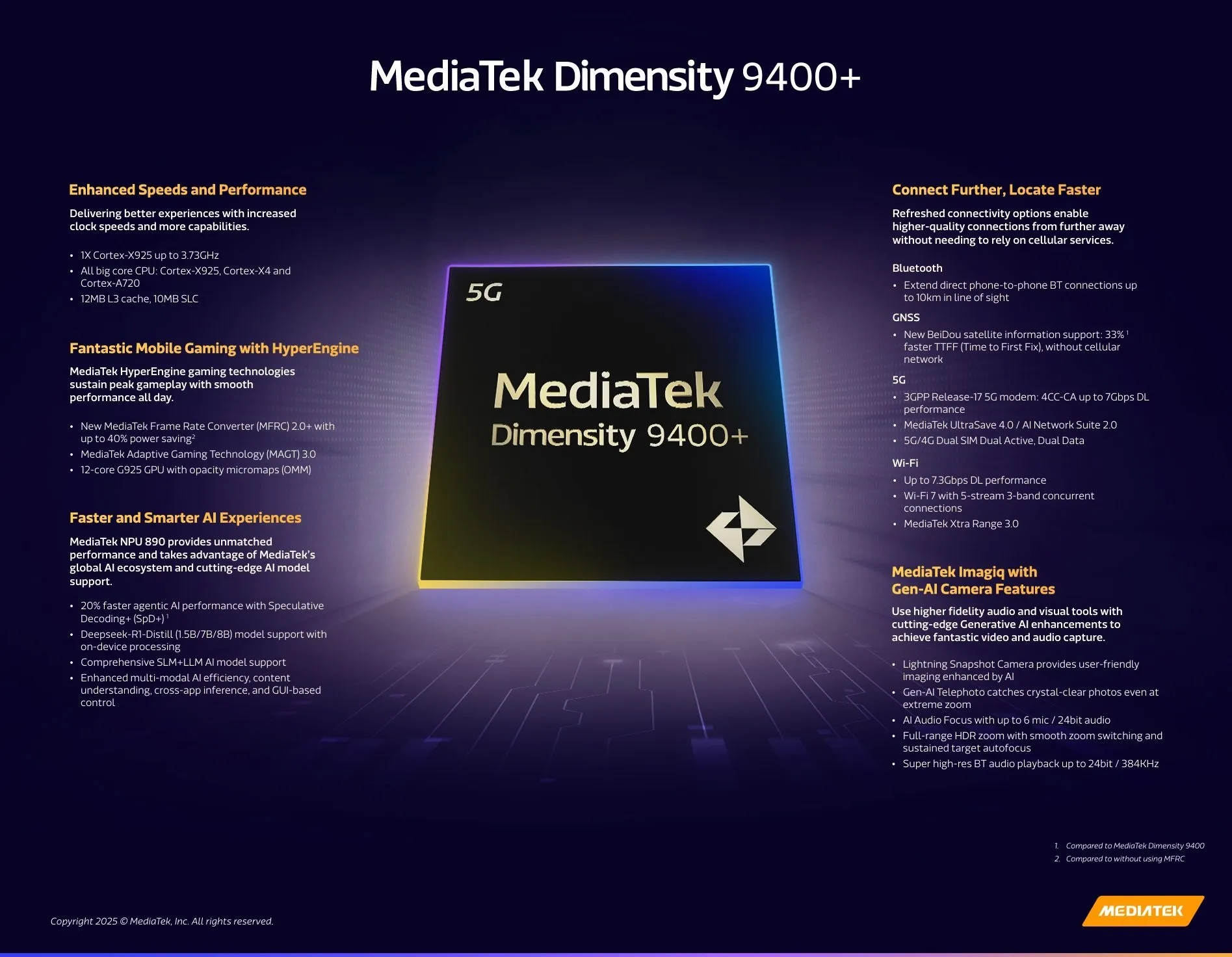
The flagship chipset, the Dimensity 9400+, was revealed in April as the replacement for the Dimensity 9400 from the previous year. It is constructed with TSMC’s state-of-the-art 3nm technology and has a powerful CPU and GPU that guarantee seamless operation even under demanding conditions.
To discover how the flagship-grade MediaTek Dimensity 9400+ chipset compares to its rivals, we’ll be examining its benchmark scores here.
Note: The Vivo X200s (powered by MediaTek Dimensity 9400+) underwent the following benchmark testing.
MediaTek Dimensity 9400+ AnTuTu score
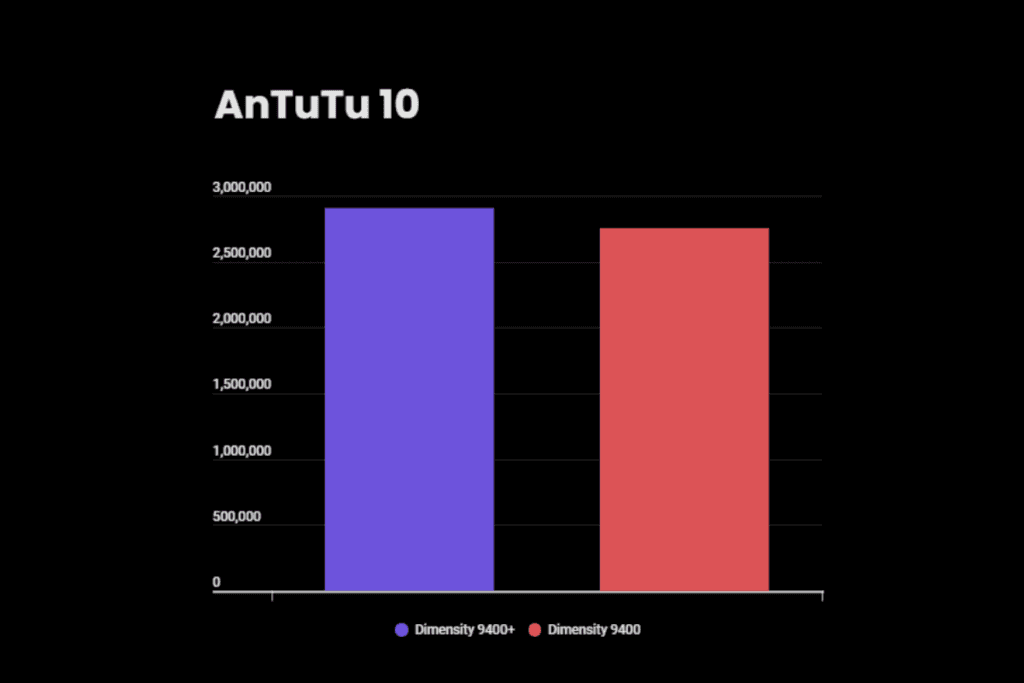
The Dimensity 9400+ receives more than 2.9 million points overall on AnTuTu v10. According to the breakdown, the CPU receives 625K points, the GPU receives 1.3 million, the memory receives 509K, and the user interface receives 459K.
In contrast, the Oppo Find X8, which is powered by the Dimensity 9400, has an overall AnTuTu score of about 2.7 million. There isn’t much of a difference between the two AnTuTu scores for the more recent chip.
Dimensity 9400+
Dimensity 9400
AnTuTu score
2,907,358
2,754,825
CPU
625,811
622,149
GPU
1,312,632
1,220,751
Memory
509,570
489,110
UX
459,344
422,815
Dimensity 9400+ Geekbench score
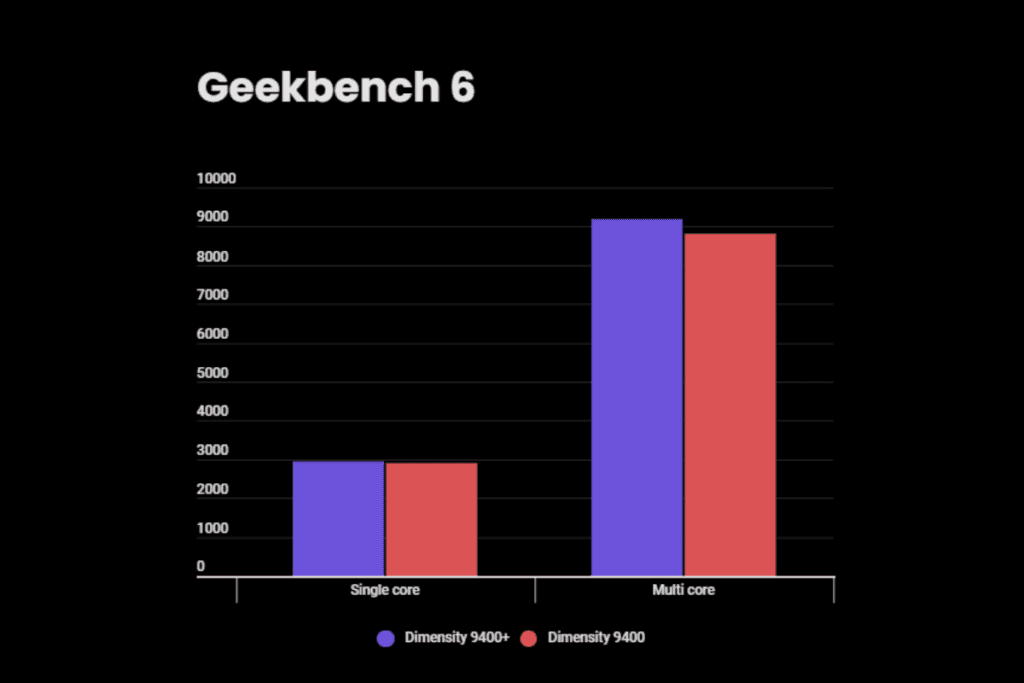
The Dimensity 9400+ receives 2,945 single-core and 9,184 multi-core marks in Geekbench 6. Once more, the Dimensity 9400, which boasts 2,904 single-core and 8,812 multi-core scores, is not a much better processor.
Dimensity 9400+
Dimensity 9400
Single core
2,945
2,904
Multi core
9,184
8,812
MediaTek Dimensity 9400+
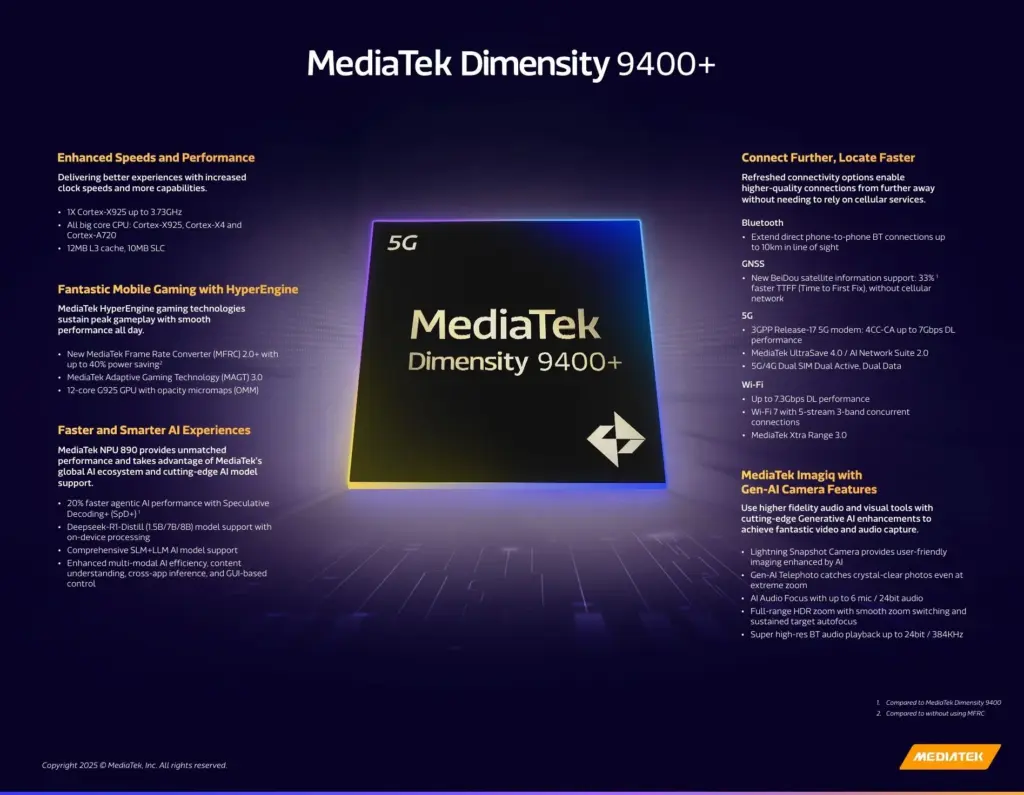
Compared to the Dimensity 9400, the Dimensity 9400+ isn’t much better. With the exception of a little boost in CPU speed for the big core, it still makes use of the same set of CPU cores—one Cortex-X925, three Cortex-X4, and four Cortex-A720. The manufacturing node (TSMC’s 4nm) and instruction set (ARMv9.2-A) remain unchanged.
The Mali-G9125 Immortalis MP12, which is based on ARM’s fifth-generation GPU architecture, offers no improvements at all. The MediaTek Frame Rate Converter tool has been improved, though not significantly. In well-known games, the updated version can provide twice the effective frame rate while also increasing power efficiency by up to 40%.
MediaTek would undoubtedly not miss out on the widespread use of agentic AI, as the Dimensity 9400+ offers a 20% quicker agentic AI performance than its predecessor with Speculative Decoding (SpD+). With on-device processing, the chip fully supports the DeepSeek-R1-Distill (1.5B/7B/8B) model.
With the exception of the newer Dimensity 9400+ chip, which increases phone-to-phone Bluetooth connections from 1.5km to 10km, connectivity isn’t getting any major changes. Everything else is the same, so it has a 3GPP Release-17 5G modem, Bluetooth 6.0, and Wi-Fi 7 (peak speed 7.3Gbps).
Dimensity 9400
Info
Announced
April 2025
Process node
3nm (TSMC)
CPU
1 x Cortex-X925 — 3.73GHz 3 x Cortex-X4 — 3.3GHz 4 x Cortex-A720 — 2.4GHz
GPU
Arm Immortalis-G925 MC12 MediaTek HyperEngine Gaming Ray tracing support
NPU
MediaTek NPU 890
Camera
MediaTek Imagiq 1090 ISP Up to 320MP single camera Up to 8K/60fp video recording Features: Gen-AI Telephoto, Full range HDR zoom, real-time AI segmentation in video
Stay connected with the latest from Droid Tools—follow us on X @droid_tools, like our page on Facebook, check out our updates on Instagram, and follow us on Google News for real-time news, device tips, and mobile tech insights.
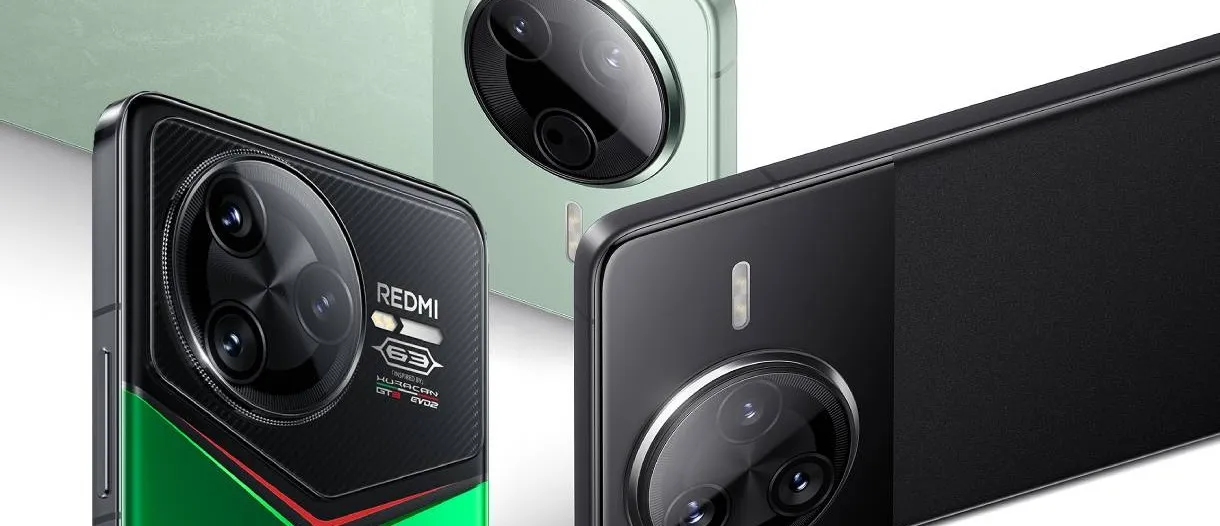
It has already been announced that the Redmi K80 series will debut on November 27. The business has revealed how well the Redmi K80 Pro can function in AnTuTu in order to create expectation.
On November 27, Xiaomi will formally launch the Redmi K80 series in China. According to reports, the regular model will launch as the F7 Pro and the K80 Pro as the F7 Ultra. The lineup is also anticipated to make its global premiere under the Poco brand sometime in December or early 2025.
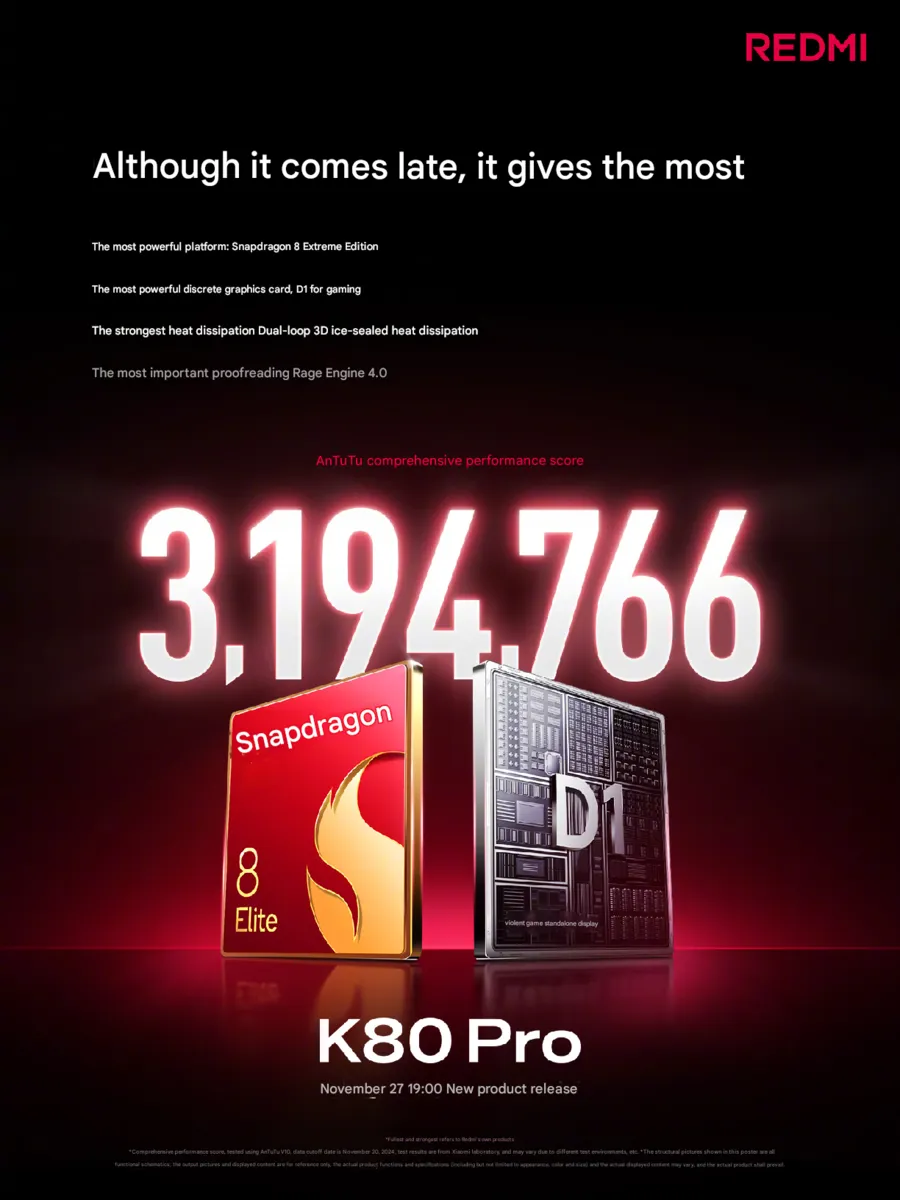
Xiaomi has revealed that the Redmi K80 Pro may score close to 3.2 million in AnTuTu before its Chinese launch. The business claims that it can reach 3,194,766 points in particular. The Snapdragon 8 Elite flagship phone has the greatest score to date, and it is far higher than the Asus ROG Phone 9’s record-breaking benchmark run.
Perhaps the Redmi K80 Pro’s enhanced 3D cooling technology made this record-breaking score feasible. This cooling method probably comprises a sizable vapor chamber, though the company has not disclosed any other setup information yet. It is currently unknown, though, if it will be sufficient to provide strong, long-term performance under high loads.
In addition to the AnTuTu score, the company said that the Snapdragon 8 Elite and D1 chip will be paired with the Redmi K80 Pro. Its purpose is to regulate the screen and improve game resolution and frame rates. In order to improve battery life, the chipset also seeks to provide excellent gaming performance without using a lot of power.
Overall, based on the company’s teasers, it appears that the K80 Pro will be a fantastic choice for anyone searching for a smartphone with a performance focus. Next month, it may even take the top spot in AnTuTu’s flagship smartphone list.
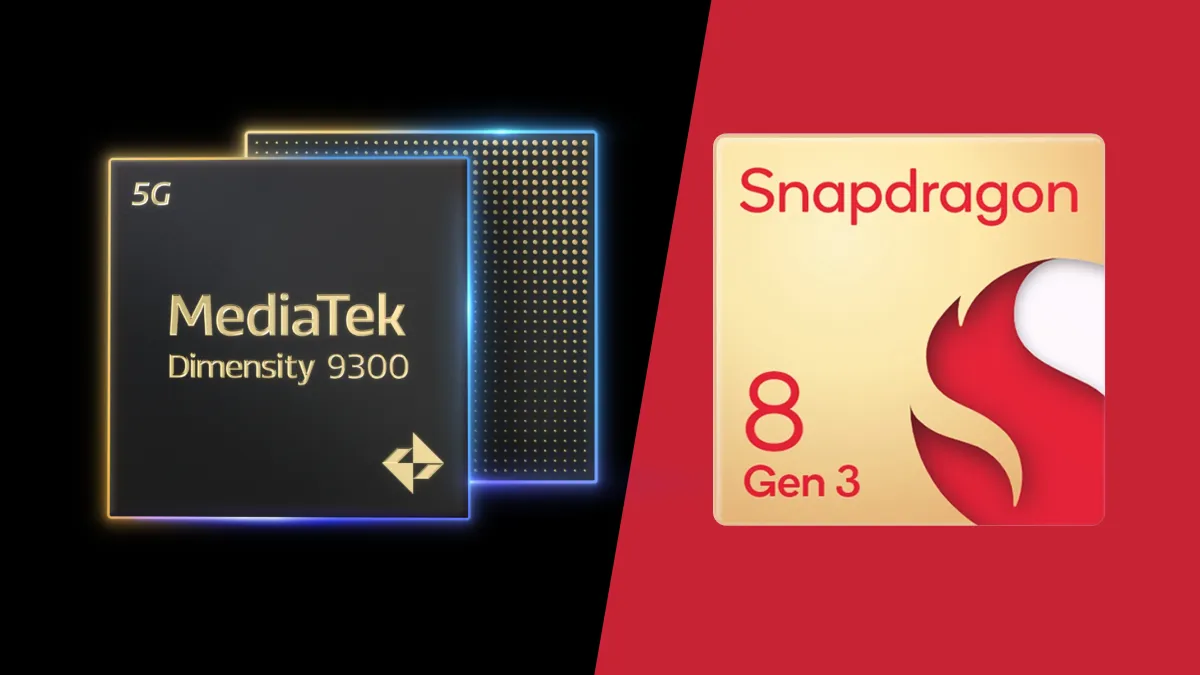
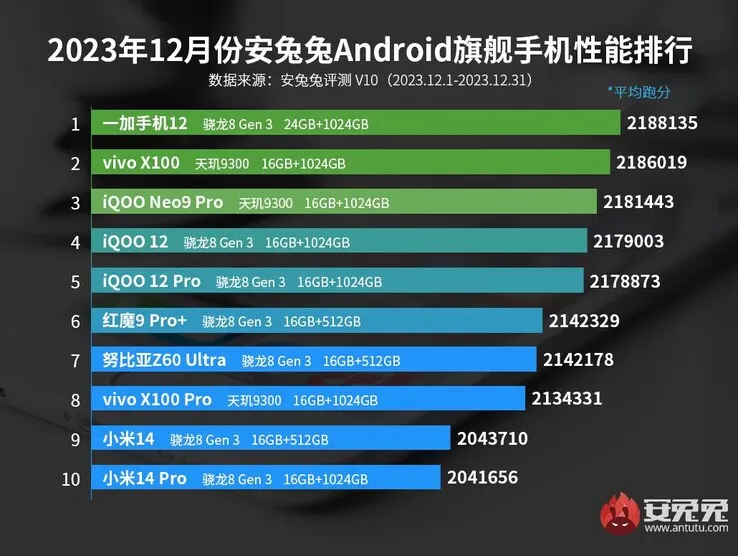
The two main flagship chipsets for Android this year are expected to be MediaTek’s Dimensity 9300 and Qualcomm’s Snapdragon 8 Gen 3. Both chipsets seem to deliver comparable performance, but AnTuTu’s most recent results suggest that the Dimensity 9300 in the new Vivo X100 has a slight advantage over the OnePlus 12 and its Snapdragon 8 Gen 3.
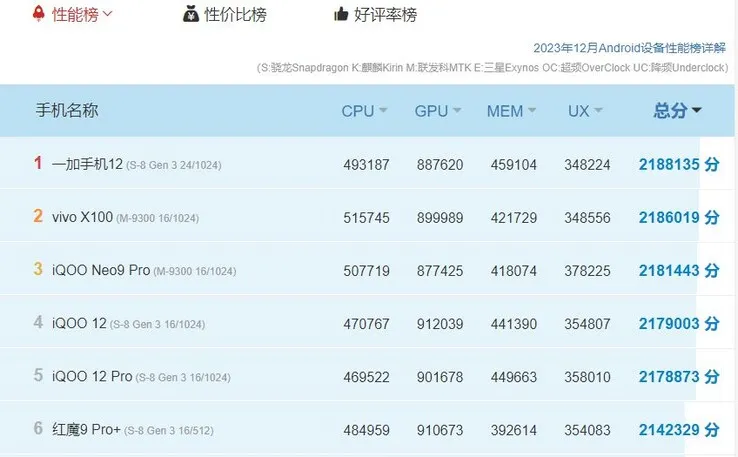
A closer look at the numbers reveals that the Dimensity 9300 outperforms the Snapdragon 8 Gen 3, with the MediaTek chipset scoring higher in the CPU and GPU tests. At first glance, the reverse seems to be true, with the OnePlus 12 ranking first with a total score of 2,188,135. The Vivo X100 comes in second with a score of 2,186,019.
The OnePlus 12 scores 493,187, whereas the Vivo X100 and its Dimensity 9300 register 515,745, indicating a roughly 5% CPU advantage for the MediaTek chipset. The difference is less pronounced in the GPU category, where the Vivo X100 scores 899,989, while the OnePlus 12 scores 887,620. Nevertheless, other Snapdragon 8 Gen 3-powered devices, such as the iQOO 12 duo, marginally outperform the Vivo X100 in this regard.
Evidently, the Dimensity 9300 edges over the Snapdragon 8 Gen 3 in both the CPU and GPU tests. The OnePlus 12 having the higher AnTuTu total score is completely down to it having superior memory, with the reported 24 GB of RAM earning it a higher score in the memory test than the Vivo X100’s 16 GB of RAM.
Xiaomi and Redmi phones have a secret GPU Overclock mode using MIUI software to boost gaming performance. You can get more FPS in games, better score for Antutu, if you allow this mode. Allowing this mode however will cause the system to overheat. Long-term usage it can turn into a dangerous situation.