Tag: 2nm

  • Samsung unveil Exynos 2600 performance boost and efficiency improvements on 2nm tech

    Samsung unveil Exynos 2600 performance boost and efficiency improvements on 2nm tech

    Samsung has begun discussing its first 2nm chips in public, and the figures are unexpectedly modest, which is causing some people to take notice. The business plans to begin shipping the new silicon in 2026, beginning with the Galaxy S26 series in Europe. Although the upgrades don’t seem like a “revolution” on paper, they are already helping Samsung earn large contracts and higher expectations.

    Samsung’s worldwide flagship strategy has been weak for years due to its Exynos chips. Customers in Europe have frequently received slower, less effective devices than their Snapdragon-equipped counterparts in the US, and it appears that the S26 and S26+ will follow suit. While the S26 Ultra is expected to continue using Qualcomm’s Snapdragon 8 Elite Gen 5 globally, those two variants are anticipated to employ the Exynos 2600.

    Exynos 2600 performance boost

    Samsung appears confident, though. According to the company’s most recent financial report, the new 2nm Gate-All-Around (GAA) process is expected to improve performance by around 5%, increase efficiency by 8%, and reduce chip size by about 5% when compared to its second-generation 3nm process. Those figures are not that large on their own. However, they are already paying off. Based on early 2nm capabilities, Samsung reportedly acquired about 25% of Galaxy S26 orders and a huge $16.5 billion contract with Tesla for its AI6 CPUs.

    Exynos 2600

    Another aspect of the jigsaw is yield. According to Samsung, the Exynos 2600 is currently achieving a yield rate of over 60%, which is supposedly sufficient to begin significant production. In comparison to employing Snapdragon chips, the company might save $20–$30 per unit if that remains true, which could result in a significant reduction in the bill of materials (BoM) for the European S26 models.

    However, not everyone believes that this is Samsung’s desired return. Exynos has a lengthy history of appearing promising on spec sheets but faltering once the phones are in the hands of consumers. Additionally, there is still a fundamental design gap: Samsung continues to use ARM’s standard Lumex core designs, which typically lag behind in real-world optimization, while Qualcomm and Apple develop highly customized CPU architectures.

    The question is rather straightforward as the Galaxy S26 debut draws near: is Samsung’s early 2nm jump a real turning point or is it just another case of déjà vu for European consumers? It’s obvious that the corporation believes little steps will build up. It’s another matter entirely if consumers concur.
  • Exynos 2600 will be the market’s first 2nm chipset according to Samsung

    Exynos 2600 will be the market’s first 2nm chipset according to Samsung

    Today, Samsung released its quarterly financial report, which showed that its semiconductor division suffered greatly, resulting in a more than 50% decline in total operating income. The company’s upcoming Exynos 2600 chip, which will be manufactured using Samsung Foundry’s 2nm Gate-All-Around (GAA) process, is a bright spot despite the poor financial results. When it launches alongside the Galaxy S26 series, it will be the first 2nm chipset on the market.

    Exynos 2600

    Exynos 2600 will be the first flagship chipset fabricated on the latest 2nm GAA process [via Samsung Foundry]… 2600 offers a significant improvement in NPU performance versus the prior version with enhanced support for on-device AI functionality.

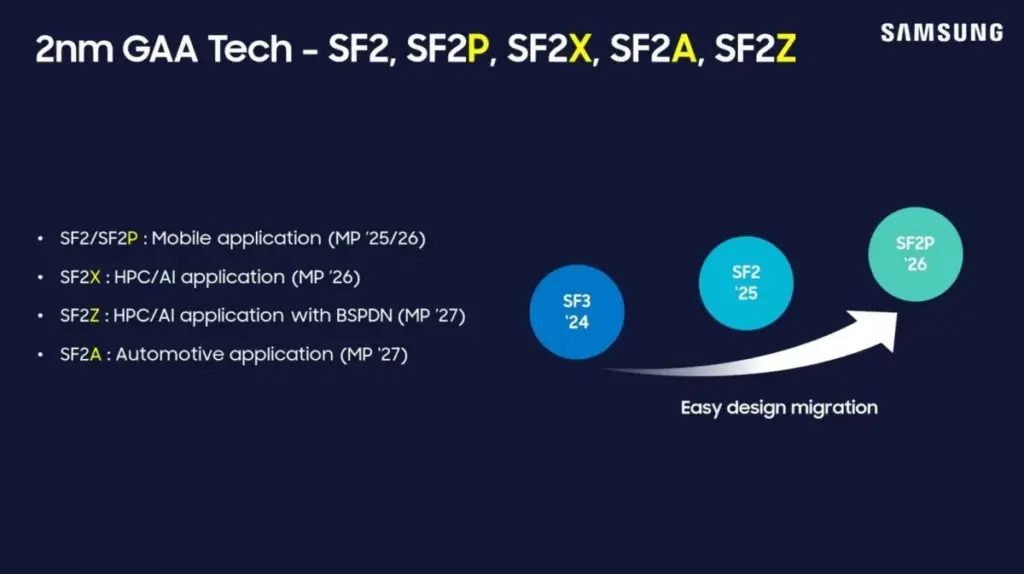
    Also, Samsung announced that the 2nm Gate-All-Around (GAA) process will be used to fabricate its next Exynos 2600 chipset.

    A leaked Geekbench listing claims that the Exynos 2600 will have a ten-core CPU, similar to the Exynos 2500, but with a different core configuration.

    Exynos 2600 will have a 1+3+6 design, according to the listing, with a single prime core clocked at 3.55 GHz, three performance cores operating at 2.96 GHz, and six efficiency units operating at 2.46 GHz. The Xclipse 960 GPU, which will accompany the CPU, is anticipated to provide up to 15% more performance than the Adreno 830 found in Qualcomm’s Snapdragon 8 Elite.

    The Galaxy S26 Pro and S26 Edge are anticipated to sport the Exynos 2600, while the S26 Ultra is likely to continue with Qualcomm’s top Snapdragon 8 Elite 2.

  • Samsung started manufacturing 2nm Exynos 2600 CPUs

    Samsung started manufacturing 2nm Exynos 2600 CPUs

    The in-house Exynos 2600 chipset is expected to be manufactured by Samsung, which is apparently nearing mass production readiness, according to a recent Korean article.

    In terms of competition, Samsung Foundry has not yet reached the desired milestone, whereas TSMC has already exceeded 60% yield on their 2nm class N2 node. However, a recent report indicates that the nascent chip manufacturer is rather close, with yields currently falling between 4 and 50 percent. It is far higher than the predicted 30% figure that was released in February.

    exynos 2600

    Samsung may be forced to forgo the Snapdragon 8 Elite 2 chip for the upcoming Galaxy S26 series in some areas next year due to the Exynos 2600 chipset’s promising results from the efficient 2nm technology.

    The Snapdragon 8 Elite 2 for Galaxy will be developed using the same 2nm technology, the report also reveals. It is expected to appear in the second half of 2026, maybe alongside the Galaxy Z Fold 8 and Galaxy Z Flip 8.

    According to a post published by a tipster on X, the Korean tech giant apparently had to sacrifice performance in order to obtain functional chips, meaning that SF2 will once again lag behind TSMC’s N2 node in terms of raw performance. There might be a significant performance difference between the standard Snapdragon 8 Elite 2 and the tipster’s claim if it turns out to be accurate.