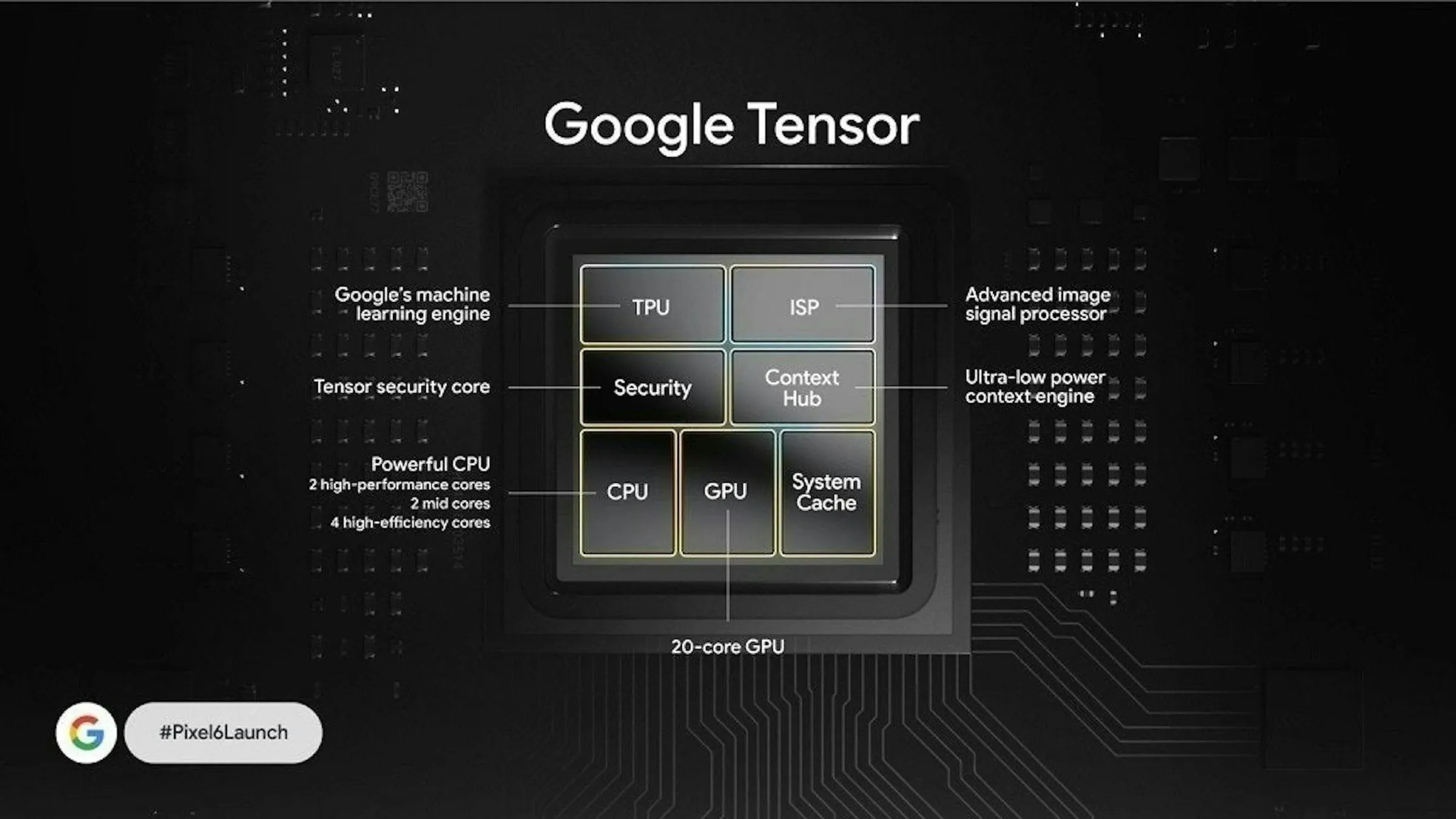
Over the years, Google’s proprietary Tensor chips have progressively advanced to become a dependable everyday driver with strong energy economy. However, performance has frequently been a source of contention. Previous Tensor chips performed well on routine tasks, but not so well on intensive workloads like gaming. That might change with the upcoming Tensor G5, which promises notable performance improvements.
“Tensor G5 is our greatest upgrade yet and gives a huge performance gain,” the tech giant claims. The newest Tensor chip, which launched with the Pixel 10 series last month, is said to feature a 30% faster average CPU and a 60% more potent TPU. Additionally, this is Google’s first mobile chipset produced at TSMC’s facility; Samsung previously produced Tensor chips. Better performance and increased battery economy are promised by the Tensor G5’s use of a more sophisticated 3nm manufacturing node.
Will the Tensor G5’s major improvements, as promised by Google, significantly improve benchmark scores where earlier Tensor chips have underperformed? We’ll examine the benchmark numbers. Here is the specification document to view the differences on paper before that:
| Tensor G5 | Tensor G4 | |
|---|---|---|
| Announced | August 2025 | August 2024 |
| Process node | TSMC’s 3nm (N3E) | Samsung’s 4nm |
| CPU | 1x 3.78 GHz — Cortex-X4 5x 3.05 GHz — Cortex-A725 2x 2.25 GHz — Cortex-A520 | 1x 3.1 GHz — Cortex-X4 3x 2.6 GHz — Cortex-A720 4x 1.92 GHz — Cortex-A520 |
| GPU | PowerVR DXT-48-1536 GPU No ray tracing support | Mali-G715 MP7 GPU No Ray tacing support |
| NPU | New Google Edge TPU | Google Custom TPU |
| Memory Storage | LPDDR5X Zoned UFS 4.0 (512GB+) | LPDDR5X UFS 3.1 |
| Connectivity | Samsung Exynos 5400 5G modem Wi-Fi 7, Wi-Fi 6E Bluetooth 6.0 | Samsung Exynos 5400 5G modem Wi-Fi 7 Bluetooth 6.0 |
AnTuTu
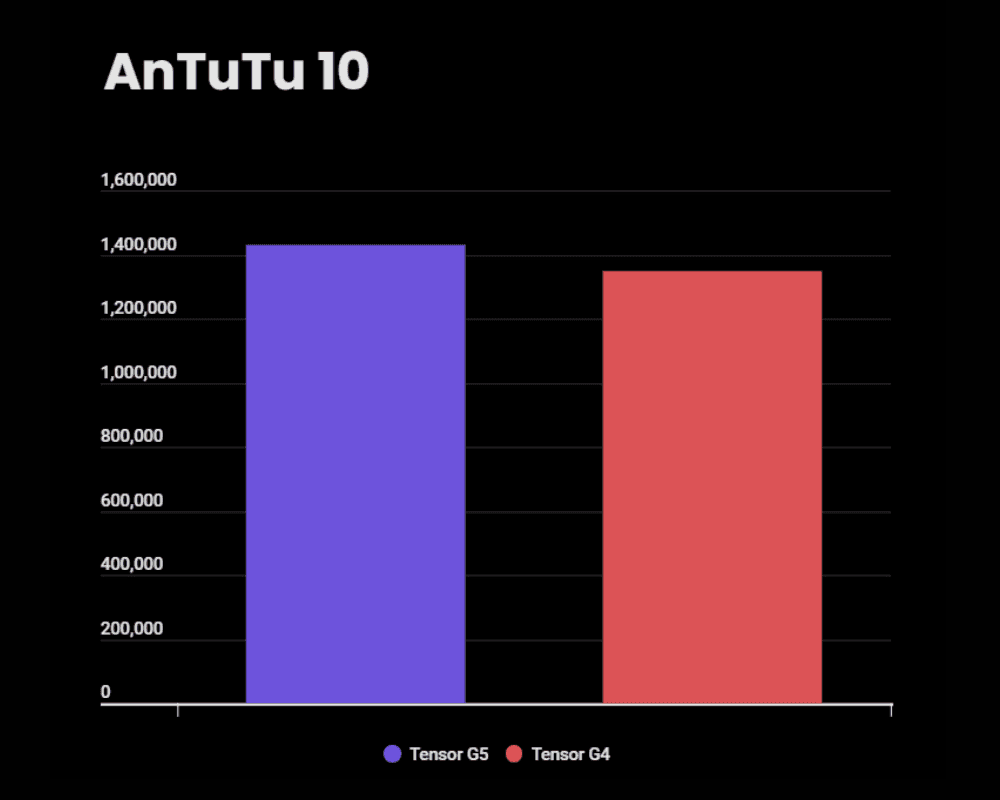
According to the AnTuTu (version 10) benchmark, the new Tensor G5 chip has a little overall improvement of 6%, scoring 1,429,557 as opposed to 1,348,226 for the Tensor G4. However, there is a pleasant 20% rise in the CPU (483,989 vs. 401,746). The RAM and UX scores also favor the newer chip with an improvement of roughly 10%.
The most unexpected of all is the GPU score, which is actually 10% lower than the G4 from the previous year. This implies that rather than promoting sheer graphics performance, Google might have placed greater emphasis on efficiency.
| Tensor G5 | Tensor G4 | |
|---|---|---|
| AnTuTu score | 1,429,557 | 1,348,226 |
| CPU | 483,989 | 401,746 |
| GPU | 416,313 | 462,415 |
| Memory | 293,467 | 266,535 |
| UX | 235,788 | 217,530 |
Geekbench
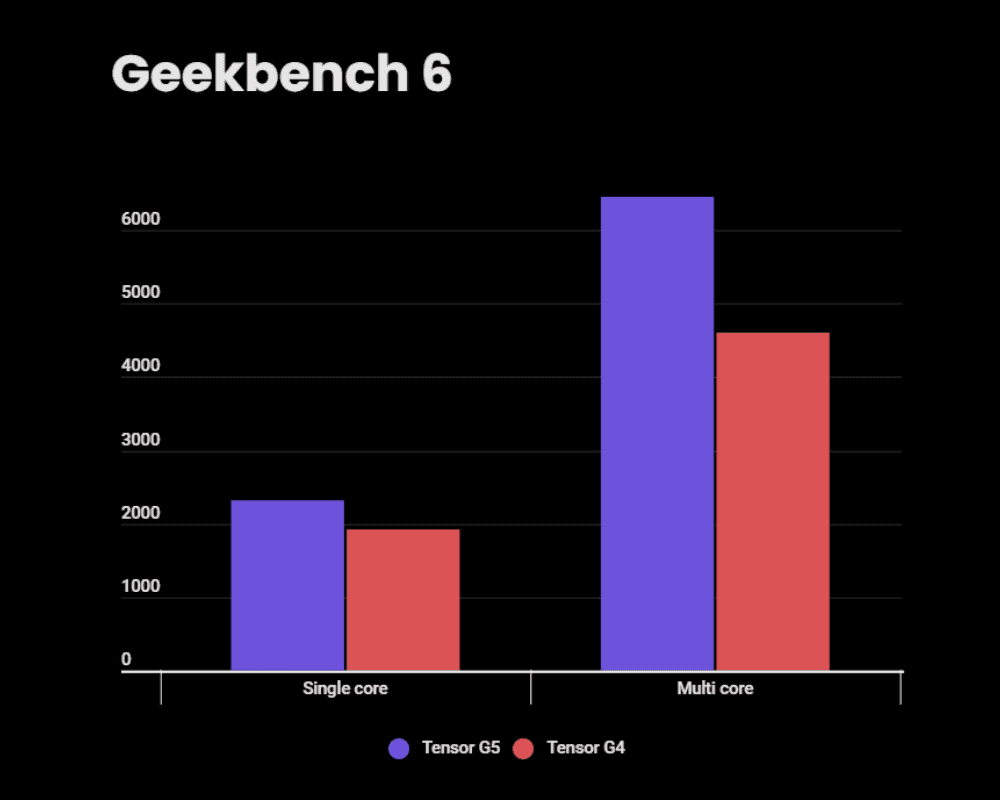
The Tensor G5 clearly outperforms the Tensor G4 in Geekbench 6. Its 2,316 single-core test score is around 20% higher than the G4’s 1,923, indicating faster responsiveness for daily tasks like UI navigation and app launches.
Stronger performance in multitasking, productivity apps, and heavier workloads is highlighted by the multi-core score, which soars to 6,452, a staggering 40% increase over the G4’s 4,602.
Overall, the results from Geekbench point to encouraging gains in Tensor G5’s raw CPU performance, particularly in multi-core efficiency, which could result in considerably more fluid performance.
| G5 | G4 | |
|---|---|---|
| Single core | 2,316 | 1,923 |
| Multi core | 6,452 | 4,602 |
3DMark score
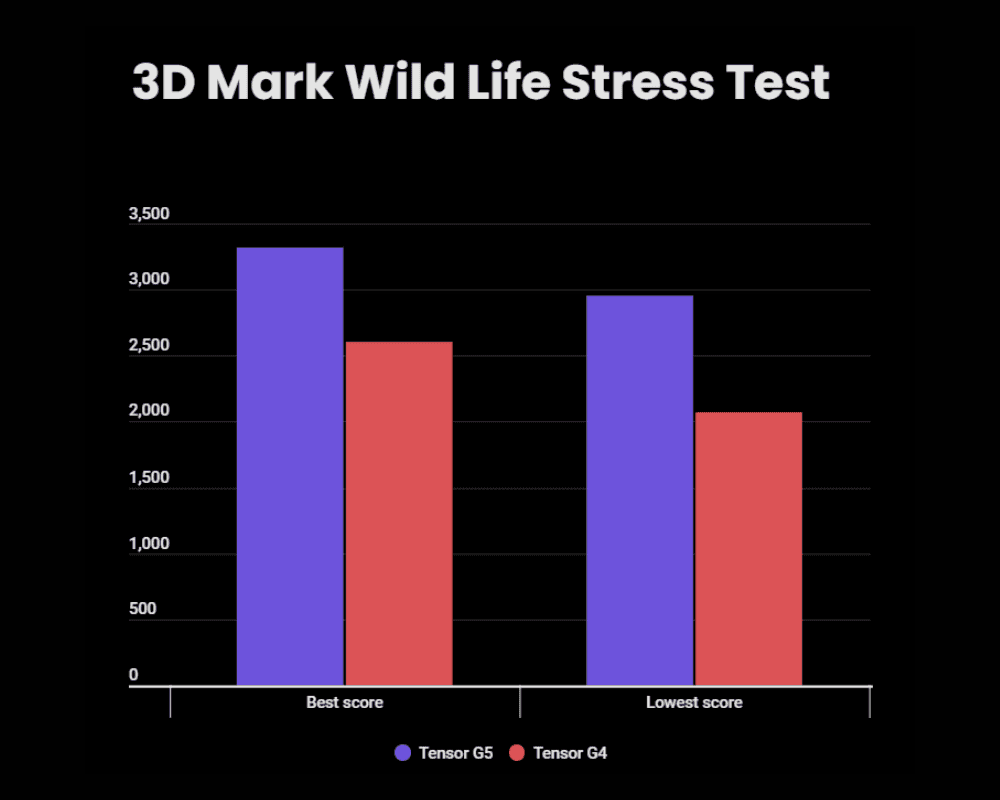
In the 3DMark Wild Life Extreme Stress Test, which gauges sustained GPU performance under high load, the Tensor G5 clearly outperforms the Tensor G4. With a highest loop score of 3,319 as opposed to 2,603 for the G4, the G5 scores an astounding 27% improvement in peak graphics performance.
More significantly, the G5 offers improved consistency as well. The G4 descends to 2,071, and its lowest loop score is 2,954. 89% vs. 79.6% is not only better performance, but also significantly more stability. As a result, the Tensor G5 is far less likely to experience thermal throttling and ought to offer more consistent, fluid gaming over extended periods.
| Tensor G5 | Tensor G4 | |
| Best loop score | 3,319 | 2,603 |
| Lowest loop score | 2,954 | 2,071 |
| Stability | 89% | 79.6% |
Tensor G5 vs Tensor G4
Thanks to enhanced CPU cores and more sophisticated TSMC manufacturing, the Tensor G5 exhibits encouraging improvements in CPU performance. GPU performance and consistency have also significantly improved, according to the 3DMark test. A better gaming experience and faster daily performance should follow from this. The majority of the heating and throttling problems users had with earlier Tensor chips are likewise fixed by the new chip.
Even while the latest Tensor chip offers significant improvements, Google still needs to catch up in order to compete with Qualcomm and MediaTek’s top offerings. We have contrasted the Snapdragon 8 Elite and Snapdragon 8 Gen 3 with the Tensor G5. To see how Google’s most recent chip compares to the finest in the business, you can look through those comparisons.